Kurdish Novel 'The Fall of the Heavens' Released in English
Author Jabar Jamal Gharib brings his awarded work to global audiences via Amazon.
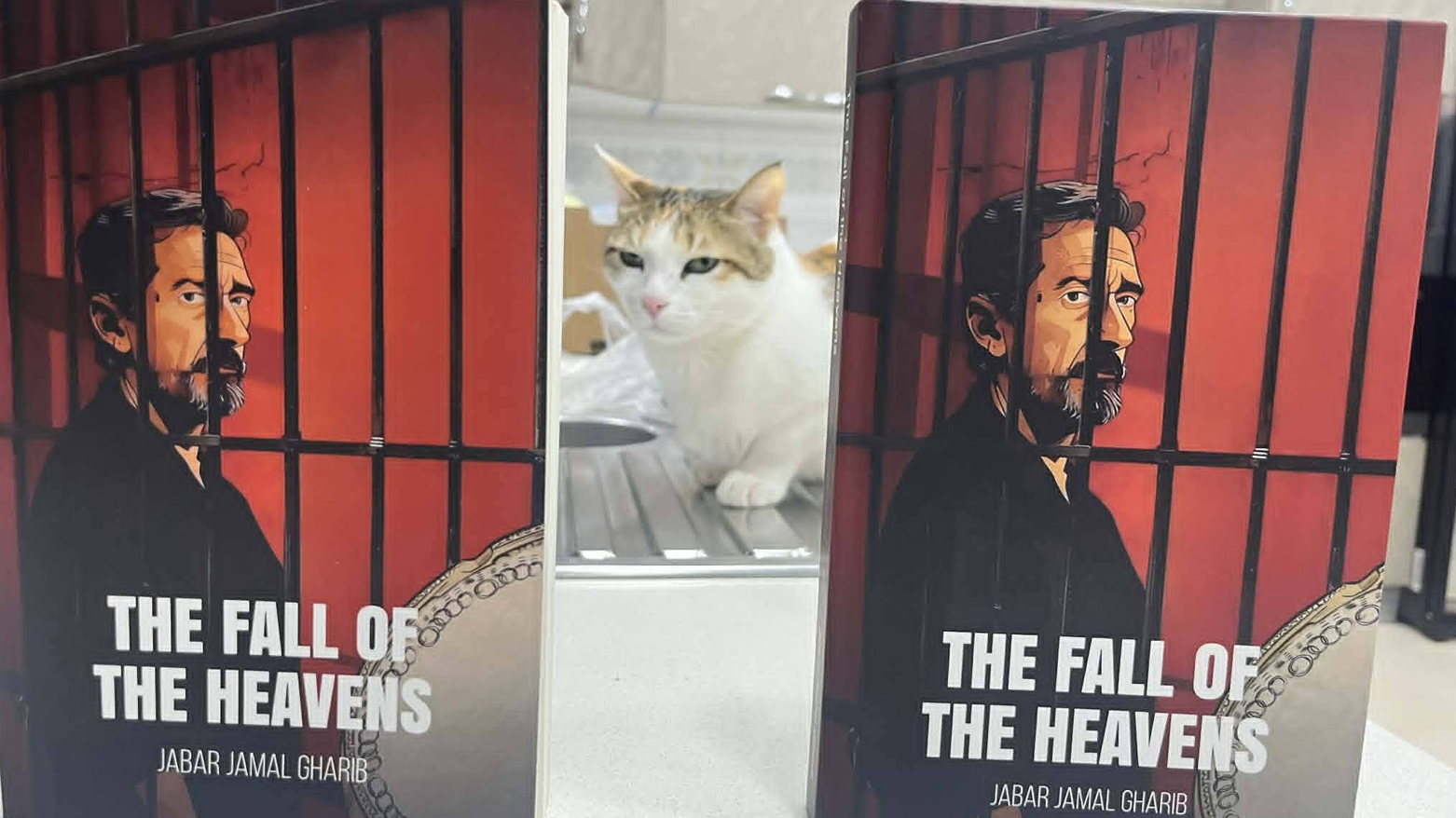
ERBIL (Kurdistan24) - Kurdish author and novelist Jabar Jamal Gharib has announced the publication of an English-language edition of his novel, The Fall of the Heavens. The work, which has already established a significant presence in Middle Eastern literary circles, is now being printed and distributed through the global retail platform Amazon.
This English release represents a deliberate effort to project Kurdish literary narratives onto the international stage, following the book's previous publication in Arabic and its controversial history with translation efforts in the region.
The English translation was completed in April 2026 by Agora Vision, a specialized firm focused on the digitalization and translation of Kurdish literature.
The move to publish on Amazon ensures the novel's availability to a global readership, marking a new phase in the distribution of Gharib’s body of work.
The publication of The Fall of the Heavens follows a trajectory of high-profile recognition within the Kurdistan Region and neighboring territories, where it has received multiple literary honors for its exploration of societal issues.
Significance of the English Publication
The transition of The Fall of the Heavens into English is seen as a pivotal cultural development for the region's intellectual output.
Speaking to Kurdistan24 on Saturday, Gharib emphasized that the novel aims to transcend local borders.
"I can say the novel The Fall of the Heavens is the most important and well-known Kurdish novel; it has rightfully earned its place within Kurdish literature and has managed to transcend the borders of Kurdish literature," Gharib stated.
According to the author, the translation serves as more than a literary exercise; it functions as a diplomatic and historical tool. Gharib noted that he hopes this English edition serves as an "opening door" for other Kurdish novels to enter the global literary canon.
He framed the success of the translation as a means to introduce the history of an "oppressed and wounded nation" to readers who may be unfamiliar with the internal dynamics of Kurdish society.
Publishing History and Regional Reception
The novel’s journey to an English-speaking audience has been marked by significant regional challenges, particularly regarding its Persian translation.
Gharib revealed that while the novel was translated into Persian, it was submitted to regional licensing authorities four separate times, only to be rejected on each occasion.
The author attributed these rejections to the "powerful content" of the work, suggesting that its realistic portrayal of historical and social themes met with institutional resistance.
Despite these setbacks, the novel found success in other languages.
An Arabic translation was previously published in London, facilitating its reach across the diaspora and the broader Arab world.
The novel has also been distinguished by prestigious literary awards.
Most notably, it received the "Golden Pen of Mamosta Hejar" in Sina in May 2025, winning the top prize among a pool of 913 competing books.
Additionally, it was awarded the Golden Prize at the 20th Galawezh Festival, further cementing its status as a core text in contemporary Kurdish letters.
Thematic and Literary Context
The Fall of the Heavens is situated within the historical framework of the Iran-Iraq War, a period that fundamentally reshaped Kurdish society.
The narrative follows five interconnected lives, navigating a landscape defined by decades of conflict, the rigors of the former Iraqi administration under Saddam Hussein, and the complexities of forbidden love and religious extremism.
The publication note describes Gharib’s writing style as being deeply informed by a culture of religious devotion and patriarchal tradition.
The novel utilizes a blend of mysticism and graphic realism, employing metaphors that reflect a specific Kurdish literary sensibility.
The prose intentionally retains the "marks of translation," refusing to conform to comfortable Western literary structures.
The work explores challenging perspectives on purity, desire, and the role of women, featuring explicit depictions of violence and sexuality that are rendered with a stark, unsentimental realism.
By insisting on meeting the reader on its own cultural and spiritual terms, the novel provides an unvarnished window into the trauma and survival strategies found at the heart of the Kurdish experience.
Author Profile and Bibliography
Born in 1961 in Qaladze, in the Kurdistan Region, Jabar Jamal Gharib is a veteran figure in the Kurdish intellectual community.
He completed his early education in his hometown before relocating to Baghdad for higher studies.
In 1985, he was admitted to the College of Arts at Baghdad University, a period that coincided with his emergence as a storyteller. His first published story, Pasharaw, appeared in Bayan magazine in the early 1980s.
Gharib transitioned into the novel form during the 1990s, with much of his early long-form fiction appearing in Raman magazine.
Among his most recognized works are The Honor of Tozuba and Women of Water. His extensive bibliography includes a diverse range of titles such as:
- Sheikh of Damus
- The World in a Book
- The Fifth Book
- I Write About Rain
- The Nation of the Sewers
- Zebra is a Name for My Tombstone
- A Touch of Heaven
- A Sculpture of Knife Dust
Beyond fiction, Gharib is a prolific researcher and critic. He has authored numerous analyses of Kurdish and foreign theater and stories, many of which were compiled by Sardam Publishing in the volume Reading Books.
His contributions to children's literature include You Know Me and The Descent of Angels.
Furthermore, his intellectual inquiries have explored the role of Islam, Christianity, and Judaism in the formulation of Kurdish culture, as well as detailed studies of biblical narratives in his independent book regarding stories in the Torah.
The publication of the English edition of The Fall of the Heavens on May 2, 2026, marks the latest milestone in Jabar Jamal Gharib’s decades-long career.
By making the novel available through Amazon, the author and Agora Vision have ensured that this awarded work of Kurdish realism is accessible to the international community.
The novel continues to serve as a factual and cultural record of the Iran-Iraq War era and its enduring impact on Kurdish social structures.