Iraq PM-Designate Ali al-Zaidi Arrives in Erbil
The Iraqi Prime Minister-designate was received at Erbil International Airport by Kurdistan Region Prime Minister Masrour Barzani.
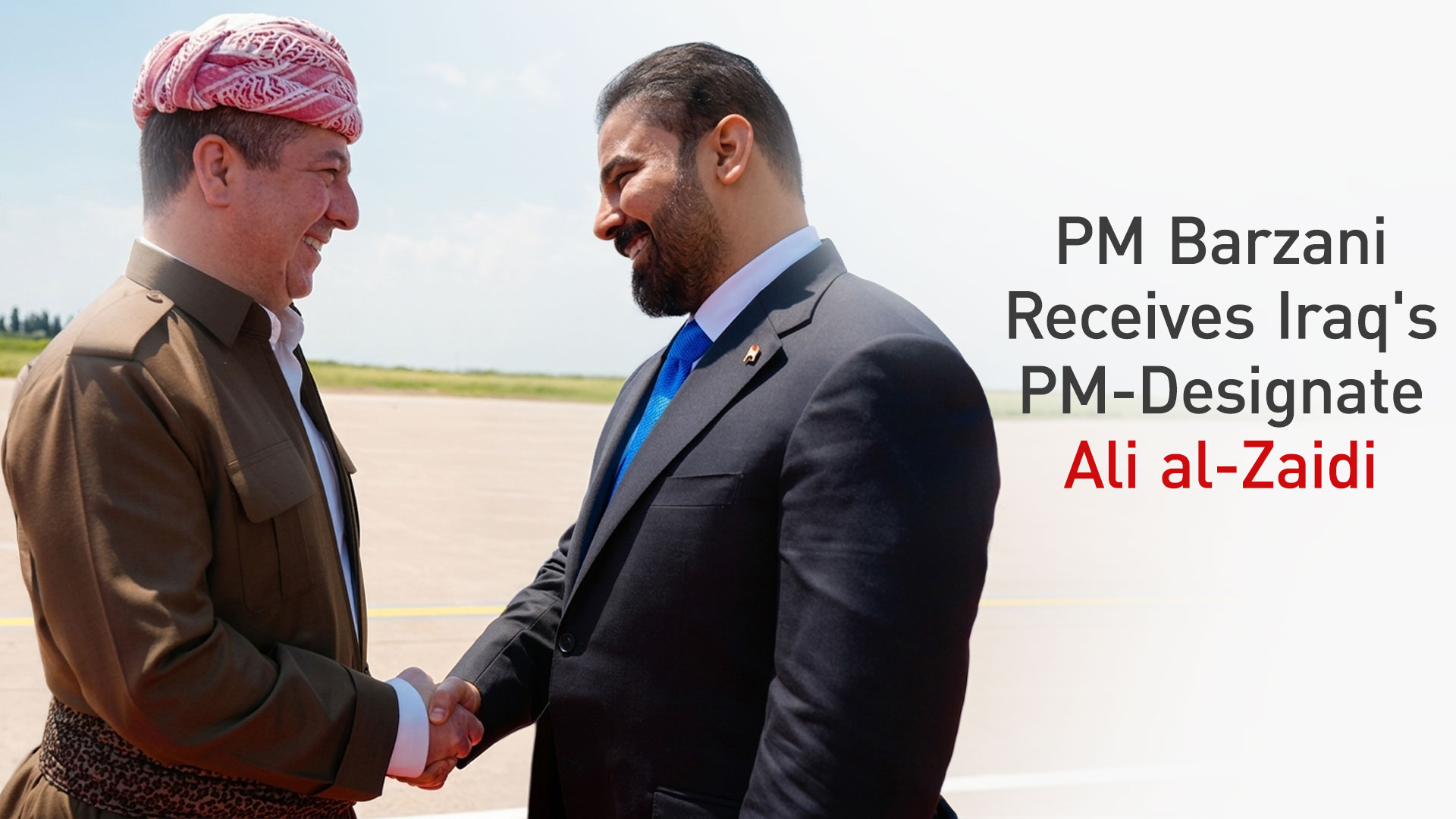
ERBIL (Kurdistan24) - Iraq's Prime Minister-designate Ali al-Zaidi arrived in Erbil on Saturday morning to initiate a series of high-level consultations regarding the political transition in both Baghdad and the Kurdistan Region.
The Prime Minister-designate was received at Erbil International Airport by Kurdistan Region Prime Minister Masrour Barzani.
Al-Zaidi arrived in the regional capital leading a senior delegation from Iraq's ruling Shiite bloc, marking a formal escalation of the negotiation process following weeks of preliminary discussions among the country's various political factions.
Strategic Objectives of the Erbil Visit
The primary objective of the mission is focused on negotiations surrounding the final stages of the executive transition, according to reports.
Sources within the Shiite Coordination Framework told Kurdistan24 that al-Zaidi's visit centers on discussing the formation of both the new Iraqi federal government and the Kurdistan Regional Government (KRG).
The visit is viewed by participating political actors as a critical effort to synchronize the formation of the two cabinets and resolve outstanding legislative priorities.
Furthermore, the talks are intended to secure a durable framework for improving ongoing administrative and political relations between Erbil and Baghdad.
Al-Zaidi has a comprehensive schedule of diplomatic engagements while in the Kurdistan Region.
He is slated to hold separate meetings with top leadership to ensure a broad-based consensus, including individual sessions with President Masoud Barzani, Kurdistan Region President Nechirvan Barzani, and Prime Minister Masrour Barzani.
Political observers noted that these consultations are essential for navigating the complex interests of major stakeholders in the government formation process.
The Domestic Nomination and Political Shift
Ali al-Zaidi's arrival in Erbil follows a significant shift in Baghdad's political landscape.
Last Monday, Iraq's President Nizar Amedi formally nominated al-Zaidi as Prime Minister-designate after he secured backing from the country's largest Shiite political bloc.
The presidency confirmed that Amedi tasked al-Zaidi, described as "the candidate of the largest parliamentary bloc," with forming the next government.
The nomination emerged after the Coordination Framework, an alliance of Shiite political parties, announced its endorsement of al-Zaidi.
The alliance had initially supported veteran political figure Nouri al-Maliki before shifting its position.
This change followed reported external pressures, including a January ultimatum from U.S. President Donald Trump regarding the return of figures with close ties to Iran.
On Monday evening, the Shiite Coordination Framework commended both al-Maliki and caretaker Prime Minister Mohammed Shia al-Sudani for what it described as a "historic and responsible stance" in withdrawing their candidacies to pave the way for a consensus nominee.
Al-Sudani stated that he and al-Maliki were entrusted with selecting a compromise candidate amid a lack of consensus, and that al-Zaidi’s nomination was the result of their joint agreement.
Internal Fragmentation and Bloc Negotiations
Despite the consensus on his nomination, al-Zaidi's rise has highlighted deep divisions within the Shiite Coordination Framework.
Prior to the agreement, the Construction and Development Alliance, led by incumbent Prime Minister al-Sudani, launched a forceful political attack on rival factions within the Framework.
Qusay Mahbouba, a leader in the Sudani-led alliance, characterized the move to install an "unknown" candidate as an attempt to paralyze constitutional procedures.
Mahbouba argued that while al-Sudani is a proven "statesman," rival parties possessed a vague project designed to serve narrow interests.
Al-Zaidi, born in 1986, is a businessman and banker who holds a PhD in public law.
While he is described as an independent technocrat and not formally affiliated with any party within the Framework, his background has drawn scrutiny.
He previously served as the Chairman of the Board of Directors of al-Janoob Islamic Bank, an institution subject to U.S. sanctions.
Kurdish Political Stance and Institutional Engagement
The Erbil consultations are taking place against the backdrop of a Kurdistan Democratic Party (KDP) parliamentary boycott.
Ashwaq Jaf, a member of the KDP Central Committee, clarified that the move is a "boycott, not a withdrawal," intended as a democratic expression against constitutional violations and the erosion of the principles of partnership and consensus.
The KDP has conditioned its return to the federal parliament on the outcome of dialogues regarding the constitutional rights of the Kurdistan Region and the correction of the political process.
Jaf stated that while the party does not have a problem with specific personnel in high offices, it objects to the manner of selection when the rights of the Kurdish component to independently determine their candidates are not respected.
Top Kurdish leadership has signaled a willingness to engage with the Prime Minister-designate.
On Tuesday, President Masoud Barzani spoke with al-Zaidi by telephone, describing the appointment as an opportunity to fix the political process.
Similarly, Prime Minister Masrour Barzani reaffirmed Erbil's readiness to resolve disputes on a constitutional basis, specifically highlighting the salary crisis and Article 140 as persistent issues requiring a new strategy.
Cabinet Distribution and the Points System
As al-Zaidi negotiates in Erbil, details of the broader cabinet distribution have emerged from within the Coordination Framework.
Ministries are being allocated through a points-based system, ranking posts by political and financial weight.
- Kurdish Component: Set to receive three to four ministries. KDP officials have confirmed they will receive two ministries, one of which will be a sovereign ministry.
- Shiite Component: Set to receive 12 to 13 ministries, including sovereign posts such as Interior and Oil, as well as Electricity, Finance, Health, and Transport.
- Sunni Factions: Set to receive five to six ministries, including Defense, Planning, and Industry.
Competition remains intense over sovereign ministries, as control over Oil, Finance, or Interior provides significant budgetary and security leverage.
International and Regional Diplomatic Positioning
The government formation process has attracted significant international attention.
On Thursday, U.S. President Donald Trump congratulated al-Zaidi on his designation and extended an invitation for him to visit Washington.
In a statement, Trump described the development as "the beginning of a tremendous new chapter" and expressed hope for a government that could deliver stability for Iraq.
Simultaneously, Tehran has formally endorsed al-Zaidi's candidacy.
Iranian Foreign Minister Abbas Araghchi welcomed the Coordination Framework's decision, expressing hope for al-Zaidi's success while pledging support for Iraqi sovereignty and political stability.
This regional balancing act comes amid a provisional ceasefire between the United States and Iran, brokered in April following military operations earlier in the year.
Iraqi Foreign Minister Fuad Hussein has reaffirmed Iraq's support for diplomacy, noting that the country has consistently paid a heavy price for regional instability.
The visit of Prime Minister-designate Ali al-Zaidi to Erbil underscores the necessity of Kurdish participation in the formation of a functional federal government.
As high-level meetings continue throughout the day, the discussions aim to reconcile the administrative demands of the Kurdistan Region with the broader objectives of the Shiite Coordination Framework.
The mission represents a critical step in a transition process marked by internal political fragmentation and significant regional diplomatic engagement.
The article was updated on Saturday, May 2, 2026, at 11:52am.