President Barzani, Iraq PM-Designate Discuss Iraqi Government Formation
President Masoud Barzani and Iraq's PM-Designate Ali al-Zaidi's meeting in Erbil focuses on constitutional adherence and resolving Erbil-Baghdad disputes.
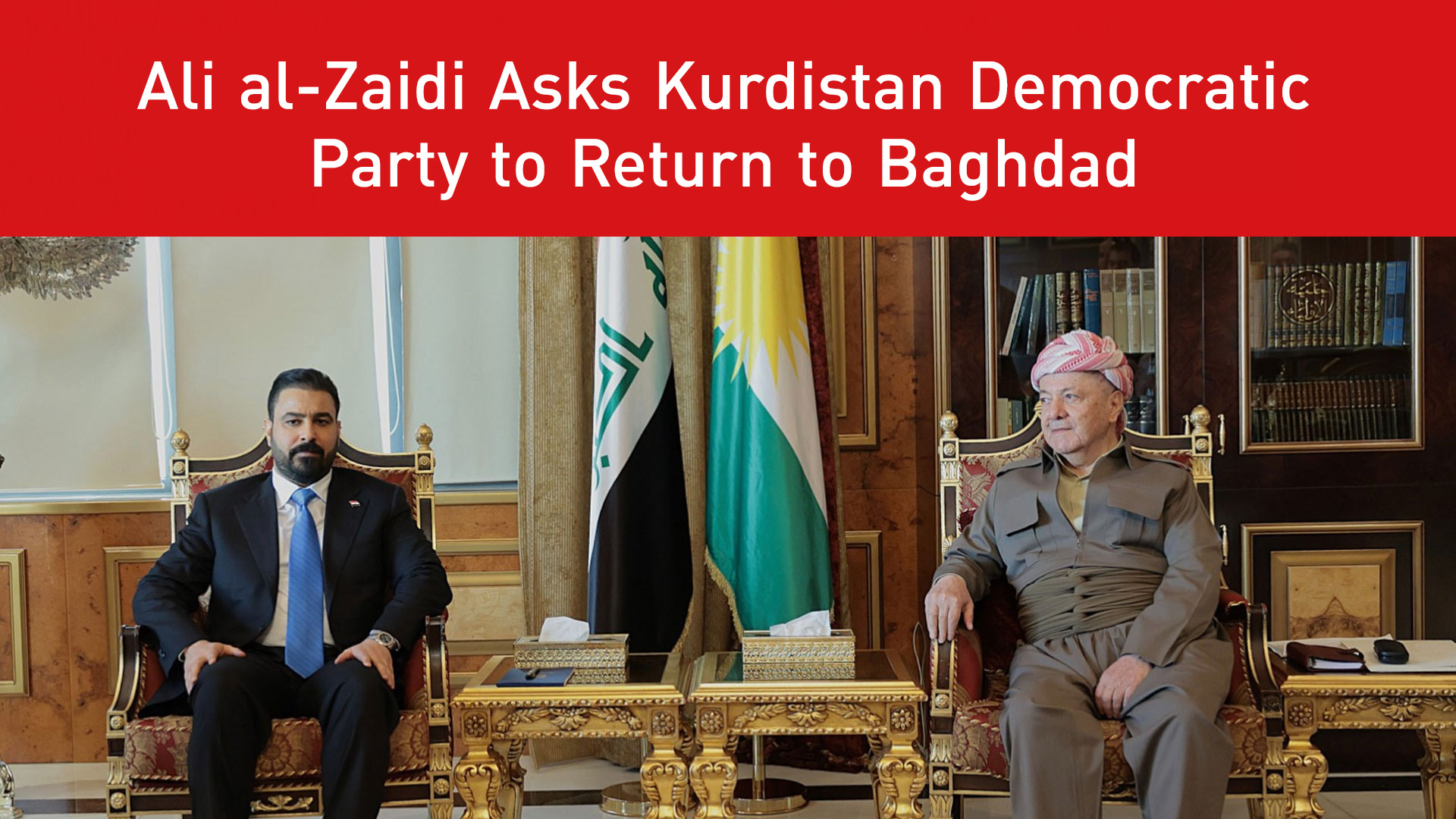
ERBIL (Kurdistan24) - The meeting between President Barzani and Ali al-Zaidi centered on the acceleration of the Iraqi government formation process and the resolution of persistent disputes between Erbil and Baghdad through strict adherence to the national constitution.
President Masoud Barzani received Iraq's Prime Minister-designate, Ali Falih al-Zaidi, and an accompanying delegation from the Shiite Coordination Framework on Saturday at the Barzani Headquarters in Pirmam.
According to a formal statement issued by the headquarters, the two leaders emphasized the necessity of finalizing the federal cabinet according to electoral entitlements and established constitutional deadlines.
The high-level consultations in the Kurdistan Region are viewed by political observers as a critical effort to synchronize the formation of the Iraqi federal government with the ongoing transition in the Kurdistan Regional Government (KRG).
The meeting marks a formal escalation of the negotiation process following weeks of preliminary discussions among Baghdad's various political blocs, as the Prime Minister-designate seeks to secure a broad-based consensus ahead of a looming parliamentary deadline.
Leadership Meeting in Erbil
During the session in Pirmam, President Barzani provided an overview of recent political developments, reiterating that the implementation of the constitution serves as the primary solution to the country's governing challenges.
According to the statement from his headquarters, the President called for all political parties to respect the legal framework to ensure national stability.
In response, Prime Minister-designate al-Zaidi underscored a commitment to overcoming previous political frictions.
According to the report, al-Zaidi emphasized the necessity of moving past the negative aspects of previous administrations to "open a new page" in the relationship between the federal government and regional authorities.
A significant portion of the discussion involved the participation of the Kurdistan Democratic Party (KDP) in the federal government.
The visiting delegation from the Shiite Coordination Framework, the largest parliamentary bloc in Baghdad, formally requested that the KDP's parliamentary and governmental factions return to active participation in the political process to facilitate the formation of the new federal administration.
Strategic Objectives and Arrival Context
The meeting in Pirmam followed al-Zaidi's arrival at Erbil International Airport earlier on Saturday morning.
The Prime Minister-designate was received by Kurdistan Region Prime Minister Masrour Barzani, initiating a comprehensive schedule of diplomatic engagements.
Beyond his meeting with President Masoud Barzani, al-Zaidi is slated to hold separate individual sessions with Kurdistan Region President Nechirvan Barzani and Prime Minister Masrour Barzani.
According to sources within the Shiite Coordination Framework cited by Kurdistan24, the strategic objective of the Erbil mission is to resolve outstanding legislative priorities.
These include the long-standing salary crisis affecting regional civil servants and the implementation of Article 140 regarding disputed territories.
The visit is intended to secure a durable framework that improves ongoing administrative and political relations between Erbil and Baghdad.
Political observers noted that these consultations are essential for navigating the complex interests of major stakeholders.
Al-Zaidi's arrival in Erbil represents his first major political act since his nomination, signaling an awareness in Baghdad that a functional federal government requires Kurdish participation and cooperation.
The Nomination and Internal Coordination
Ali al-Zaidi's emergence as the consensus candidate follows a period of significant political shifting in Baghdad. Iraq's President Nizar Amedi formally tasked al-Zaidi with forming the next government last Monday after he secured the backing of the Shiite Coordination Framework.
The nomination came after a lack of consensus within the Shiite political house led to a joint agreement between caretaker Prime Minister Mohammed Shia al-Sudani and State of Law leader Nouri al-Maliki.
According to a statement from al-Sudani, the two leaders were entrusted with selecting a compromise candidate, leading to the unanimous endorsement of al-Zaidi by the broader alliance.
Al-Zaidi, an independent technocrat born in 1986, holds a PhD in public law and constitutional law.
His rise was catalyzed by reported external pressures, including a U.S. ultimatum regarding the return of veteran political figures with close ties to regional powers.
Despite the current consensus, al-Zaidi's nomination faced initial criticism from within the Shiite bloc; the Construction and Development Alliance, led by al-Sudani, had previously characterized the selection of a relatively unknown candidate as a potential risk to constitutional procedures.
Kurdish Parliamentary Dynamics and Cabinet Distribution
The consultations in Erbil are taking place against the backdrop of a KDP parliamentary boycott in Baghdad.
Ashwaq Jaf, a member of the KDP Central Committee, clarified that the party's stance is a "boycott, not a withdrawal," intended to protest constitutional violations and the erosion of the principle of partnership among Iraq's three main components.
The KDP has conditioned its return to the federal parliament on the outcome of discussions regarding the constitutional rights of the Kurdistan Region.
Specifically, the party has objected to the manner in which leadership posts were selected, arguing that the Kurdish component must be allowed to independently determine its candidates for high-level offices, such as the deputy parliamentary speaker.
Details regarding the broader cabinet distribution have begun to emerge during the negotiations. Ministries are being allocated through a points-based system:
- Shiite Component: Allocated 12 to 13 ministries, including the sovereign posts of Interior, Oil, and Finance.
- Sunni Factions: Set to receive five to six ministries, including Defense and Planning.
- Kurdish Component: Expected to receive three to four ministries. KDP officials have confirmed the party is in line for two ministries, one of which is designated as a sovereign ministry.
Regional and International Engagement
The Iraqi government formation process has drawn immediate international attention.
U.S. President Donald Trump held a phone call with al-Zaidi on Thursday, congratulating him on his designation and extending an invitation to visit Washington.
In a statement on the social media platform X, al-Zaidi noted that they discussed strategic bilateral relations and regional stability.
Simultaneously, Tehran has formally endorsed the candidacy.
Iranian Foreign Minister Abbas Araghchi publicly welcomed the Shiite Coordination Framework's choice, expressing hope for al-Zaidi's success while pledging respect for Iraqi sovereignty.
This regional engagement occurs amid a provisional ceasefire between Washington and Tehran, brokered in April.
Iraqi Foreign Minister Fuad Hussein has reiterated the importance of reaching a final resolution to end regional hostilities, noting that Iraq has consistently borne the heaviest consequences of instability.
The success of the Erbil talks is seen as a prerequisite for stabilizing the domestic political landscape and fulfilling the 30-day constitutional window for cabinet formation.
President Masoud Barzani and Prime Minister-designate Ali al-Zaidi concluded their initial discussions with an emphasis on accelerating the federal transition.
The consultations in Erbil are expected to continue as the parties work toward a definitive policy agreement.