CENTCOM Begins ‘Project Freedom’ Mission to Protect Navigation in Hormuz
Iran warns U.S. involvement in Hormuz violates ceasefire
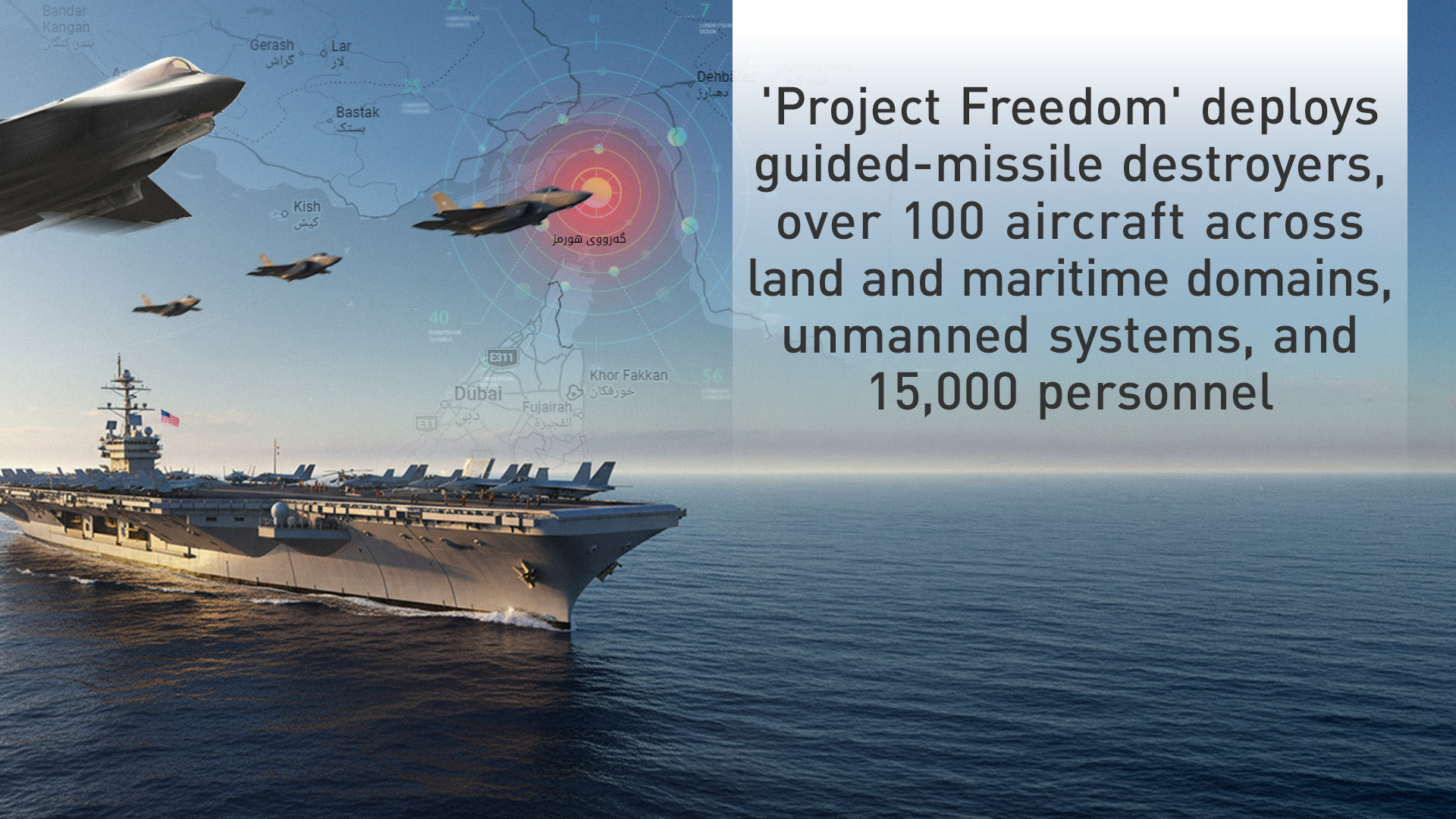
ERBIL (Kurdistan24) — U.S. Central Command (CENTCOM) officials on Monday confirmed the launch of a maritime security operation designed to restore freedom of navigation through the Strait of Hormuz, a vital artery for global trade through which roughly a quarter of the world’s seaborne oil passes, along with significant volumes of fuel and fertilizer products.
“Our support for this defensive mission is essential to regional security and the global economy as we also maintain the naval blockade,” said Admiral Brad Cooper, commander of CENTCOM, underscoring the dual-track approach of deterrence and protection.
Tensions between Tehran and Washington escalated on Monday as Iran warned it would treat any U.S. intervention in the Strait of Hormuz as a breach of a recently established ceasefire, following a U.S. announcement of a naval escort mission for commercial vessels.
Ebrahim Azizi, head of the Iranian parliament’s national security commission, said any American involvement in what he described as a “new maritime regime” governing the strait would constitute a violation.
“Any American interference in the new maritime regime of the Strait of Hormuz will be considered a violation of the ceasefire,” he wrote in a post on X.
The warning came shortly after U.S. President Donald Trump announced that U.S. forces would begin escorting ships through the strategic chokepoint, which has faced disruptions in recent days.
According to CENTCOM, the move aims to ensure safe passage for commercial shipping amid heightened regional instability.
The operation, referred to as Project Freedom, will involve a substantial U.S. military presence, including guided-missile destroyers, more than 100 aircraft operating across land and sea domains, unmanned systems, and approximately 15,000 personnel.
Separately, the U.S. State Department recently unveiled a broader initiative—the Maritime Freedom Construct—developed in coordination with the Department of Defense. The framework aims to enhance intelligence-sharing and operational coordination with international partners, blending diplomatic engagement with military readiness to secure maritime routes.
Trump announced late Sunday a new initiative to safely escort foreign vessels stranded in the Strait of Hormuz amid ongoing regional tensions. Writing on Truth Social, he said multiple countries had requested U.S. assistance to free their ships, describing them as “neutral and innocent bystanders” caught in a conflict they are not involved in.
The U.S. president said Washington would begin escorting these vessels out of restricted waters under a plan dubbed “Project Freedom,” set to start Monday morning, Middle East time.
The developments highlight the fragile nature of the ceasefire and the risk of renewed confrontation in one of the world’s most strategically sensitive waterways, where even limited disruptions can have far-reaching implications for global energy markets and supply chains.