Statue of Leyla Qasim Unveiled in Xanaqin on 52nd Anniversary of Execution
A statue of Leyla Qasim was unveiled in Xanaqin on the 52nd anniversary of her execution by Iraq's former Ba'athist regime, reinforcing her place in Kurdish historical memory as a symbol of resistance, political sacrifice and the role of women in the national movement.
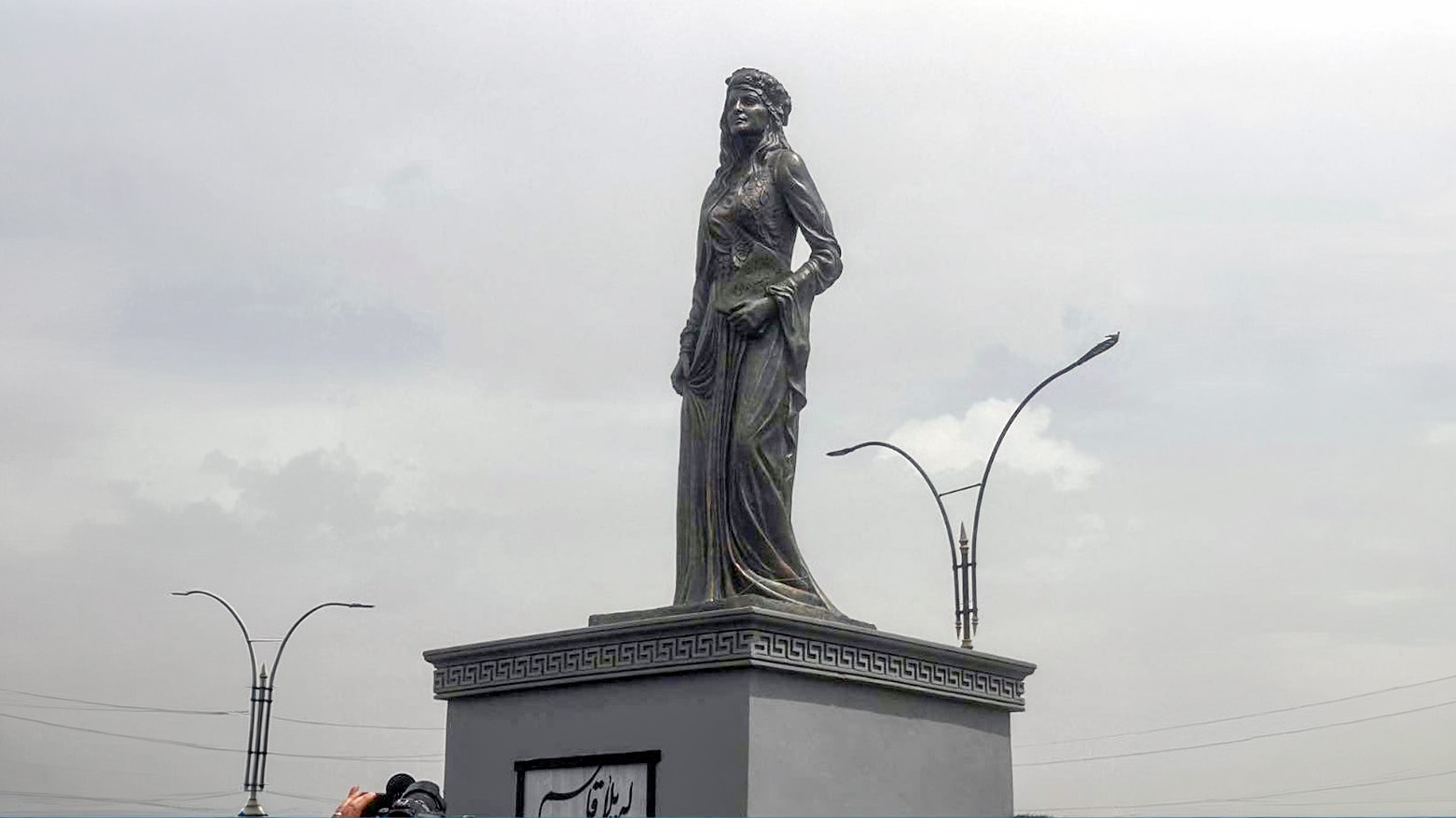
ERBIL (Kurdistan24) - In a formal ceremony attended by various government and political figures, a statue of Leyla Qasim was unveiled in the city of Xaneqîn (Khanaqin) on Tuesday. The event, held on May 12, 2026, was organized to coincide with the 52nd anniversary of Qasim's execution by the former Iraqi government in 1974.
Arranged by the Kurdistan Women's Union, the commemoration serves as a public tribute to a figure widely recognized as a foundational icon in the history of Kurdish political activism and resistance.
The unveiling was presided over by institutional leaders and members of the regional administration.
According to a report by Kurdistan24, the initiative is part of an ongoing effort to institutionalize the collective memory of historical figures who faced state repression.
Officials present at the ceremony characterized the event as a vital step in preserving the historical narrative of the Kurdish people and honoring the specific contributions of women within the liberation movement.
Historical Legacy and Institutional Memory
According to a commemorative message issued by President Masoud Barzani, Leyla Qasim remains a paramount figure in the historical and political identity of the Kurdistan Region.
Characterized by the Kurdish leadership as an enduring symbol of resistance and sacrifice, her legacy is framed as a model of political agency for current and future generations.
President Barzani's statement highlighted that the memorialization of Qasim and her companions functions not only as a tribute to their individual courage but also as a mechanism for reinforcing a shared national narrative rooted in the pursuit of civil and cultural rights.
Within the context of Kurdish public discourse, the act of erecting monuments in Kurdistani territories like Xaneqîn is described by officials as an assertion of historical continuity and cultural identity, signaling the importance of preserving the memory of those who faced execution for their nationalistic convictions.
Statue Unveiled in Xaneqîn
The ceremony in Xaneqîn featured several keynote addresses from political and social leaders.
Ziba Taha, the Secretary of the Kurdistan Women's Union, stated during a press conference that the erection of the statue was a national obligation.
According to Taha, honoring the history of Leyla Qasim is essential to acknowledging her status as the first Kurdish woman executed by the Ba'ath regime.
She indicated that the primary objective of the monument is to communicate the resilience of the Kurdish people to contemporary society and to pay homage to the historical role women have played in political struggles.
The event also saw participation from the legislative branch.
Shakhawan Abdullah, the head of the Kurdistan Democratic Party (KDP) faction in the Iraqi Parliament, provided remarks praising the initiative, describing Qasim as a "supreme example" of a woman who refused to yield to state pressure.
He further argued that the presence of such memorials in areas outside the primary administration of the Kurdistan Region serves as tangible evidence of the "Kurdistani identity" of those territories.
According to his statement, these areas have been defined by the historical sacrifices and the "blood of their children," making the placement of the statue in Xaneqîn, Qasim's birthplace, particularly significant.
During the same event, Abdullah also briefly touched upon the current political landscape in Baghdad. He indicated that while the distribution of ministries for the new Iraqi government has been finalized, regional and international interference has caused a temporary delay in the formation process.
He noted that an agreement between parties could lead to the formal establishment of the government within the coming week.
Commemorating Leyla Qasim: A Historical Biography
The historical record, as detailed in reports regarding the 52nd anniversary, describes Leyla Qasim as a pivotal figure in the 20th-century Kurdish movement.
Born in 1952 in Xaneqîn to a farming family, she grew up facing the systemic challenges directed at Feyli Kurds during that period. Despite being raised in a household that faced economic hardship, the report noted that she maintained a strong sense of identity.
According to historical background provided by Kurdistan24, Qasim relocated to Baghdad in 1971 to pursue a degree in sociology at the University of Baghdad's College of Humanities.
It was within the restrictive political climate of the capital that she intensified her activism. Having joined the KDP and the Kurdistan Students' Union in 1970, she and her brother Çiyako reportedly authored and distributed underground pamphlets.
These documents denounced state policies, including forced Arabization, and accused the Ba'ath government of failing to uphold the autonomy promised in the 1970 March Manifesto.
State retaliation followed as Kurdish uprisings escalated. In early 1974, Qasim was arrested alongside her fiancé, Jawad al-Hamawandi, and three of her comrades: Nariman Fouad Misty, Azad Suleiman Miran, and Hasan Mohamed Rashid.
The detainees were held at the Abu Ghraib prison. According to historical accounts cited in the reports, the group endured severe physical abuse while in custody.
The text indicated that Qasim suffered significant injuries, including the loss of an eye, prior to being convicted by a revolutionary court. The trial, described by historians as lacking any semblance of due process, resulted in a conviction on charges of sedition and terrorism.
On May 12, 1974, at the age of 22, Leyla Qasim and her companions were executed in Baghdad. She was later interred in the Valley of Peace cemetery in Najaf.
President Barzani Highlights Historical Legacy
In a formal address disseminated on the social media platform X, President Masoud Barzani honored the memory of the activists, describing them as "enduring symbols of resistance."
His message, issued specifically for the 52nd anniversary, sought to frame their actions as a courageous sacrifice intended to secure the "freedom and dignity of their people."
According to the statement from the Barzani office, the President emphasized that Qasim and her fellow activists have become role models for "all freedom-seekers" within Kurdistan.
By situating their historical actions within the broader pursuit of political rights, the leadership aims to ensure that the heavy costs of historical dissent are recognized as a cornerstone of the region's current status.
President Barzani concluded his message by extending greetings to the "pure souls" of all those who lost their lives in the pursuit of freedom, reinforcing the institutional view that such sacrifices are integral to the region's collective historical identity.
Symbol of Kurdish Resistance and Cultural Agency
The symbolic weight of Leyla Qasim is deeply rooted in the manner of her death and her public identity. Historical sources frequently reference her defiance at the time of her execution.
Reports describe her requesting to wear traditional Kurdish attire and singing "Ey Reqîb," the Kurdish national anthem, as she faced the state's ultimate penalty.
According to documented accounts, she informed her family that her death would lead to a wider awakening among the Kurdish population, famously utilizing the metaphor of becoming the "Bride of Kurdistan" (Leyla-yê Kurdistanê).
The report noted that Qasim's execution had a profound effect on Kurdish society in the 1970s. It served as a catalyst for student activism and accelerated recruitment into the Peshmerga forces during the 1974-1975 conflict.
Internationally, her death brought media attention to the repressive policies of the Ba'athist government, often framing the state's actions as evidence of a broader intent to suppress the Kurdish national identity.
Furthermore, the reporting highlighted that Qasim's legacy has been analyzed through various academic and cultural lenses.
Scholars cited in the background material, such as Ofra Bengio and Choman Hardi, have noted that her story illustrates an intersectional struggle, where gender, ethnicity, and class discrimination converged under an authoritarian state.
Her assertion of dignity is seen as a precursor to contemporary Kurdish women's movements, which have increasingly integrated themes of gender equality into broader nationalist narratives.
Broader Cultural and Political Significance
The institutional reverence for Qasim indicates that her narrative continues to inform the cultural and political identity of the present day.
Beyond statues and formal statements, her life has been immortalized in literature and patriotic theater, such as the 2010 play Leyla, the Kurdish Bride. There are also ongoing discussions regarding documentary projects and the potential for reburial in a national museum to further cement her status as a revolutionary icon.
According to the reports, the annual observance of May 12 acts as a critical mechanism for preserving the historical record of state violence.
By honoring figures like Qasim, the Kurdish administration seeks to bridge the gap between historical struggle and contemporary civic identity. As officials in Xaneqîn noted during the unveiling, the monument is intended to ensure that the contributions of women in the political arena are never forgotten.
The unveiling of the statue in Xaneqîn serves as a tangible reminder of the historical costs associated with political dissent in Iraq.
Decades after her death, Leyla Qasim remains a central figure in the Kurdistan Region's efforts to maintain a cohesive historical memory and a shared sense of political purpose.
Decades after her execution, Leyla Qasim continues to occupy a prominent place in Kurdish historical memory, serving as an enduring icon of political agency and sacrifice.