Families of Anfal Victims Hold Memorial at Nugra Salman Prison
Hundreds of Anfal survivors and relatives of victims traveled to Iraq's remote Nugra Salman prison after a Baghdad court sentenced former Baath official Ajaj al-Tikriti to death for genocide crimes committed during the 1988 Anfal campaign against the Kurdish people.
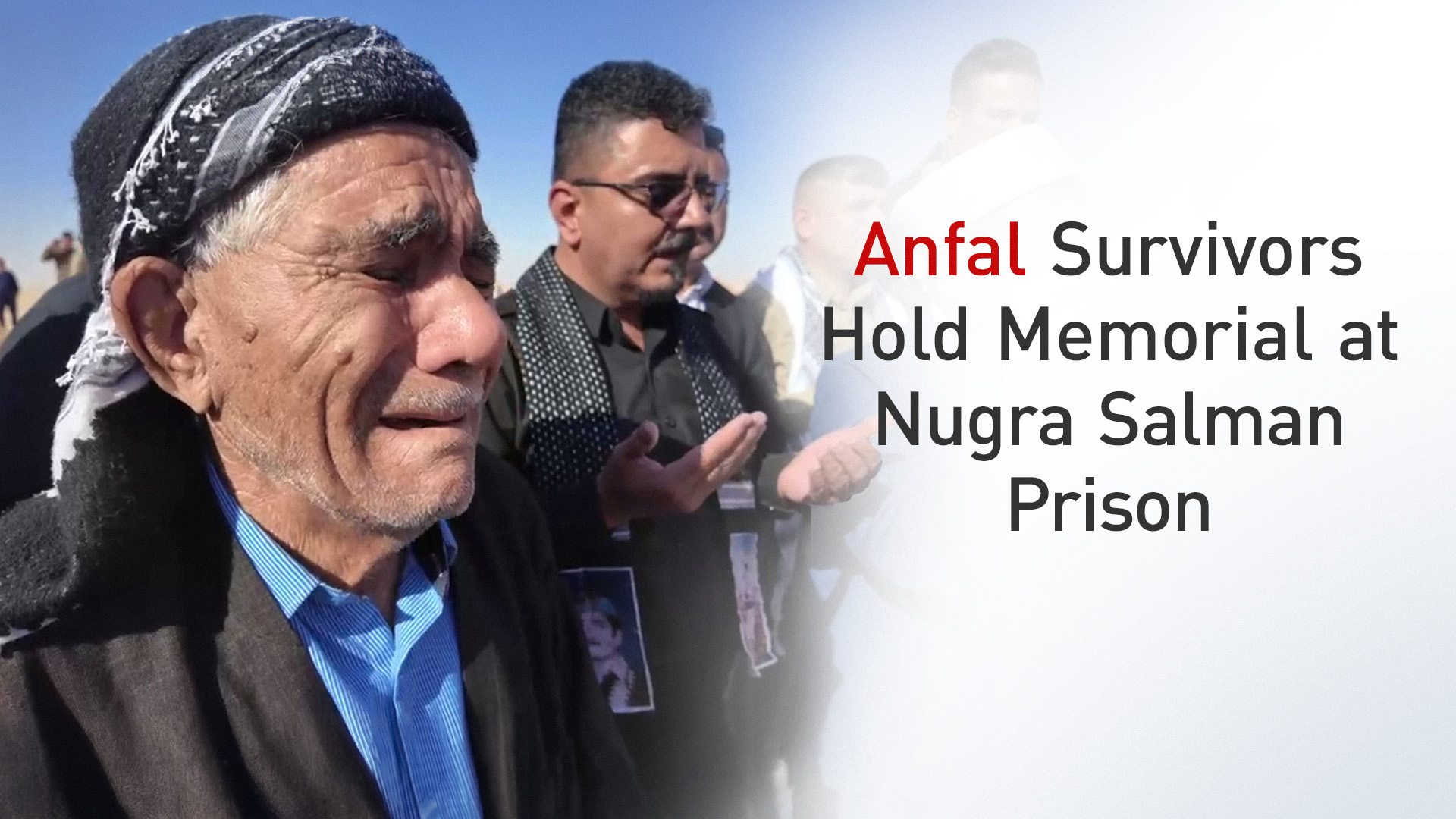
ERBIL (Kurdistan24) - Following a death sentence handed down by an Iraqi court against a notorious former Baath prison official, hundreds of relatives of Anfal victims and genocide survivors journeyed to the remote Nugra Salman fortress in Muthanna province on Friday.
The emotional gathering at the site where thousands of Kurds were imprisoned, starved, and killed during the 1988 Anfal campaign served as a solemn tribute to the dead and a defiant assertion of survival.
The visit was organized in the immediate wake of the capital conviction of Ajaj Ahmed Hardan al-Tikriti, widely known among survivors as the "Executioner" or "Butcher" of Nugra Salman, marking a pivotal moment in the decades-long pursuit of justice for the victims of the Baathist regime.
Families Return to Site of Atrocities
Hundreds of citizens from various cities across the Kurdistan Region mobilized to travel to southern Iraq, arriving at the desolate desert fortress on Friday morning.
According to Kurdistan24 reporter Harem Jaf, who accompanied the delegation, the families organized the visit explicitly to commemorate their loved ones following the court's verdict.
Relatives placed bouquets of Kurdish flowers on the grounds, honoring those buried in mass graves whose exact locations remain unknown.
The gathering featured a collective Friday sermon and prayers held inside the former prison walls.
The ceremony was designed as a symbol of resilience, meant to keep the memory of the Anfal victims alive in the very location where one of the most severe crimes against the Kurdish people occurred.
The local administration in southern Iraq expressed solidarity with the visiting families.
Mohanad Itabi, the Governor of Muthanna, told Kurdistan24 that the mass graves scattered across the Samawa desert serve as "undeniable and immortal evidence of the injustice committed against the Kurdish people."
He welcomed the delegation, stating that the local population honors the memory of those who were "buried alive in a very brutal manner, far from all human values."
Court Details Systematic Crimes
The impetus for the commemorative journey was the definitive ruling issued by the High Criminal Court in Rusafa, Baghdad.
On Thursday, the tribunal sentenced Ajaj al-Tikriti to death by hanging.
According to statements released by the Iraqi Judicial Authority's Media Office, the court found al-Tikriti guilty of participating in an "organized and systematic project" of genocide against Kurdish detainees held at Nugra Salman during the 1988 offensives.
The judicial findings detailed a brutal policy implemented under the former regime.
The court cited systematic crimes including torture, intentional starvation, humiliation, and the forced disappearance of 1,068 individuals, including women, children, and disabled civilians, who were subsequently buried in mass graves.
The sentencing followed extensive and harrowing testimony during multiple trial sessions.
According to Kurdistan24 reporting, witnesses recounted severe abuses committed under al-Tikriti's supervision.
Salam Bakhtiar, a lawyer representing the victims, stated that al-Tikriti had confessed in detail to the crimes during the investigation phase, and that prosecutors utilized photographs, videos, and crime scene reconstructions to solidify the case.
Bakhtiar noted that under Iraqi law, the death sentence will be automatically referred to the Court of Cassation for a judicial review, a process expected to take roughly a month due to the massive volume of evidence.
Survivors Recount Prison Conditions
The trial provided a platform for survivors to officially document the horrors of Nugra Salman.
Amina Ali, an elderly survivor who testified before the court, tearfully described how her 11-year-old daughter and four-year-old son died in her arms from starvation, thirst, and a lack of medical care while imprisoned.
The personal dimension of the legal victory was perhaps most profoundly embodied by Fazila Hama-Khula, an Anfal survivor whose relentless 37-year search directly led to al-Tikriti's arrest.
According to previous Kurdistan24 reporting, Hama-Khula tracked her former tormentor to the Rumaythah area, where he had been living under the assumption that he was presumed dead.
She provided the critical intelligence that allowed Iraq's National Security Service to apprehend him in July 2025.
Hama-Khula previously recounted witnessing her six-year-old brother die of starvation and abuse, only to see his body consumed by stray dogs after being discarded by prison guards.
Similar traumatic accounts were shared publicly during the trial by Kurdistan24 presenter Ammar Najmaddin, who was imprisoned at Nugra Salman as an 11-year-old child.
He described the prison conditions as a systematic starvation campaign, noting that detainees survived on salty water and minimal bread rations, leading to rampant death from cholera and malnutrition.
Justice Efforts Continue Decades Later
The conviction of al-Tikriti prompted responses from the highest levels of Kurdish leadership.
Kurdistan Region President Nechirvan Barzani welcomed the death sentence, describing the ruling on the social media platform X as "a victory for justice."
Kurdistan Region President stated that the verdict offers some consolation to the victims' families and proves that crimes against the Kurdish people will not be forgotten.
The Region's President Nechirvan Barzani used the occasion to renew calls for the Iraqi federal government to fulfill its legal obligations by providing both material and moral compensation to the survivors of the Anfal campaign, which was officially recognized as a genocide by the Supreme Iraqi Criminal Tribunal.
The somber prayers held by the families inside the walls of Nugra Salman underscore the enduring trauma of the Anfal genocide.
While the conviction of a key perpetrator represents a significant legal milestone, the presence of the survivors at the site of their former imprisonment highlights that the search for missing relatives, the opening of undiscovered mass graves, and the broader pursuit of historical justice remain ongoing decades after the atrocities were committed.