Arab Tribal Leader Calls Prime Minister Masrour Barzani a 'National Figure' in Iraq
Izz al-Arab Muslim Hussein, the Emir of the Himyar tribe in Iraq, called Kurdistan Region Prime Minister Masrour Barzani a "national leader," saying his Baghdad visit strengthened Kurdish-Arab unity and urging an end to salary cuts for Kurdistan Region citizens.
ERBIL (Kurdistan24) - In a significant declaration highlighting the evolving dynamics of Iraqi cross-community relations, the Emir of the Himyar tribe in Iraq, Izz al-Arab Muslim Hussein, has characterized Kurdistan Region Prime Minister Masrour Barzani as an essential national leader and a vital reference point (marja) for the entire country.
Speaking as a featured guest on Kurdistan24's Basi Roj (Topic of the Day) program, hosted by Zhino Mohammed on Monday, the tribal leader emphasized the political and social weight of the Prime Minister's latest diplomatic mission to Baghdad.
According to the Emir, the high-level visit has played a critical role in defusing regional tensions and has brought immense joy to traditional tribal components throughout central and southern Iraq, signaling a deep desire for institutional stability and mutual recognition that transcends partisan divides.
A Symbolic Gesture of Unity in Baghdad
The Emir's remarks followed an extraordinary reception organized by traditional leaders during the Prime Minister's diplomatic itinerary in Baghdad.
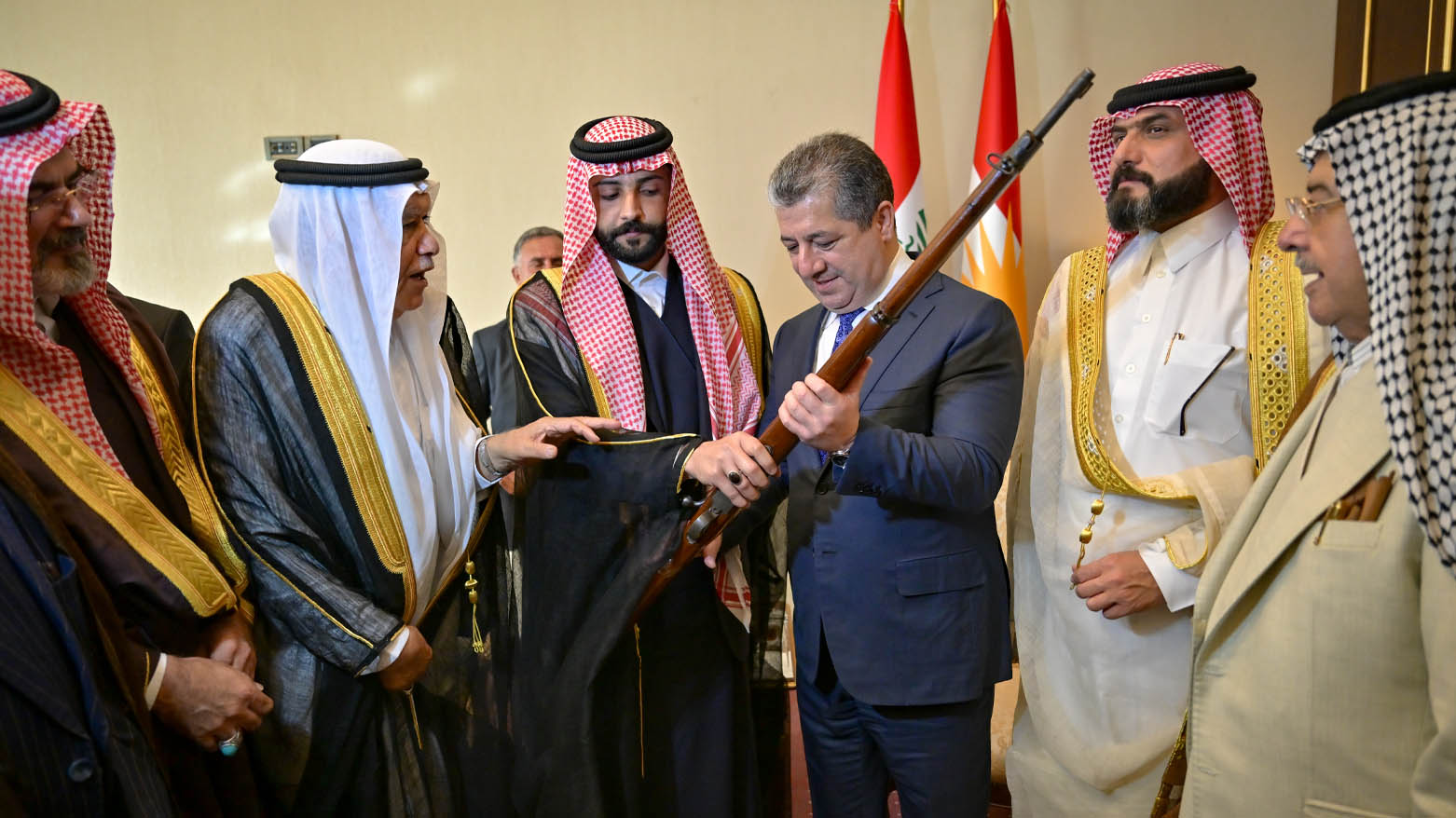
According to background accounts from the Kurdistan24 reporting desk, prominent sheikhs and elders representing major provinces, including Basra, Najaf, Karbala, Diwaniyah, Baghdad, and Anbar, assembled on Sunday, to welcome Prime Minister Barzani.
In a notable demonstration of solidarity, the assembly presented Prime Minister Barzani with an antique Brno rifle.
Read More: 'You Are Not A Guest Here, You Are The Owner': Arab Tribal Chiefs Welcome Prime Minister Barzani
Shakhawan Abdullah, head of the Kurdistan Democratic Party (KDP) parliamentary bloc in the Iraqi parliament, told Kurdistan24 in an exclusive statement that this gesture carried immense historical weight.
Tribal representatives explicitly stated that presenting this heritage weapon was a definitive declaration that Arab tribes stand ready to defend all regions of Iraq alongside their Kurdish brothers, viewing the rifle as a historic symbol of shared resistance against previous dictatorial governance.
Furthermore, the reception highlighted a profound message regarding domestic belonging and partnership.
As reported by Kurdistan24, one participating tribal chief remarked unequivocally that Prime Minister Barzani must never be viewed as a visitor in their sovereign territories, asserting firmly that the Prime Minister is not a guest but rather a true homeowner within these lands.
This strong framing underscored a collective rejection of artificial social divisions, with tribal figures emphasizing that Kurdish-Arab fraternity remains an unshakeable reality that must be insulated from immediate legislative disputes or political stalemates occurring within Baghdad's governmental corridors.
Historical Ties Between Kurds and Arab Tribes
During his interview on the Basi Roj program, Emir Izz al-Arab Muslim Hussein expanded on the deep generational ties connecting the Prime Minister Barzani leadership with the diverse tribal landscape of central and southern Iraq.
The Emir observed that these relationships are firmly rooted in history, drawing a direct line back to the extensive networks of solidarity established by the late Kurdish leader Mala Mustafa Barzani.
He noted that the historic leader maintained deep, respectful ties with the prominent tribes of Basra, Najaf, and Babel, adding that many families in these southern regions continue to carefully preserve photographs and mementos from that foundational era.
This historical continuity, the Emir argued, serves as the bedrock for modern relations, demonstrating that the alliance between the Kurdish freedom movement and Arab tribal structures remains an enduring social reality.
Rejecting Sectarianism and Economic Grievances
Addressing the current socio-political environment in Iraq, the Emir used his platform on Kurdistan24 to issue a robust rejection of sectarian politics, stating categorically that Kurds, Shiites, and Sunnis complement one another to form the complete fabric of the state.
However, Hussein did not shy away from addressing pressing economic grievances.
He strongly criticized the systematic delay of public salaries and the disruption of livelihoods impacting citizens within the Kurdistan Region.
The Emir characterized the withholding of financial entitlements from the people of Kurdistan as an unacceptable act that runs counter to national unity, noting that the Kurdish population has historically endured severe tribulations and deserves to be treated with absolute equity.
He called for an immediate cessation of these economic pressures, urging both governments to resolve outstanding disputes through constructive dialogue.
Blacklisting Sectarianism: Prime Minister Barzani's Baghdad Visit and Expanding Tribal Engagement
The broader political framing of Prime Minister Barzani's visit underscores an intentional expansion of Kurdish diplomatic engagement beyond formal state institutions.
KDP parliamentary bloc leader Shakhawan Abdullah highlighted that this visit marked the first time a Kurdish prime minister had formally received such a diverse delegation of traditional leaders from the south and center of Iraq to listen directly to their regional concerns.
Tribal leaders communicated to Prime Minister Barzani that while contemporary politicians may experience operational disagreements, the overarching legacy of the Barzani family and the KDP remains far greater than temporary political disputes.
They explicitly described the Barzani lineage as an authentic shield and protective symbol for Iraq, a sentiment reinforced by the symbolic presentation of the historic rifle.
Politics of Recognition and Coexistence
Ultimately, the convergence of high-level political meetings and grassroots tribal recognition during this Baghdad summit highlights a renewed vision for Iraqi statehood based on genuine partnership.
The Emir of the Himyar tribe concluded his remarks by praising the visionary policies of KDP leadership, President Masoud Barzani, and Prime Minister Masrour Barzani, crediting them with successfully shielding Iraq from devastating regional conflicts.
Expressing his deep affection for Erbil, the Emir voiced his hope that the model of peaceful coexistence, tolerance, and rapid administrative development characteristic of the Kurdistan Region's capital would eventually be transferred to other Iraqi provinces, ensuring a future where all citizens can live with shared prosperity and dignity.