Iran's Revolutionary Guards Claim Retaliatory Strike on U.S. Base Amid Gulf Escalation
Tehran warns of severe consequences following purported U.S. attacks on its infrastructure, while Kuwaiti air defenses intercept a barrage of drones and missiles.
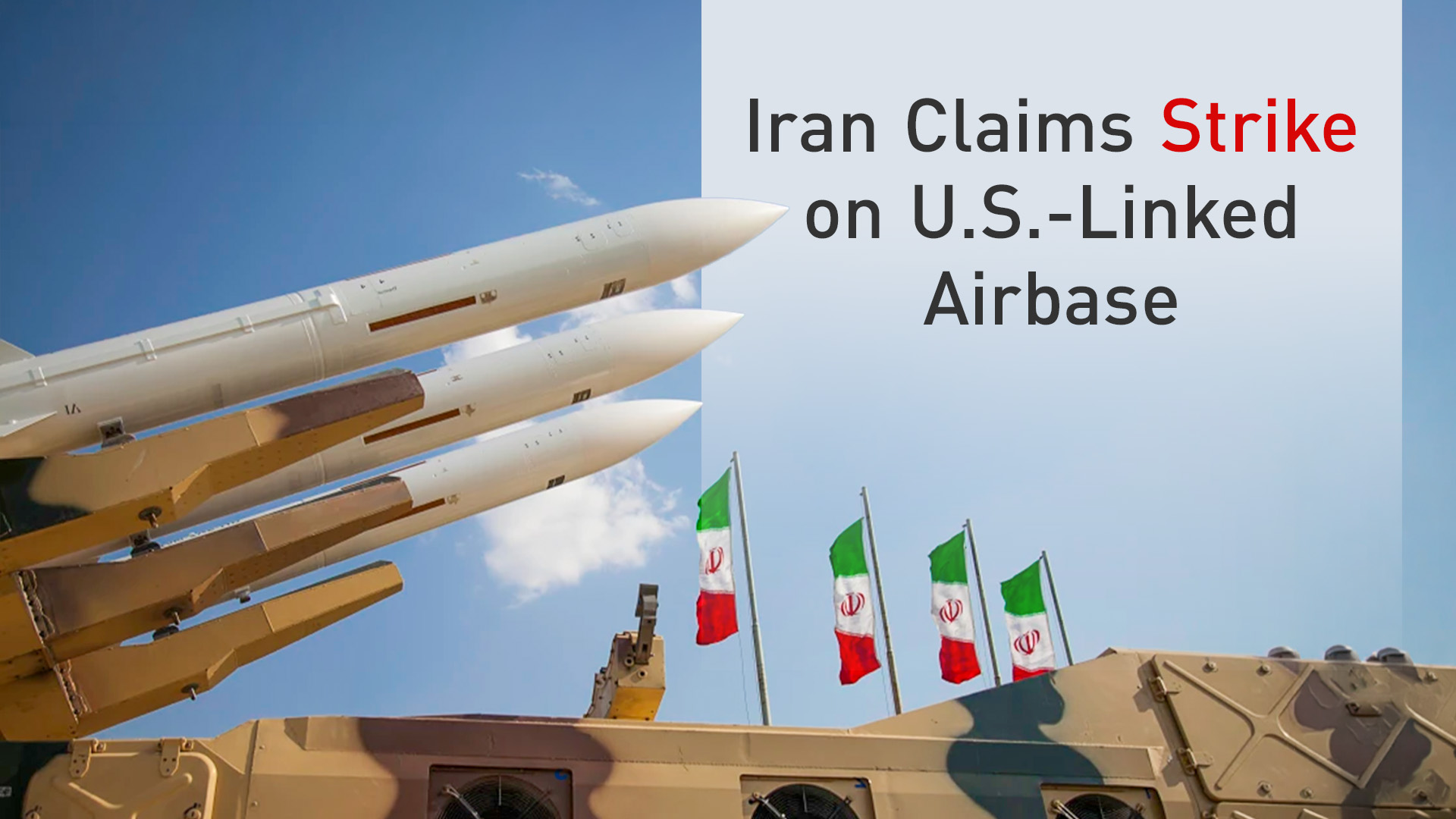
ERBIL (Kurdistan24) - Iran's Islamic Revolutionary Guard Corps (IRGC) announced on Monday that it had launched a retaliatory strike against a military base utilized by the United States, further escalating the direct military confrontation between Washington and Tehran. The purported attack was framed by Iranian authorities as a direct response to what they described as American strikes on Iranian sovereign territory.
According to the public relations department of the IRGC, the retaliatory operation explicitly targeted the facility from which "U.S. aggressor forces" had allegedly launched an attack on a communications tower on Sirik Island in Hormozgan Province.
A report published by Sepah News, the official media outlet of the IRGC, detailed the group's rationale.
“Following the aggression carried out one hour ago by the U.S. military against a communications tower on Sirik Island... the IRGC Air Force targeted the airbase that served as the source of the aggression, successfully destroying the designated targets,” the statement read.
The IRGC accompanied its operational claims with a stark warning, asserting that should the United States repeat such "acts of aggression," the Iranian response would be "entirely different" and more severe, explicitly holding Washington responsible for any regional fallout.
A Pattern of Retaliation
The early Monday announcement builds on a similar narrative of tit-for-tat exchanges.
Merely days prior, last Thursday, the IRGC claimed it had struck a U.S. military facility following alleged American operations in southern Iran.
According to a communiqué broadcast by Iranian state television, a 4:50 a.m. strike was launched in response to "aggression carried out by the occupying U.S. military" near Bandar Abbas Airport, purportedly targeting the originating American airbase.
While Iranian authorities have heavily publicized their offensive actions, independent verification of the damage at the targeted U.S.-linked sites remains limited. However, the spillover effects of the Iranian barrage quickly became apparent across the border.
Kuwait Caught in the Crossfire
Just prior to the IRGC's official announcement on Monday, the Kuwaiti military revealed that its forces had intercepted a series of hostile missiles and drones.
In an alert published on the social media platform X, the General Staff of the Kuwaiti Army announced the activation of its air defense systems. The military clarified that the loud explosions heard across the Gulf nation were the result of interceptors neutralizing incoming aerial threats. Urging citizens to heed official safety instructions, the Kuwaiti armed forces prioritized domestic security as the country found itself abruptly caught in the U.S.-Iran crossfire.
Read More: Kuwait Activates Air Defenses as Missiles and Drones Target Gulf State
The incoming barrage over Kuwaiti airspace directly aligns with the spike in regional hostilities.
According to reporting by Jon Gambrell of The Associated Press, the attacks likely constituted Iran's retaliation for U.S. military operations conducted over the weekend.
Kuwait occupies a highly strategic yet vulnerable position, hosting U.S. Army Central, the forward command for American ground forces in the Middle East. This major U.S. military infrastructure frequently places the nation in the crosshairs of regional proxy conflicts.
Fragile Diplomacy Amid Escalation
The sequence of strikes highlights a rapidly deteriorating security environment.
According to Gambrell's AP report, U.S. Central Command (CENTCOM) confirmed that American forces had struck Iranian radar installations and a ground control station around Geruk and Qeshm Island over the weekend.
CENTCOM described the U.S. operations as a "measured and deliberate" response to Iran's downing of an American MQ-1 Predator drone over international waters.
Iran's state-run IRNA news agency subsequently acknowledged the IRGC's counterattack.
Emphasizing the anti-American nature of the retaliation, Iranian state television broadcast footage of a ballistic missile launch featuring a graphic of a bruised U.S. President Donald Trump overlaid on a closed Strait of Hormuz, captioned: “Until the last American soldier leaves the region.”
The dueling strikes severely test the viability of ongoing ceasefire negotiations. Despite the active exchange of fire, President Trump posted an optimistic message on his Truth Social platform early Monday, asserting that Iran wants a deal and advising his followers to "sit back and relax."
Yet, as missiles are intercepted over Kuwait and the IRGC issues increasingly bellicose warnings, the reality on the ground contradicts diplomatic optimism.
The latest military exchange serves as a stark illustration of the growing risk that the U.S.-Iran confrontation could engulf neighboring Gulf states, threatening wider regional stability despite efforts to negotiate a truce.