From Scarcity to Surplus: How Erbil Solved Its Water Problem for the Next 30 Years
A $480 million emergency supply project now delivers 20,000 cubic meters of treated water per hour, making Erbil the only city in the region with a guaranteed summer water supply
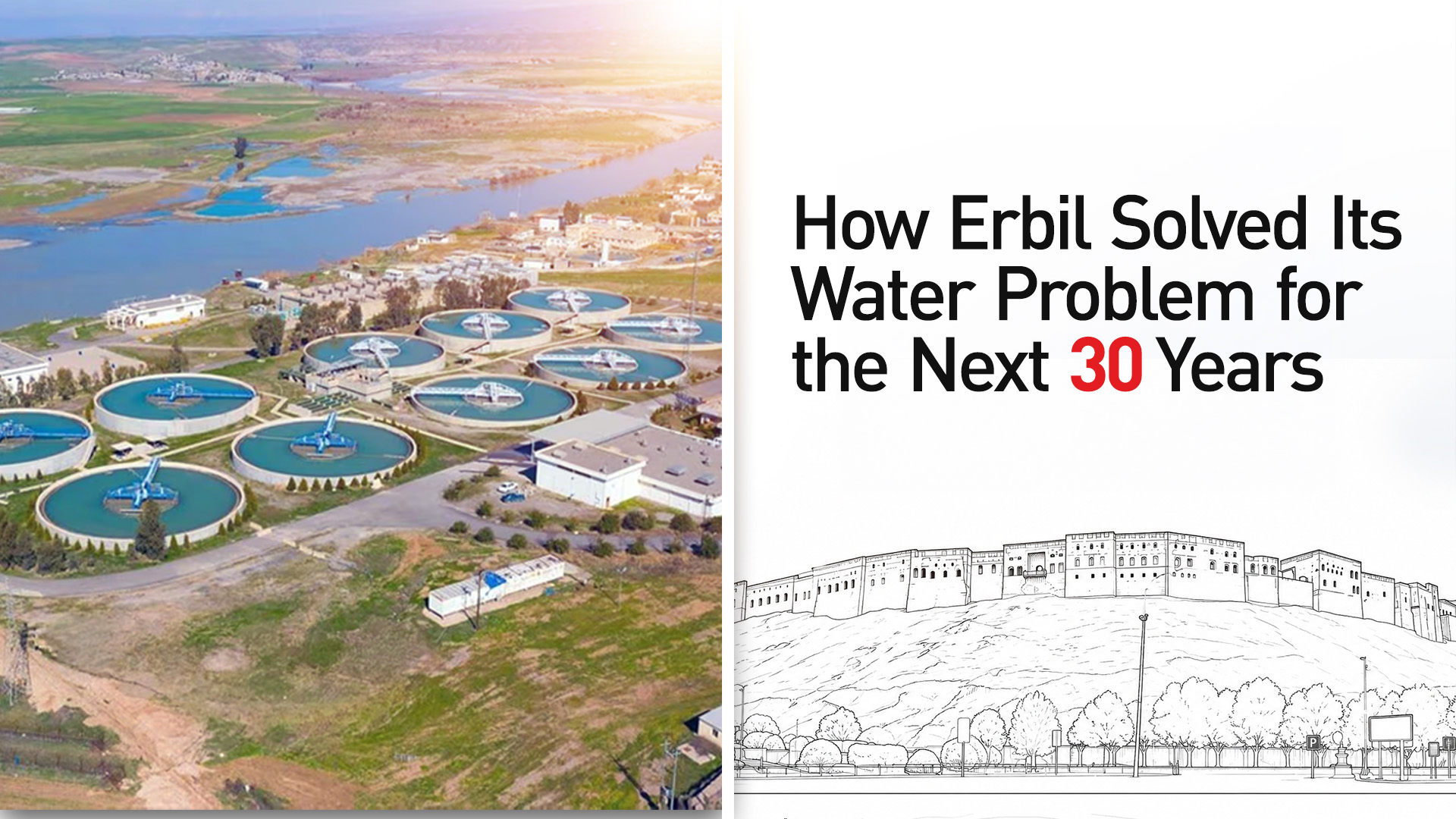
ERBIL (Kurdistan24) - For a city that once watched its groundwater table sink by hundreds of meters as summer approached, Erbil has quietly achieved something its neighbors have not: a guaranteed water supply, around the clock, through even the most punishing heat.
That transformation is the result of deliberate, large-scale infrastructure investment by the Kurdistan Regional Government's ninth cabinet, a strategic bet on water security that officials say has permanently reshaped how the capital is supplied, stored, and delivered.
At the center of the overhaul is the Erbil Emergency Water Supply Project, inaugurated on Sept. 8, 2024, by Prime Minister Masrour Barzani.
Completed ahead of its scheduled deadline and at a cost of nearly $480 million, the project was designed from the outset to accommodate not just Erbil's current population but its growth over the coming three decades.
The scale is significant. The project draws 480,000 cubic meters of water daily from the Greater Zab River, treating and distributing it at a rate of between 20,000 and 21,000 cubic meters per hour across the city's neighborhoods.
Four dedicated pipeline networks fan out across Erbil, reaching districts from Shekhashl and Gazna in the north to Mamzawa, Qatwi, and Kasnazan in the west, and central neighborhoods including Kurdistan, Nergiz, and Bahary Nwe.
'No water problems this summer'
Raber Hussein, director of Erbil's Water Directorate, said in an exclusive interview Wednesday that the results are already measurable, and definitive.
"For this summer, there will be no water supply problems for our households," he said, "except in unavoidable technical situations such as pipe breaks, power outages, or motor failures, and in any such case, problems will be resolved quickly and within a short period."
His confidence rests on a combined distribution capacity that now stands at 35,500 cubic meters per hour across all active projects serving Erbil and its surrounding areas, including legacy infrastructure such as the Ifraz One, Ifraz Two, and Ifraz Three systems.
Perhaps the most telling indicator of the project's success is what is no longer needed. Nearly 1,000 groundwater wells that once served central Erbil have been decommissioned since the emergency project came online, a decision with consequences that extend well beyond logistics.
Hussein explained that the closure of those wells has had a direct and measurable effect on the city's underground water table, which had fallen sharply in previous years.
By the Water Directorate's own measurements from last year, groundwater levels had dropped by 700 meters in the Kasnazan area and 500 meters in the city center, a decline driven by chronic over-extraction and reduced rainfall.
That trend is now reversing. Combined with this year's heavy snowfall and rainfall, and the deliberate recharging of ponds and reservoirs, groundwater levels are projected to rise significantly.
The General Directorate of Water Resources continues to monitor dedicated measurement wells across Kasnazan to track the recovery in real time.
The directorate's planning is grounded in international benchmarks. Hussein noted that, according to joint studies conducted with Iraq's national water authority, each person requires 240 liters of water per day under standard conditions, a figure that rises to 400 liters during summer, when air conditioning and cooling systems drive household consumption well above global norms.
Even so, Hussein was direct in his appeal to residents. The water being delivered, he emphasized, is intended for drinking and domestic use, not for washing streets or irrigating gardens.
He called on citizens to respect KRG guidelines and use water responsibly, warning against waste at a moment when infrastructure capacity and public behavior must work in tandem.
What sets Erbil apart is not merely the infrastructure itself, but the policy vision behind it. While cities across the wider region continue to grapple with seasonal water shortages, aging distribution networks, and groundwater depletion, Erbil enters summer 2026 as the only city in the region with a system capable of meeting peak demand without interruption.
The ninth cabinet's investment has effectively decoupled the city's water supply from the variables — drought, population growth, seasonal demand spikes — that have historically made summer a period of rationing and anxiety for residents.
As Hussein put it: Erbil's water problem has been solved. The work now is making sure it stays that way.