Strikes and Ceasefire in the Same Breath: Israel and Lebanon Agree to Truce as Bombs Keep Falling
A Washington-brokered truce requiring Hezbollah's complete withdrawal from southern Lebanon lasted only hours before Israeli drone strikes, rocket barrages, and the deaths of three paramedics cast the deal's survival into doubt
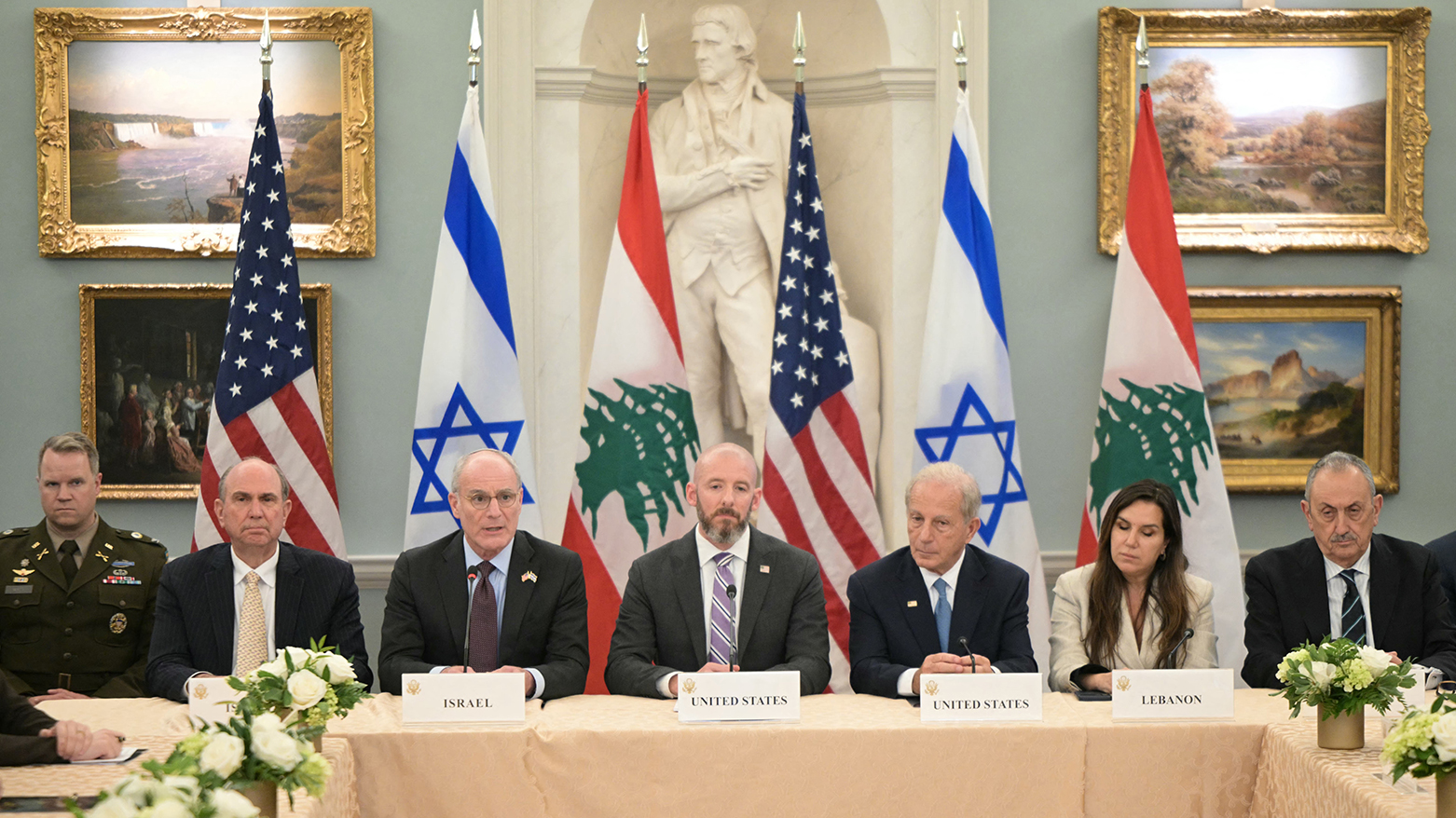
ERBIL (Kurdistan24) - The ink on the agreement had barely dried. On Wednesday, Israeli and Lebanese diplomats emerged from US-led talks in Washington with what both sides called a conditional ceasefire, a framework that, for a fleeting moment, suggested the grinding cross-border conflict that has claimed hundreds of lives might be edging toward a pause.
By Thursday morning, Lebanese state media was reporting Israeli drone strikes along southern roads. Three paramedics were dead. A Lebanese soldier had been killed. And one of Israel's own cabinet ministers was publicly denouncing his government's deal as a catastrophic error.
The ceasefire, it appeared, had survived less than a night.
Wednesday's joint statement, the product of the fourth round of direct talks between Israeli and Lebanese diplomats since fighting erupted on March 2, was carefully worded in ways that foreshadowed its fragility.
The ceasefire, both sides agreed, was "contingent on a complete cessation" of fire by Iran-backed Hezbollah, a condition that the group, which has consistently framed its attacks as legitimate resistance rather than aggression, gave no indication it intended to meet.
The agreement also called for the creation of "pilot zones" in which the Lebanese armed forces "will take exclusive control of the territory to the exclusion of all non-state actors," a language that effectively demands Hezbollah evacuate its operatives from southern Lebanon, a demand the group's senior official Mahmud Qomati had already addressed on Tuesday when he told AFP that Hezbollah "would not accept a partial ceasefire."
Both parties agreed to meet again the week of June 22, the statement said, "with a view toward reaching a comprehensive agreement" — an acknowledgment, embedded in the diplomatic language itself, that Wednesday's deal was a beginning rather than a resolution.
A Ceasefire That Did Not Hold
The sequence of events that followed the announcement illustrated precisely how tenuous the framework was. Just hours after the deal was publicized, air raid sirens sounded across northern Israel as a "suspicious aerial target" was identified, though no casualties were reported.
The Israeli military said it intercepted a "hostile aircraft" and two projectiles that had crossed into Israeli territory from Lebanon.
Hezbollah's response was direct. The group said that "in response to the Israeli enemy army's violation of the ceasefire," its fighters had launched a rocket barrage targeting Israeli soldiers in northern Israel.
In the early hours of Thursday, it announced a further "salvo of rockets" aimed at Israeli soldiers and vehicles in the southern Lebanese town of Al-Qantara, and said it had targeted an Israeli command position near Chqif Castle with two drones.
Meanwhile, Lebanese state media reported Israeli drone strikes along roads in several south Lebanon locations on Thursday morning, with the state-run National News Agency (NNA) confirming that at least one strike caused casualties.
This was not, notably, the first time a truce had failed to take hold. A ceasefire was meant to halt the fighting on April 17 but, as the NNA documented throughout the intervening weeks, was never observed, with both sides citing the other's alleged violations as justification for continuing their own attacks.
A Revolt From the Right
In Tel Aviv, the political fallout was equally swift. National Security Minister Itamar Ben Gvir, a member of Israel's far-right flank and a persistent internal critic of Prime Minister Benjamin Netanyahu's strategic choices, did not wait before going public with his dissent.
"The ceasefire with Lebanon is a serious mistake and the pipe dreams of advisers are dragging the prime minister to wrong decisions," Ben Gvir wrote on X on Thursday.
The statement was significant not merely for its content but for its timing, a sitting cabinet minister publicly undermining a diplomatic agreement concluded by his own government within hours of its announcement.
For Netanyahu, who has long governed through an uneasy coalition with far-right partners, Ben Gvir's rebuke signals the limits of what the prime minister's political base will accept in any eventual comprehensive deal.
Paramedics, Soldiers, Civilians
The human cost of Wednesday's fighting made the collapse of the ceasefire impossible to abstract into diplomatic language.
Lebanon's health ministry reported that an Israeli strike on Al-Hawsh, near the city of Tyre, killed four Syrians and two Palestinians.
An Israeli military spokesperson told AFP's Jerusalem bureau that the military was "not aware of any such attack having occurred in the area."
More viscerally documented was the targeting of emergency workers. An Israeli strike hit an ambulance in southern Lebanon, killing two paramedics from the Risala Scouts Association, which is affiliated with Hezbollah's ally the Amal movement.
The health ministry circulated images of the badly damaged vehicle, with medical masks spilling across the road. A third paramedic was subsequently killed in a separate attack on an ambulance team affiliated with the Hezbollah-linked Islamic Health Committee in the town of Zibdine.
At least 130 emergency and health workers have been killed since the fighting began — a figure that has drawn increasing international concern over the protection of medical personnel in the conflict.
Lebanon's army confirmed that a soldier was also killed in an Israeli strike, with an officer and a second soldier wounded in a separate attack on a military vehicle.
The Lebanese armed forces denounced what they called Israel's "deliberate targeting of army personnel, vehicles and positions," a charge that carries particular weight given that the very ceasefire agreement signed hours earlier had assigned those same armed forces the task of establishing exclusive control over southern Lebanese territory.
The Iranian Dimension
Running beneath the Israel-Lebanon track is a deeper disagreement about the nature of the conflict itself. US President Donald Trump said Wednesday that he wanted to separate the talks on Lebanon from those concerning the broader war with Iran, a compartmentalization that would allow Washington to pursue a Lebanon settlement without resolving the Iranian dimension first.
Tehran has rejected that framing categorically. Iranian Foreign Minister Abbas Araghchi warned that any attack on Beirut would trigger a "full-scale resumption" of war, a formulation that ties Iran's restraint directly to Israel's conduct in Lebanon, and that makes any durable Lebanon ceasefire contingent, in Tehran's view, on a de-escalation that extends far beyond the Israel-Lebanon bilateral track.
Whether the two conflicts can in fact be separated, or whether they are, as Iran insists, a single interconnected struggle that must be resolved together, may be the most consequential strategic question facing American diplomacy in the region right now.