'Write in Kurdish, Think in Kurdish': Erbil Hosts Inaugural Kurdish Book Fair
Held under the slogan "Write in Kurdish, Think in Kurdish," the inaugural fair at the Erbil International Fairground brings together 30 publishing houses and over 10,000 titles
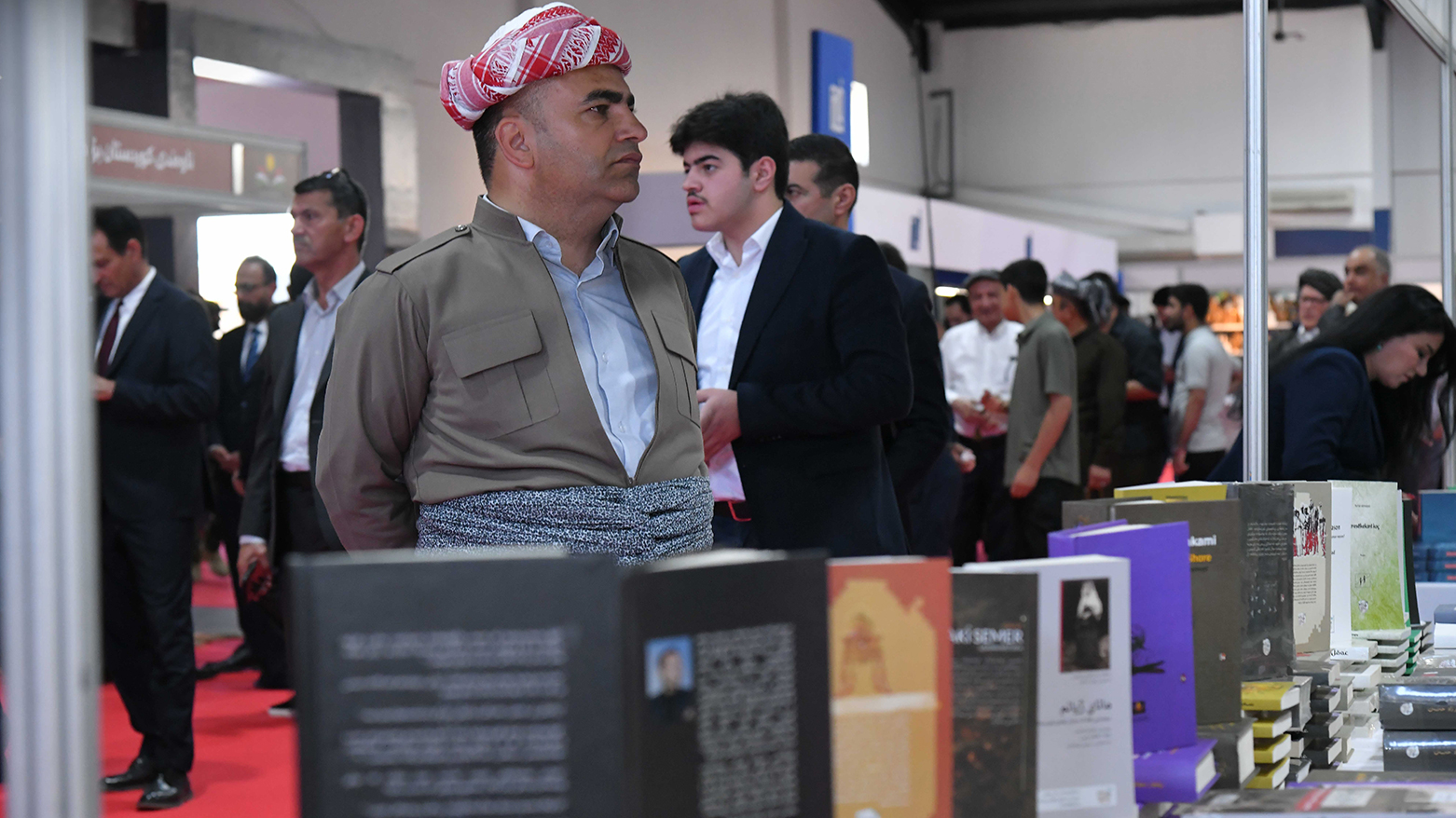
ERBIL (Kurdistan24) - In a city that has long prided itself as a haven for intellectuals and a crossroads of Kurdish cultural life, Erbil on Thursday opened the doors of something it had never hosted before: a book fair dedicated entirely to the Kurdish language.
The first Kurdish Book Fair inaugurated at the Erbil International Fairground on Thursday, in the presence of government and party officials alongside a significant gathering of writers and intellectuals.
Organized under the slogan "Write in Kurdish, Think in Kurdish," the fair will run until June 10 and is being received as a landmark moment for Kurdish literary and intellectual life in the Region.
The event's origins carry their own significance. This year, the annual Erbil International Book Fair — a fixture in the city's cultural calendar, was not held due to regional conditions.
Rather than leave that space empty, organizers took a different decision: to fill it with something more specific, and in many ways more pointed. A fair not for all languages, but for Kurdish alone.
The result is an exhibition that showcases only books written in the Kurdish language, featuring works by Kurdish authors residing in the Kurdistan Region who hail from all four parts of Kurdistan.
The decision to restrict the fair to Kurdish-language titles transforms what might have been a straightforward literary event into a quiet but unmistakable cultural statement, that the Kurdish language is not a secondary concern or a subcategory, but a literary tradition capable of sustaining an entire fair on its own terms.
The numbers behind the fair are striking. Nearly one million Kurdish books are available across the exhibition, spanning more than 10,000 distinct titles.
The thematic range is broad, covering political, religious, historical, social, and economic subjects, and encompassing the full spectrum of Kurdish dialects and linguistic variants.
Thirty publishing and distribution centers are participating, making the fair as much a showcase of the Kurdish publishing industry as it is a celebration of Kurdish letters.
For readers, organizers have described the event as a rare opportunity to encounter the latest works of Kurdish authors up close — a living inventory of where Kurdish writing stands in 2026 and where it is headed.
Beneath the logistics of publishers and titles and visitor numbers lies a deeper aspiration. The fair is explicitly framed as a support mechanism for the broader movement of writing, publishing, and distributing in the Kurdish mother tongue — a movement that, across the four parts of Kurdistan and the diaspora beyond, has always contended with the pressures of dominant state languages and restricted cultural space.
In Erbil, at least for the week of June 4 to June 10, that pressure is reversed. The Kurdish language is not a guest in someone else's fair. It is the host.