How Kurdistan Cut More Than 1 Million Tons of CO₂ While Transforming Its Cities
Kurdistan Regional Government Green Belt and diesel generator removals reshape Kurdistan's environment; KRG data signals major scale.
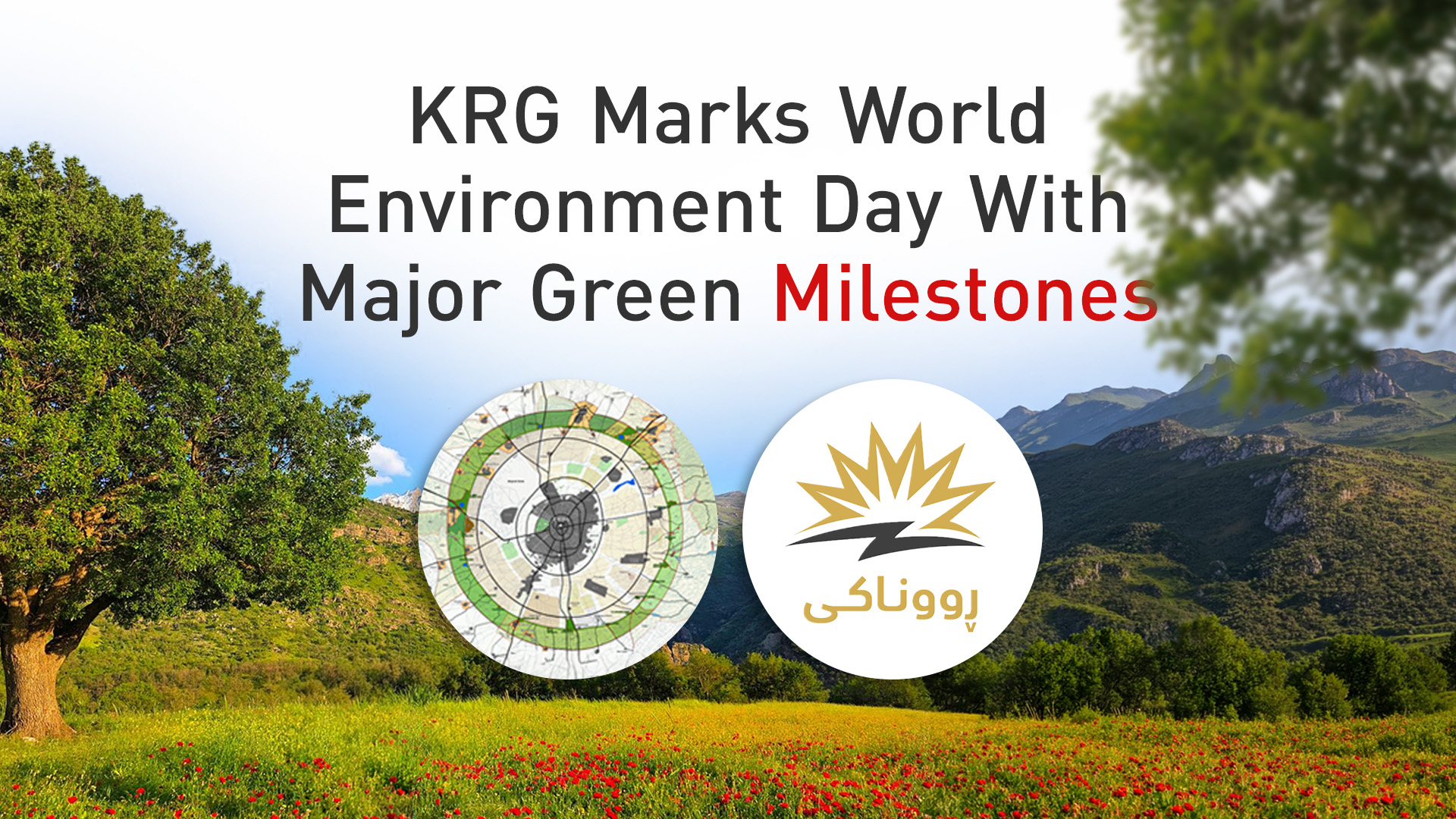
ERBIL (Kurdistan24) - As the international community observed World Environment Day on Friday, the Kurdistan Regional Government (KRG) highlighted a series of transformative ecological milestones. Under the strategic direction of the Ninth Cabinet, authorities in Erbil have elevated environmental protection to a core pillar of governance, launching massive afforestation projects and sweeping energy reforms designed to drastically reduce greenhouse gas emissions and expand the region's urban green canopy.
The global observance of World Environment Day dates back to the landmark 1972 United Nations Conference on the Human Environment.
First celebrated under the theme “Only One Earth,” the day has evolved over the past five decades into the premier international platform for advocating nature conservation and ecological awareness.
Aligning with these global imperatives, the KRG has initiated an aggressive sustainability agenda, refusing to allow persistent financial and regional challenges to derail its long-term environmental objectives.
Central to this green transformation is a deliberate policy shift toward sustainable urban development.
Despite complex economic headwinds, the Ninth Cabinet has successfully initiated large-scale infrastructural changes aimed at improving air quality and protecting public health.
According to official government data, these combined environmental programs have already succeeded in removing approximately 1.1 million tons of carbon dioxide from the atmosphere, ensuring that Kurdistan's rapidly growing cities maintain safe air quality standards.
The centerpiece of this ecological strategy is the massive Erbil Green Belt.
Designed as a flagship environmental initiative, the project involves planting a 78-kilometer forested perimeter around the capital city.
The ultimate goal is to plant seven million trees, utilizing economically viable species such as olive, pistachio, and orange trees to create a sustainable agricultural buffer.
The implementation of the Green Belt is already well underway. During the project's first phase, agricultural teams successfully planted 700,000 saplings across 4,200 dunams of land.
Once fully mature, environmental authorities estimate that this sweeping forestation effort will absorb up to 210,000 tons of harmful greenhouse gases annually, serving as a vital ecological lung for the capital.
Parallel to this massive planting effort, the KRG has launched the "Runaki" program, an ambitious energy transition project that strikes directly at the region's most persistent source of urban pollution: neighborhood diesel generators.
For years, cities across the Kurdistan Region relied heavily on private diesel units to supplement the centralized power grid, blanketing residential areas in thick smoke and continuous noise.
The Runaki initiative is systematically replacing these heavily polluting generators with a stabilized, 24-hour centralized electricity supply.
The environmental impact of this transition has been immediate and profound. By decommissioning thousands of diesel units, the program has prevented the emission of vast quantities of carbon dioxide and other toxic particulates.
The regional emissions reduction data highlights the sheer scale of the Runaki project.
In Erbil alone, the decommissioning of nearly 3,000 generators has removed over 570,000 tons of CO₂ annually, the ecological equivalent of taking more than 518,000 cars off the road.
In Sulaimani, the removal of 805 generators cut emissions by over 153,000 tons.
Similar reductions have been achieved across the region, with Duhok eliminating over 96,000 tons of CO₂, Zakho cutting 93,000 tons, and substantial reductions recorded in Raperin, Soran, Koya, Pirmam, Halabja, Semel, and Akre.
This dramatic reduction in atmospheric pollution is accompanied by a steady expansion of urban green spaces.
According to the KRG's environmental and urban development authorities, the overall ratio of green space across the Kurdistan Region has now reached an average of 20 percent.
However, city-level outcomes vary based on recent infrastructural investments.
In Sulaimani, the green ratio is currently estimated between 22 and 23 percent, while Duhok has reached between 20 and 22 percent.
Halabja currently stands slightly below the 20 percent mark.
In Erbil, the highly anticipated completion of the Green Belt is projected to push the capital's green coverage beyond 25 percent, marking a dramatic transformation of the city's environmental landscape.
The commitment to urban greening extends beyond basic forestation, influencing the design of major public infrastructure.
Landmark initiatives such as the Zakho Corniche and Sarhaldan Park in Duhok represent a new approach to urban planning, seamlessly integrating environmental sustainability with aesthetic municipal design.
By achieving the removal of over 1.1 million tons of CO₂ and committing to the vast expansion of its green infrastructure, the Kurdistan Region is actively aligning itself with global climate action trends.
For the Ninth Cabinet, these milestones represent more than just environmental statistics; they are foundational investments in public health, long-term ecological stability, and sustainable economic development.
As World Environment Day serves to remind the global community of its shared ecological responsibilities, the ongoing success of the Runaki and Green Belt programs demonstrates that ambitious environmental reform remains achievable, establishing a vital blueprint for the future of the Kurdistan Region.
|
Summary Marking World Environment Day 2026, the Kurdistan Regional Government announced major environmental milestones. Under the Ninth Cabinet's Runaki and Green Belt initiatives, authorities have slashed regional CO₂ emissions by over 1.1 million tons and significantly expanded urban green spaces. |