Hegseth Links D-Day Legacy to Migration Debate, Urges Europe to Strengthen Defense
U.S. War Secretary calls migration an “invasion” and presses European allies to increase military contributions during the Normandy anniversary commemoration
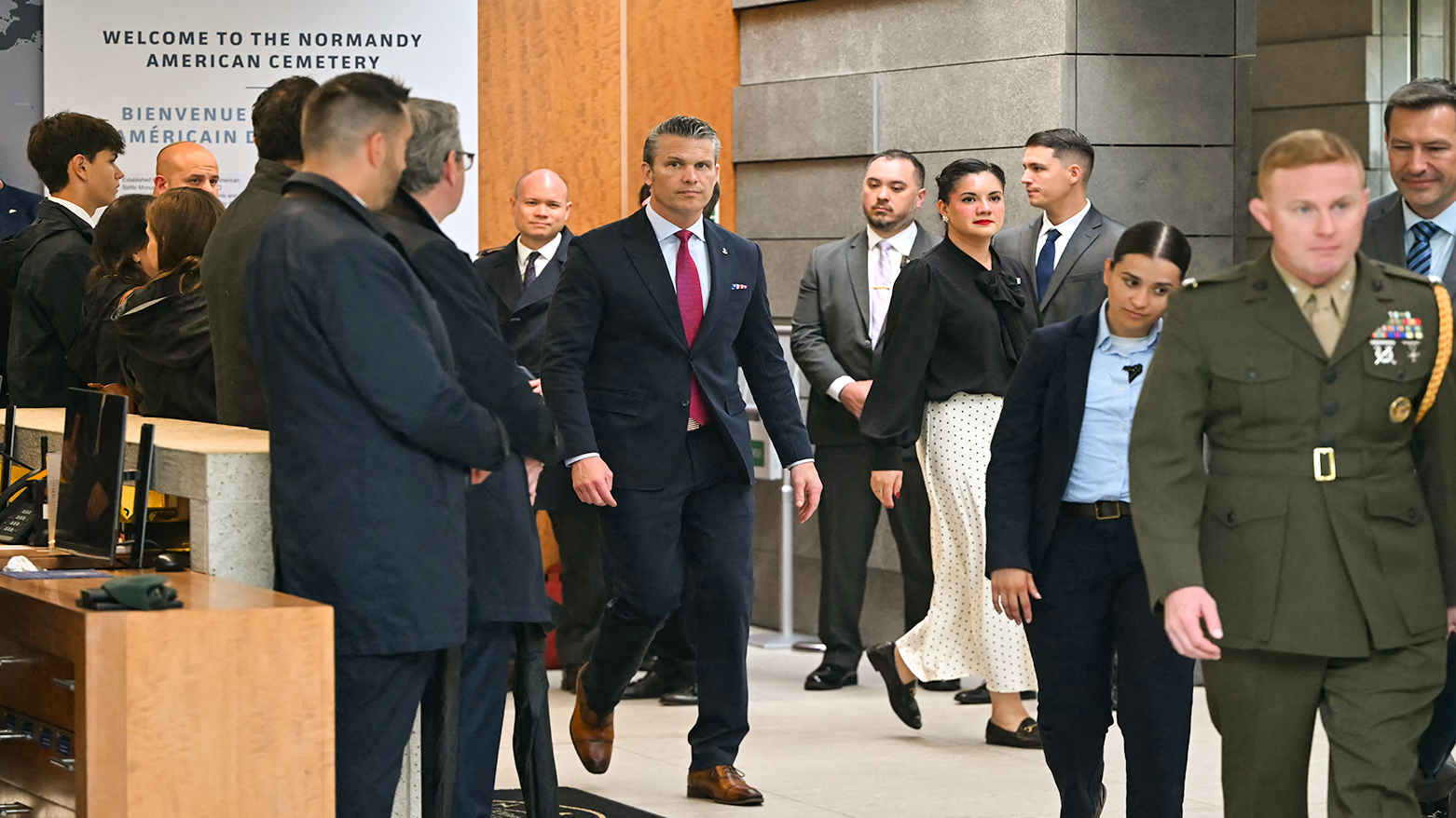
ERBIL (Kurdistan24) — U.S. War Secretary Pete Hegseth used the 82nd anniversary of the D-Day landings on Saturday to urge European nations to confront irregular migration and take greater responsibility for their own defense, drawing parallels between modern security challenges and the sacrifices made by Allied forces during World War II.
Speaking at the American military cemetery in Colleville-sur-Mer, Normandy, Hegseth said Europe faces new threats that require decisive action, arguing that migration across the continent’s southern coastline poses a challenge to European societies.
“Sadly, today different European beaches are stormed by different dangerous ideologies,” Hegseth said during the ceremony honoring American soldiers who died in the Battle of Normandy.
Referring to migrant arrivals on the shores of southern Europe, he questioned whether European governments were doing enough to address what he described as an “invasion.”
The remarks echoed the position of the administration of U.S. President Donald Trump, which has repeatedly argued that large-scale migration poses a threat to Western societies and security.
Hegseth delivered his speech before rows of 9,387 white crosses marking the graves of American service members killed during the Normandy campaign.
He used the occasion to call for stronger burden-sharing among NATO allies and warned against relying on symbolic declarations rather than tangible military commitments.
“The men buried here fought in a war-fighting alliance where every partner brought its full measure of industry, courage and sacrifice,” he said.
“Not empty slogans, not lavish summits, not communiques. Real allies doing real things, taking real losses for a shared cause worth fighting and dying for.”
The War Secretary reiterated Washington’s longstanding demand that European allies increase defense spending and military readiness.
The Trump administration has frequently criticized European nations for relying too heavily on American security guarantees and has at times raised questions about the future role of the United States within NATO.
While stressing that the United States would continue to lead, Hegseth said allied nations must be prepared to stand alongside Washington when confronted by common threats.
“Peace is secured only through strength,” he said. “And it's strength on both sides of the Atlantic, fortified by readiness, shared military capabilities and an unwavering political will.”
Hegseth’s appearance in Normandy came as he was expected to skip the main international D-Day commemoration ceremony later in the day, drawing attention amid a gathering of world leaders and officials marking one of the most significant military operations in modern history.
The D-Day landings on June 6, 1944, marked the beginning of the Allied liberation of Western Europe from Nazi occupation. Widely regarded as the largest amphibious invasion in history, the operation involved nearly 7,000 vessels and more than 132,000 troops from the United States, Britain, Canada, Belgium, Norway, and Poland.
The Normandy assault proved decisive in the defeat of Nazi Germany, opening a western front as Soviet forces advanced from the east and accelerating the end of World War II in Europe.