In a Multilingual World Cup Welcome, Toronto Transit Posters Offer the Kurdish Diaspora a Sense of Belonging
The inclusion of the word "Bexêrbên" in the city's public transportation network has resonated deeply among a community whose mother tongue has historically faced severe political restrictions.
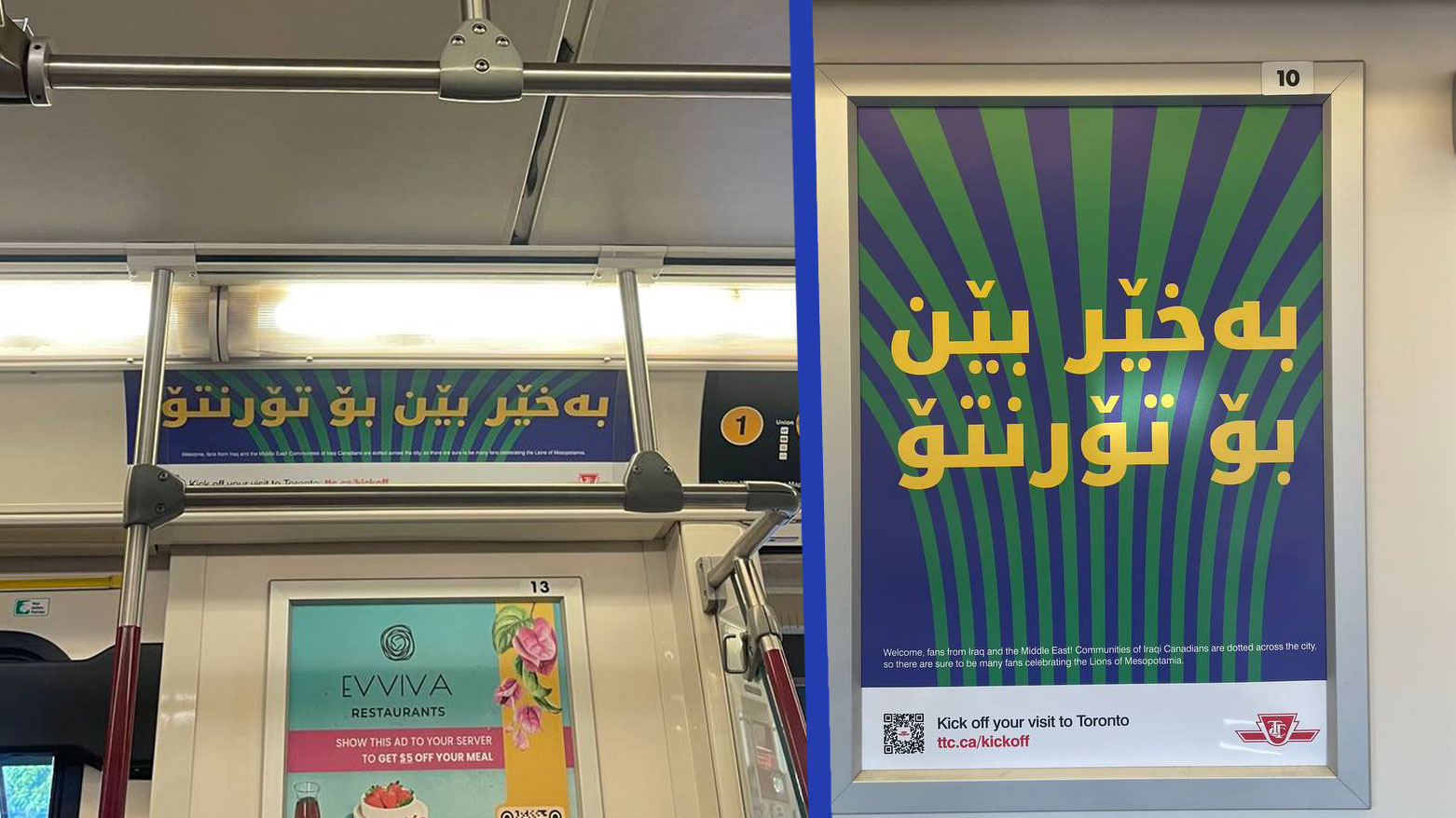
ERBIL (Kurdistan24) - As Toronto prepares to welcome an influx of international visitors for the 2026 FIFA World Cup, the city's public transportation network has launched a sprawling multilingual advertising campaign. Among the varied greetings adorning subway stations and train cars is a word that has resonated deeply with a specific segment of the city's population: "Bexêrbên", the Kurdish word for welcome.
The Toronto Transit Commission (TTC) initiative, designed to reflect the city's status as one of the most culturally diverse urban centers globally, places Kurdish alongside other major world languages in a highly visible civic space.
The inclusion of the phrase has quickly captured the attention of daily commuters and sparked an outpouring of pride across social media from members of the Kurdish diaspora in Canada and beyond.
The 2026 FIFA World Cup, jointly hosted by Canada, the United States, and Mexico, will be the first edition of the premier global sporting event to feature an expanded roster of 48 national teams.
As one of the key host cities, Toronto has invested heavily in public engagement and outreach campaigns intended to project an atmosphere of global inclusivity.
For the city’s substantial Kurdish community, however, the transit commission's multilingual posters represent far more than a routine hospitality effort.
For many Kurdish Canadians, the public display of their mother tongue carries profound emotional and historical weight.
Across digital platforms, social media users have highlighted the stark contrast between this civic embrace in North America and the historical realities of their homelands.
Throughout parts of the Middle East, the Kurdish language has frequently been subjected to severe state restrictions. In certain eras and jurisdictions, individuals faced interrogation, imprisonment, or violence merely for singing a song, publishing a book, or writing a letter in Kurdish.
Against this historical backdrop, seeing "Bexêrbên" elevated alongside other global languages on a public transit system serves as a powerful marker of civic inclusion.
It validates a cultural identity that has long struggled for recognition, transforming a standard transit advertisement into a symbol of belonging and preservation.
Major international events like the World Cup frequently serve as catalysts for host cities to leverage and celebrate their demographic diversity.
Toronto, where over half the population was born outside of Canada, utilizes multilingual campaigns not only to assist foreign tourists but to mirror the daily reality of its residents.
By consciously incorporating Kurdish into its welcoming materials, the transit commission has acknowledged a community that forms a vital, integrated part of the city's multicultural fabric.
As the tournament approaches, the visual presence of Kurdish in Canada's largest metropolis underscores the evolving nature of diaspora identity. It highlights how globalization and international sport can occasionally converge to offer minority communities a highly visible platform.
For the thousands of Kurds who navigate Toronto's transit network daily, the campaign ensures that as the world arrives for the 2026 tournament, their language will be among the first to greet them.
|
Summary As Toronto prepares to co-host the expanded 2026 FIFA World Cup, the city's transit system has unveiled multilingual welcome posters featuring the Kurdish word 'Bexêrbên.' For the Kurdish diaspora, the inclusion of their mother tongue is a profound symbol of civic belonging and recognition. |