KRG Finance Ministry Rejects Claims Over Federal Transfers, Says Region Fulfilled All Legal Obligations
Erbil-Baghdad financial dispute resurfaces amid renewed debate over budget transfers and salary payments
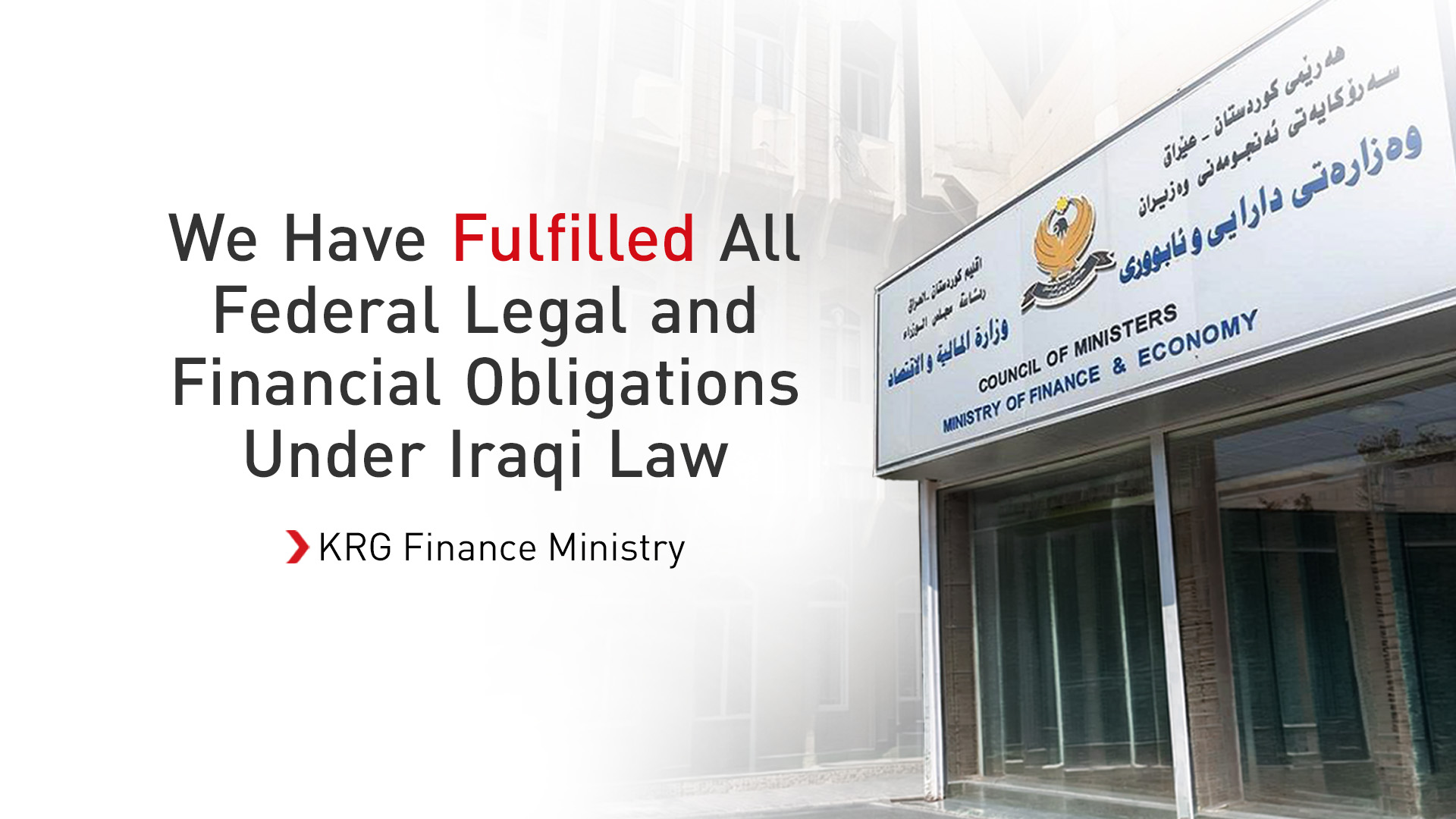
ERBIL (Kurdistan24) — The Kurdistan Regional Government's (KRG) Ministry of Finance and Economy - Directorate General of Accounting issued a detailed clarification on Tuesday in response to remarks by the First Deputy Speaker of the Iraqi Parliament, Adnan Fayhan al-Dulaimi, who called for suspending federal financial transfers to the Kurdistan Region until disputed fiscal accounts are fully settled.
In its statement, the ministry firmly rejected the claims, stressing that the Kurdistan Region has consistently fulfilled its obligations under Iraq’s Federal Financial Management Law No. (6) of 2019 and the Federal Budget Laws No. (13) for the years 2023, 2024, and 2025.
The statement emphasized that the regional government has always expressed readiness to address any outstanding observations or financial reconciliations through dialogue with federal authorities.
According to the clarification, the KRG committed in 2025 to transferring the federal treasury’s share of non-oil revenues in accordance with existing agreements with the previous federal government.
The ministry noted that, in return, salaries for public sector employees in the region were funded for ten months of the year, while allocations for November and December were not disbursed—despite federal payrolls being fully financed for other parts of Iraq during the same period.
Regarding 2026, the ministry said the region continued transferring the federal share of non-oil revenues for the months of January through May, based on agreed mechanisms.
It added that revenues in March and April declined significantly due to regional wartime conditions and unresolved implementation of the ASYCUDA customs system at border crossings in the Kurdistan Region.
The statement further argued that delays in implementing the customs modernization system were used in a way that contributed to what it described as “economic pressure” on the region, despite ongoing technical discussions reaching advanced stages.
It also noted that an agreement had been reached with the previous federal government to transfer 50 percent of non-oil revenues during periods of reduced income.
Responding to calls to suspend transfers to the Kurdistan Region, the ministry described such proposals as legally and constitutionally problematic, warning against selective financial treatment of citizens.
It argued that withholding or deducting salaries from specific segments of Iraqi citizens undermines the principle of equality and raises serious legal concerns, particularly when raised by senior parliamentary figures.
The ministry urged political actors to pursue constitutional and legal solutions to outstanding fiscal disputes, including what it described as “arbitrary spending practices” that have affected the full and timely disbursement of the region’s financial entitlements.
It reaffirmed the Kurdistan Region’s commitment to cooperation with federal authorities and called for continued dialogue to resolve disputed financial issues in accordance with Iraq’s constitutional framework.
The long-running dispute between Baghdad and Erbil over budget transfers, non-oil revenues, and salary financing has repeatedly strained relations between the two sides, often resurfacing during budget cycles and periods of fiscal adjustment.
Despite multiple agreements, disagreements over implementation mechanisms—particularly customs revenue systems and oil and non-oil accounting—continue to complicate financial coordination between the federal government and the Kurdistan Region.