Kurdistan24 exclusive: 'I'd rather stay in a camp than face prison' — ISIS wives break their silence
In a special interview with Kurdistan24, Women from Russia, France, Serbia, and Dagestan describe lives frozen in the ruins of the caliphate — not by ideology, but by the prison sentences waiting for them
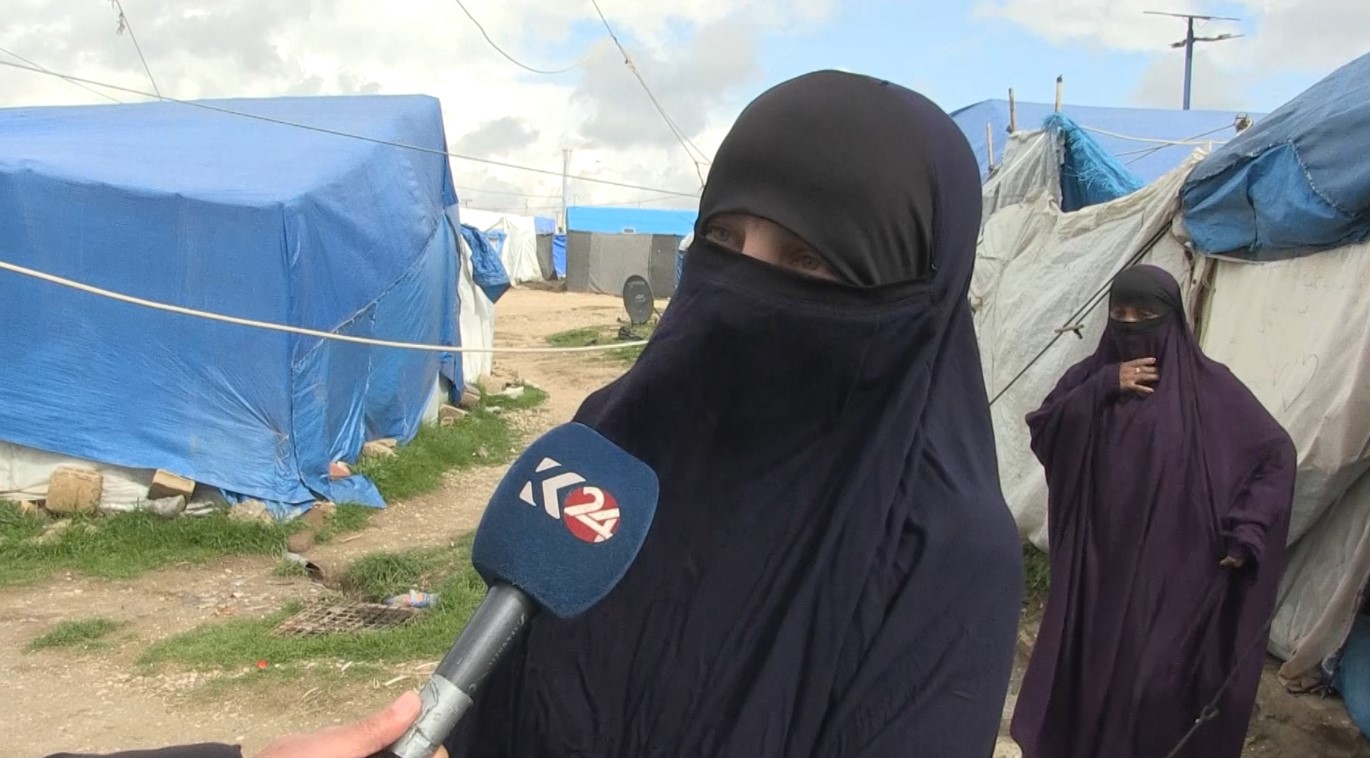
ERBIL (Kurdistan24) - The Islamic State's territorial caliphate collapsed in the dust of Baghouz in 2019. But for the women who followed husbands into its war zones, from the suburbs of Paris, the mountains of Dagestan, the cities of Russia and Serbia, the war never truly ended.
It simply changed shape, becoming a quieter, slower crisis: years in detention camps in northeastern Syria, children growing up behind fences, and the looming prospect of criminal prosecution in countries they once called home.
In a series of exclusive interviews, four women — a Russian national, a French citizen, a woman from Dagestan, and a Serbian mother of five — spoke to Kurdistan24 with unflinching candor about what keeps them stranded.
Their answers converge on a single, devastating calculation: the camps are miserable, but the prisons waiting for them may be worse.
'Russian prisons involve hard labor, hunger, and disease'
Fatima Issa arrived in Syria from Russia in 2014, traveling with her husband and children at a moment when the Islamic State was drawing recruits from across the former Soviet space with promises of a new Islamic utopia.
Her husband was killed in Al-Bukamal, one of ISIS's last strongholds on the Euphrates, leaving her alone with two children in a country that was never hers.
Russia, she says, does not want her back, and the feeling, in a sense, is mutual. "If I go back, I face 10 to 25 years in prison," Fatima said. "Russian prisons are very harsh, unlike those in France or other countries.
They involve hard labor, hunger, and disease. A person might only survive three to five years there." For Fatima, the arithmetic is bleak: the camp is survivable. A Russian penal colony may not be.
'I was 18. I followed my family. I didn't know much then.'
Salma Wahbi was a teenager when she left France at the end of 2014, 18 years old, following an uncle who had already made the journey. Her husband was killed in Baghouz in the same offensive that ended the caliphate.
She has two children and, she says, contact with her grandparents in France, who want her home but fear the consequences.
Her account complicates any simple narrative of ideological commitment. "I was 18 when I came," she said. "My uncle had already come here. I followed my family. I didn't know much then."
Life inside ISIS territory, she said, was bearable in the narrow sense that she was not personally harmed — but escape was never an option. "I couldn't leave."
What she wants, she said plainly, is to go home. What stops her is a calculation shared by nearly every woman in the camp. "I want to return to France, but I am afraid of the prison sentence and having my children taken away from me.
If France treated us like some other countries, I would go back immediately." She estimated her likely sentence at a minimum of five years. "I don't think anyone here wants to go back to France under these harsh conditions."
'I no longer believe in their ideology. It's gone.'
Raissa Kamel came from Dagestan in 2015, traveling with her husband, who is now in prison. She is among the women who speak most directly about ideological disillusionment. "Life under ISIS was difficult due to the constant bombings," she said.
"I no longer believe in their ideology. It's gone. I just want to return home to my parents and children. I regret coming here. Syria is not my country; Russia is."
Her words carry the particular weight of someone who has processed, over years of camp life, exactly what she joined and what it cost her. The desire to return is uncomplicated. The obstacle, as with Fatima, is the Russian penal system and what she describes as fear of its conditions.
'I lost my life, my parents, my friends. I am 42 years old.'
Perhaps the most wrenching account belongs to Irma Smailov, a Serbian national who arrived in 2014 at 32 years old, traveling with three children and a husband whose decision she says she was not free to refuse.
"In my culture in the Balkans, a woman must follow her husband. He made the decision, and I had to go with him." Her husband was killed in Baghouz.
Irma has now spent a decade in the camp. She is 42. Two of her children were born in Syria and have no documentation, a bureaucratic obstacle that she says has complicated even the preliminary steps of repatriation discussions with Serbian authorities.
"I spoke to a Serbian journalist once and told them I wanted to return," she said. "The process is slow."
What she describes is not an ideological standoff but an existential one. "I am not a radical. I want a second chance at a normal life and for my children to go to school."
Asked directly whether she regrets what happened, she did not hesitate. "Yes, everyone makes mistakes. I have changed. I've lived 10 years in this camp. I've seen enough." She became emotional.
"I lost my life, my parents, my friends," she said. "I have no problems with the Kurdish guards or anyone here if you don't cause trouble. I am just tired and sick. I want to go home. Please, give us a chance for a normal life."
A crisis without a resolution
The women's stories, taken together, are not a vindication of the choices that brought them to Syria. They are, rather, a portrait of the problem that remains after the territorial defeat of ISIS — one that governments in Moscow, Paris, and Belgrade have found easier to defer than to resolve.
The camps in northeastern Syria hold thousands of foreign women and children. The Democratic Autonomous Administration of North and East Syria (DAANES), which administers the camps, has repeatedly called on home countries to take their nationals back.
Most have done so only selectively, prioritizing orphaned children over adult women, and adult women with extenuating circumstances over others.
Whether the fear of prosecution constitutes a reason to delay repatriation or, paradoxically, an argument for it — and on what terms — is a question that legal systems, counter-terrorism agencies, and human rights organizations have not yet answered with any consistency.
Fatima, Salma, Raissa, and Irma are waiting for an answer. So are their children.