KRG Council of Ministers Moves to Expedite Pensions, Protect Farmers’ Rights, and Secure Budget Entitlements
According to a statement from the KRG, the meeting opened with discussions on the status of public employees who have retired but have not yet begun receiving their pension salaries.
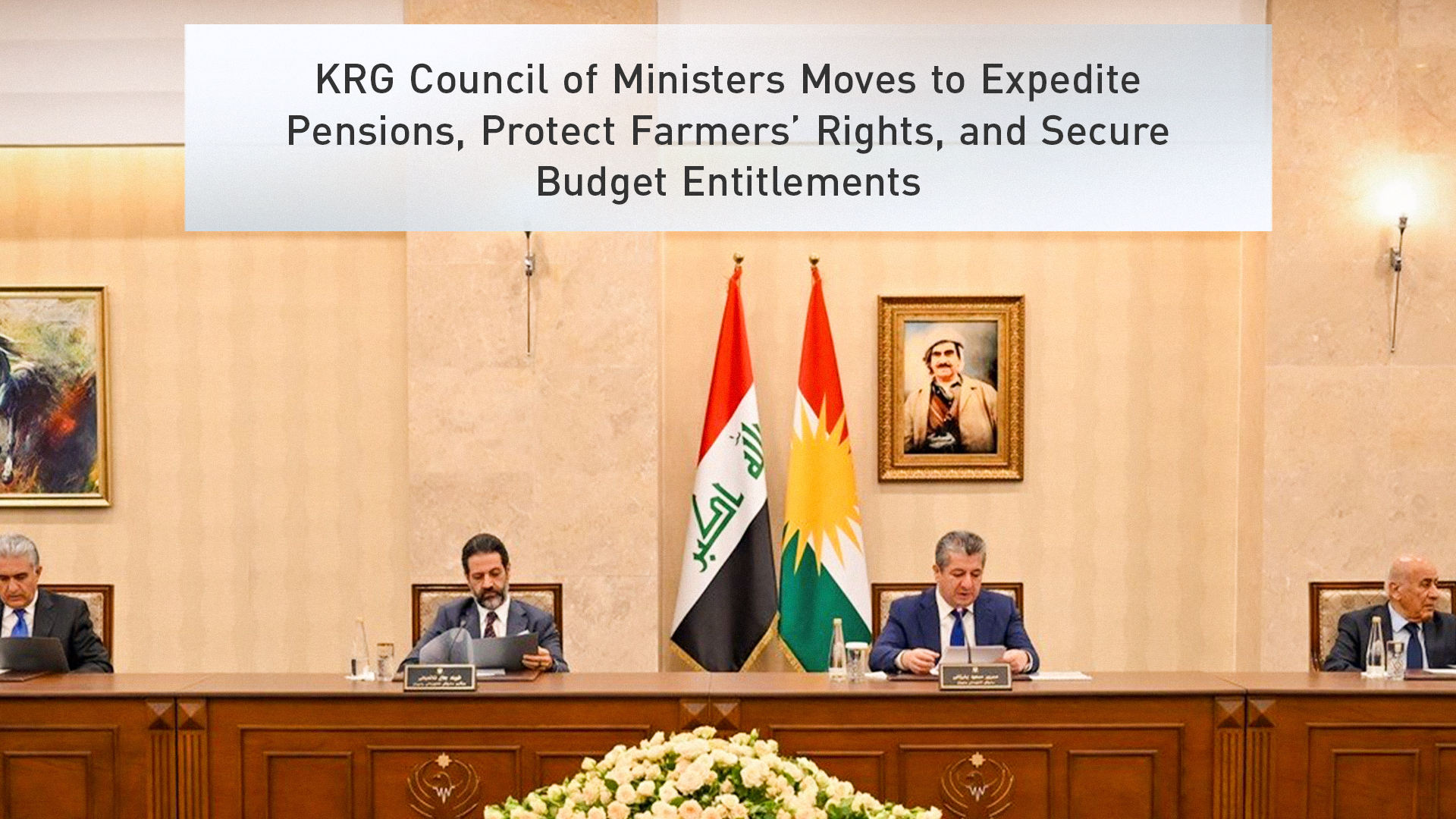
ERBIL (Kurdistan24) – The Kurdistan Region Council of Ministers, chaired by Prime Minister Masrour Barzani and attended by Deputy Prime Minister Qubad Talabani, convened on Wednesday and issued a series of decisions aimed at accelerating pension payments for newly retired employees, safeguarding farmers' interests, and ensuring the Kurdistan Region receives its rightful share of sovereign expenditures under Iraq's federal budget.
According to a statement from the Kurdistan Regional Government (KRG), the meeting opened with discussions on the status of public employees who have retired but have not yet begun receiving their pension salaries.
Prime Minister Barzani stressed the need to address the issue as quickly as possible in accordance with the law. The Council directed relevant ministries and institutions to coordinate with federal authorities and take the necessary legal and administrative measures to ensure retirees receive their pension payments from the date they become eligible.
The Council also reviewed the federal government's wheat procurement program and the purchase of wheat produced by farmers in the Kurdistan Region as part of Iraq's national grain purchasing plan.
The Minister of Agriculture and Water Resources, Begard Dlshad, presented a comprehensive report detailing production levels, procurement challenges, marketing issues, and ongoing coordination efforts between the KRG and federal authorities. Additional updates were provided by the Head of the Kurdistan Region Board of Investment and the Deputy Minister of Trade and Industry.
Following discussions, the Council decided that coordination with the federal authorities should continue to resolve obstacles affecting the procurement and marketing of agricultural products from the Kurdistan Region.
The Council further stressed that the federal government must implement its wheat procurement program fairly and equally across Iraq while taking into account the specific circumstances and needs of the Kurdistan Region.
In the second part of the session, ministers discussed the retirement eligibility of members of the Kurdistan Region's provincial councils. The Council noted that members who meet legal requirements regarding age and years of service are entitled to full retirement benefits and that these rights must be protected.
To address the matter, the Council approved the formation of a special committee comprising representatives from the Presidency of the Diwan of the Council of Ministers, the Council Secretariat, and the Ministries of Interior and Finance and Economy. The committee will establish and oversee the implementation of the necessary legal procedures governing provincial council members' retirement.
The meeting also focused on sovereign expenditures allocated to the Kurdistan Region through Iraq's federal budget, including allocations related to the food ration card system and the monthly food basket program.
While expressing support for Baghdad's efforts to reform and reorganize the food basket system, the Council reaffirmed the Kurdistan Region's legal right to receive its fair share of sovereign expenditures. These include allocations for food, medicine, wheat procurement, energy subsidies, electricity, and other essential services.
The issue of pension payments for retired public employees has remained a key point of coordination between the KRG and the federal government in Baghdad, particularly amid broader discussions over budget transfers and financial obligations.
Meanwhile, wheat procurement has become an increasingly important issue for farmers in the Kurdistan Region. The KRG has repeatedly called on Baghdad to treat Kurdish farmers equally under Iraq's national wheat purchasing program and to ensure that agricultural products from the Region are accepted and marketed without discrimination.
The KRG has also consistently maintained that the Kurdistan Region is entitled to a fair share of sovereign expenditures under Iraq's federal budget, arguing that allocations for essential services such as food security, healthcare, energy support, and wheat procurement should be distributed equitably among all Iraqi citizens, including those in the Kurdistan Region.