Remembering the Four Officers Executed for Defending the Republic of Kurdistan
Executed in 1947 for defending the short-lived Republic of Kurdistan, four Iraqi military officers remain enduring symbols of a cross-border struggle for self-determination.
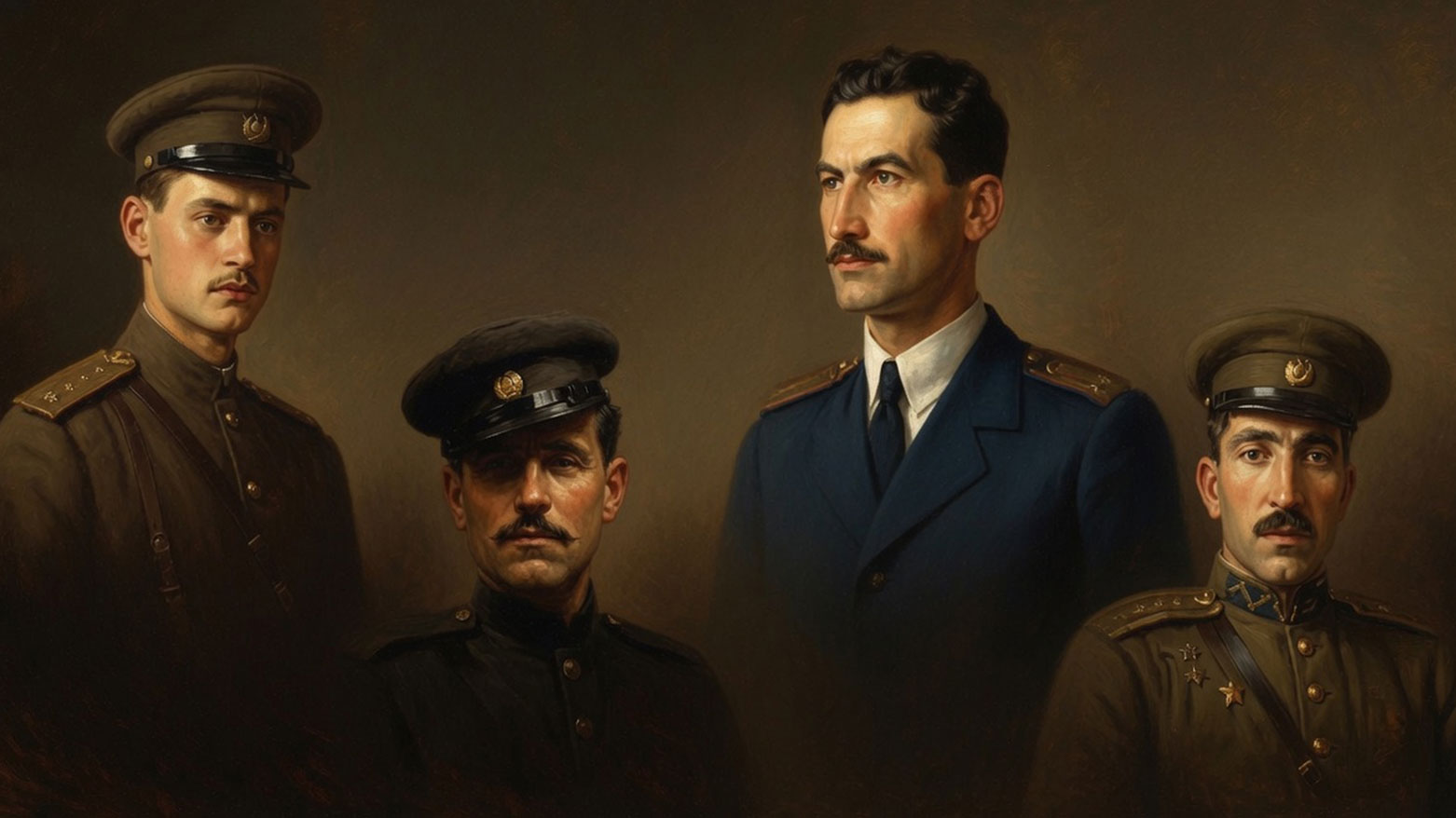
ERBIL (Kurdistan24) - In the predawn hours of June 19, 1947, four Kurdish military officers were led to the gallows in Baghdad. By direct order of Iraqi Prime Minister Salih Jabr, Izzat Abdulaziz, Mustafa Khoshnaw, Khairullah Abdulkarim, and Mohammed Qudsi were hanged.
Their crime, in the eyes of the Iraqi monarchy, was not merely military desertion. It was a radical act of transnational patriotism. A year earlier, the four men had abandoned their posts in the Iraqi army to cross into neighboring Iran and defend the Republic of Kurdistan in Mahabad, the first modern Kurdish state.
Today, exactly 79 years after their executions, the legacy of these four officers endures as a cornerstone of Kurdish political memory.
Their sacrifice continues to resonate, symbolizing a borderless struggle for self-determination that bridged Southern and Eastern Kurdistan.
The historical backdrop of their defiance was a fleeting moment of post-war geopolitical realignment.
Established in early 1946, the Republic of Kurdistan in Mahabad represented the zenith of Kurdish nationalist aspirations.
As Kurdish scholar Abbas Vali contends in "Kurds and the State in Iran: The Making of Kurdish Identity," the Republic of Kurdistan in Mahabad represented a watershed in the evolution of Kurdish nationalism.
It transformed the Kurdish struggle from a series of localized tribal revolts into a modern political project grounded in institutional governance, national consciousness, and aspirations for statehood.
Drawn by this historic undertaking, Abdulaziz, Khoshnaw, Abdulkarim, and Qudsi traveled to Mahabad to offer their military expertise.
There, they served under the command of legendary Kurdish leader Mulla Mustafa Barzani, whose forces formed the military backbone of the new republic.
However, the republic’s survival was inextricably tied to the early currents of the Cold War.
When the Soviet Union withdrew its protective umbrella from northwestern Iran under intense Western pressure, the Kurdish enclave was left fatally exposed.
As chronicled by William Eagleton Jr. in his seminal book "The Kurdish Republic of 1946," the Iranian military swiftly reclaimed the territory, collapsing the republic before the end of the year and executing its president, Qazi Muhammad.
Following the republic's demise, Mulla Mustafa Barzani and his core fighters embarked on a grueling retreat to the Soviet Union, but the four Iraqi officers chose to return home.
The Iraqi monarchy, eager to criminalize Kurdish participation in Mahabad and extinguish any domestic nationalist embers, showed no leniency. The executions of June 19, 1947, were intended to serve as a brutal deterrent against future uprisings.
Yet, the state’s attempt to brand them as traitors ultimately failed, undone by the very political tides that had doomed them. Eleven years later, the 1958 Iraqi Revolution violently swept away the Hashemite monarchy in Iraq.
The revolution fundamentally reshuffled Iraq's political order, facilitating Mulla Mustafa Barzani's triumphant return from Soviet exile. One of Mulla Mustafa Barzani's first and most pressing demands of the new republican government, led by Abdul Karim Qasim, was the exoneration of his fallen comrades.
Under Barzani's sustained pressure, the Iraqi state formally reversed its judgment.
A government communiqué officially cleared the four officers of their treason charges, elevating them instead to the status of "revolutionaries and patriots."
As noted by scholar David McDowall in "A Modern History of the Kurds," such rehabilitations were vital in consolidating Kurdish political identity and validating their struggle within the new Iraqi republic.
The formal exoneration restored their military honor and fundamentally rewrote their place in history. No longer state criminals, they were enshrined as martyrs who had crossed imperial borders to defend a shared national vision.
Seventy-nine years after the hangman's noose fell in Baghdad, the story of these four officers remains much more than a historical footnote.
Their journey from Iraqi army officers to defenders of Mahabad, and finally to national martyrs, encapsulates the enduring continuity of the Kurdish movement. It is a powerful reminder that for the Kurds, the pursuit of sovereignty has consistently transcended the borders drawn by others.
|
Summary Today marks exactly 79 years since the execution of four Kurdish officers who abandoned the Iraqi army to defend the 1946 Republic of Kurdistan in Mahabad. Hanged in Baghdad, they were later rehabilitated as national heroes in 1958, cementing their legacy as powerful symbols of transnational Kurdish unity. |