Iraqi Prime Minister Vows to Press Ahead With Anti-Corruption Drive, Thanks Political and Public Support
Ali al-Zaidi says the fight against corruption is a national mission to protect public funds, uphold the rule of law, and strengthen state institutions
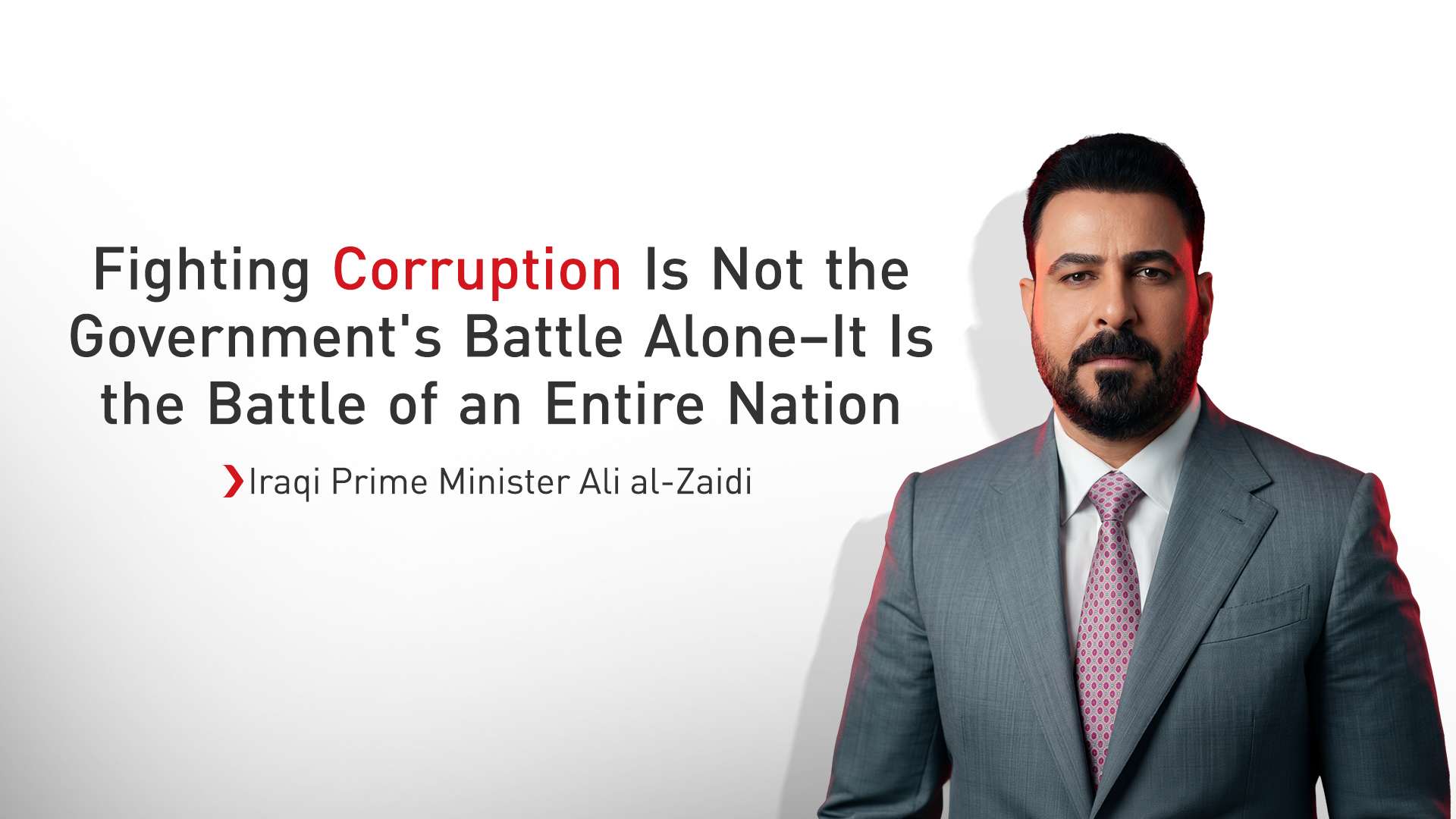
ERBIL (Kurdistan24) — Iraqi Prime Minister Ali al-Zaidi on Saturday reaffirmed his government's commitment to pursuing corruption cases, recovering state assets, and strengthening the rule of law, declaring that Baghdad would not retreat from its anti-corruption campaign despite mounting challenges or political pressure.
In a statement posted on X, al-Zaidi said his government would continue "with firmness and determination" to pursue corrupt officials, restore the state's rights, and reinforce institutions based on justice and accountability.
"Our government is moving forward, with steadfastness and resolve, in pursuing the corrupt, recovering the state's rights, and consolidating a state of institutions and justice," he said. "We will not retreat from this approach, no matter how great the challenges or the pressures."
The prime minister also expressed gratitude to the Iraqi people for what he described as their steadfast support for the government's reform agenda.
He extended his appreciation to a broad range of political, judicial, religious, and security institutions, including the Iraqi parliament, the Supreme Judicial Council, religious authorities, security and oversight agencies, tribal leaders, journalists, and national political forces that have backed the government's anti-corruption efforts.
Al-Zaidi specifically thanked Muqtada al-Sadr, the Coordination Framework, the National Political Council, the Kurdistan Democratic Party (KDP), the Patriotic Union of Kurdistan (PUK), and other political parties for supporting the government's campaign.
According to the prime minister, the broad political and public backing demonstrates that combating corruption is not solely the responsibility of the government but a shared national cause.
"This broad national unity confirms that fighting corruption is not merely the battle of a government, but the battle of an entire nation," al-Zaidi said. "It is a cause in which everyone stands together to defend public funds, the rule of law, and Iraq's future."
The statement comes as the Iraqi government continues to emphasize anti-corruption measures as a central pillar of its reform agenda. Successive Iraqi administrations have pledged to tackle entrenched corruption, recover misappropriated public assets, and improve governance, while facing persistent criticism over the pace of reforms and the influence of powerful political and economic networks.
The prime minister's remarks come amid one of Iraq's most high-profile anti-corruption campaigns in recent years. Since taking office, al-Zaidi's government has made combating corruption a central pillar of its reform agenda, pledging to dismantle long-standing patronage networks, recover stolen public assets, and strengthen the independence of state institutions.
In recent weeks, Iraqi authorities have launched a sweeping series of investigations targeting senior current and former officials, lawmakers, and politically connected figures accused of embezzlement, abuse of office, illicit enrichment, and large-scale financial crimes.
Security forces and judicial investigators have carried out coordinated raids on residences and properties linked to several high-ranking officials, seizing billions of U.S. dollars in cash, foreign currencies, gold bullion, luxury watches, and documents believed to be connected to illicit financial activities.
The unprecedented seizures, which authorities describe as among the largest in Iraq's modern history, have drawn widespread public attention and intensified pressure on the country's political establishment.
Officials say the investigations remain ongoing and have resulted in multiple arrest warrants, travel bans, and asset freezes as prosecutors work to trace public funds allegedly diverted through corruption schemes over many years.
The campaign has received backing from a broad spectrum of Iraq's political, judicial, and religious leadership, including major parliamentary blocs and Kurdish parties. The government has repeatedly maintained that the anti-corruption drive targets individuals based on evidence rather than political affiliation, arguing that recovering public funds and restoring confidence in state institutions are essential to Iraq's long-term economic stability and governance reforms.