Dutch Deputy Consul-General Backs Long-Term Bazian Valley Partnership
A Dutch-supported initiative shaped by three years of research is positioning the Bazian Valley as a model for modern, collaborative agriculture while reinforcing broader economic ties between the Netherlands and the Kurdistan Region.
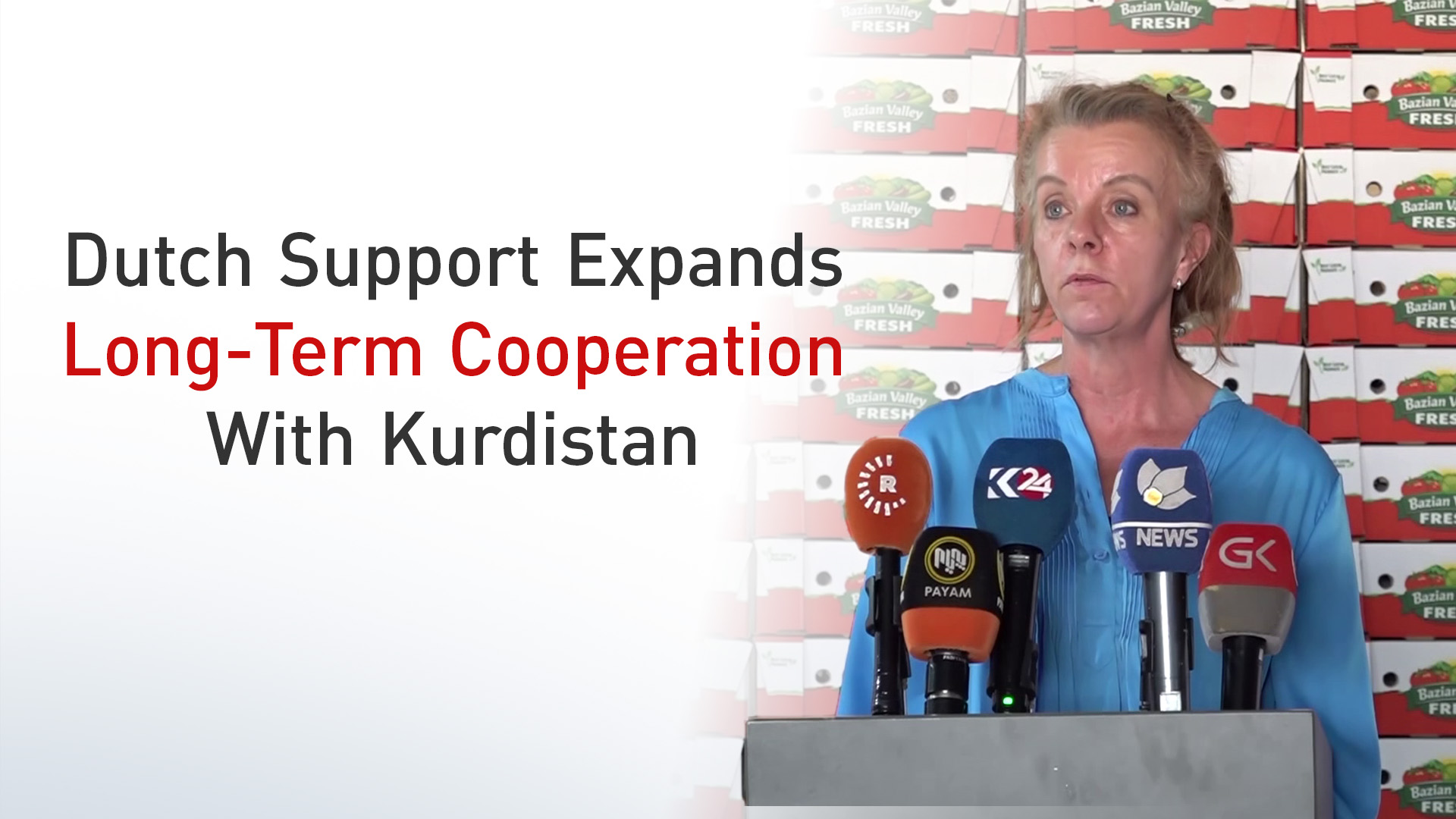
ERBIL (Kurdistan24) - A Dutch-backed agricultural initiative in the Bazian Valley has moved beyond the pilot stage to become what the Netherlands describes as the foundation of a long-term partnership with the Kurdistan Region, reflecting a broader strategy to modernize farming, strengthen food security, and support economic diversification through sustained cooperation rather than short-term development assistance.
Speaking at the project's launch on Monday, Dutch Deputy Consul-General in Erbil Bertrille Snoeijer said the Bazian Valley initiative represents "the beginning" of a longer journey, arguing that its success will depend on lasting collaboration among farmers, government institutions, researchers, universities, traders, suppliers and private businesses rather than any single investment.
"Today it's not only about celebrating the achievements of the project," Snoeijer told participants. "It's about celebrating partnerships, shared ambitions and the belief that agriculture can become a powerful driver of economic growth, food security and rural development."
"Agriculture can become a powerful driver of economic growth, food security and rural development," Snoeijer said.
Her remarks framed the initiative as part of a wider Dutch effort to help transform agriculture in the Kurdistan Region through practical, market-oriented cooperation, building on more than a decade of bilateral engagement in the sector.
According to Snoeijer, the project did not begin with construction or new technology, but with an extensive three-year assessment designed to understand the realities facing vegetable producers in Bazian.
Researchers interviewed farmers, traders, retailers, suppliers and government institutions to identify weaknesses throughout the agricultural value chain, from production and harvesting to marketing and sales.
Rather than introducing predetermined solutions, she said, the project was designed around evidence gathered from those consultations, allowing partners to tailor interventions to the region's specific challenges.
The result has been a package of initiatives intended to improve both productivity and competitiveness.
These include farmer field schools where producers exchange practical knowledge, trials of improved tomato and turmeric varieties, the introduction of internationally recognized food safety testing, improvements in grading and sorting systems, upgraded packaging, and the creation of the Bazian Valley Fresh brand to strengthen market recognition.
"The future of Bazian Valley will be built by farmers who continue learning, governments that create the right conditions, businesses willing to invest, and partners who believe that collaboration creates more value than working alone," Snoeijer said.
The project has also incorporated the University of Sulaimani, enabling students and researchers to work alongside producers, while encouraging broader participation by women across different stages of the agricultural value chain.
Snoeijer said these elements reflect what Dutch policymakers commonly describe as the "Dutch Diamond Model", an approach in which farmers, suppliers, traders, research institutions and government agencies each play complementary roles in strengthening agricultural production.

"Each partner has a different role but all work for one and the same goal, a stronger, more competitive and more sustainable sector," she said.
Rather than presenting agriculture as solely a farming issue, the model emphasizes coordination across the entire supply chain, helping producers improve quality, reduce losses after harvest, expand market access and respond more effectively to pressures such as climate change, water scarcity and growing international competition.
Snoeijer argued that those challenges are increasingly difficult for individual farmers to overcome independently, making long-term partnerships and knowledge-sharing essential to future growth.
She also stressed that the Netherlands sees the current phase as only the beginning of a longer process. An evaluation scheduled for August will review the project's results and, she said, is expected to help shape a broader framework for continued cooperation.
"In August we will evaluate the results together and we hope this will provide a foundation for a longer-term cooperation program," Snoeijer said.
"This project should not be seen as the end of a journey but the beginning," Snoeijer said, expressing hope that the experience in Bazian would provide the basis for a long-term agricultural cooperation program.
"This project should not be seen as the end of a journey but the beginning," Snoeijer said.
The initiative builds on years of expanding Dutch engagement in the Kurdistan Region's agricultural sector.
According to Kurdistan24's March 2025 report by Dler Mohammed, Dutch Consul General Adriaan IJsselstein said cooperation between Dutch institutions and Kurdish partners had helped transform potato production from a small domestic industry into a sector capable of exporting processed products to regional markets.
The report attributed that progress to improvements throughout the agricultural value chain, including seed quality, production methods, processing technologies and sustainability measures.
Read More: From Importer to Exporter: The Netherlands' Role in Kurdistan's Agri-Revolution
Speaking separately to Kurdistan24 in July 2025, IJsselstein said bilateral cooperation had increased annual potato production from roughly 2,000 tons to more than 600,000 tons over the course of a decade.
He said the partnership had generated employment, strengthened food security and created opportunities to export agricultural products to other parts of Iraq and neighboring markets, while identifying vegetables and dairy as promising areas for future collaboration.
Read More: Dutch Consul General Highlights Decade-Long Agricultural Cooperation with Kurdistan Region
The Bazian Valley initiative reflects that broader evolution. Rather than concentrating on a single crop, it seeks to strengthen the systems that underpin agricultural production, from technical training and scientific research to branding, quality standards and market organization.
Agriculture has also become one of the strongest pillars of the Netherlands' broader relationship with the Kurdistan Region.
According to Kurdistan24 reporting on a September 2025 meeting between Prime Minister Masrour Barzani and Dutch Chargé d'Affaires Christoph Prommersberger, both sides reaffirmed their commitment to expanding economic cooperation, with the Netherlands announcing plans to send a trade delegation aimed at deepening commercial ties.
During those discussions, agriculture was highlighted as one of the clearest examples of successful bilateral cooperation and an important contributor to the Kurdistan Regional Government's strategy of diversifying the economy beyond oil.
Dutch officials have consistently linked those economic ambitions to broader institutional cooperation.
In an interview with Kurdistan24 English earlier in 2025, IJsselstein described the Kurdistan Region as a strategically important partner whose political stability and investment climate make long-term economic cooperation possible. He said continued investment, strong governance and public-private partnerships are essential to attracting Dutch businesses and expanding bilateral trade.
Read More: Kurdistan Region: A Strategic Partner in a Changing Middle East
That confidence is increasingly shared by the private sector. Dutch investor Peter de Graaf, co-founder of Phil & Flo, told Kurdistan24 in September 2025 that the Kurdistan Region had exceeded his expectations as an investment destination, citing improvements in infrastructure, the business environment and the government's openness to foreign investment.
He also pointed to agriculture as one of the sectors with the greatest long-term potential, noting the region's determination to expand domestic production and reduce dependence on imported food.
Read More: Dutch Investor Praises Kurdistan Region’s Investment Climate and Rapid Development
Against that backdrop, the Bazian Valley project illustrates how Dutch-Kurdistan cooperation is moving beyond technology transfer toward building integrated agricultural systems.
By linking farmers with researchers, universities, businesses and public institutions, the initiative seeks to improve productivity while strengthening food security, encouraging more efficient use of water, supporting rural employment and creating higher-value agricultural products capable of competing in wider markets.
For the Kurdistan Regional Government, those objectives align closely with broader efforts to diversify the economy, strengthen domestic supply chains and reduce reliance on oil revenues.
For the Netherlands, the project represents another step in a partnership that has increasingly focused on long-term resilience rather than short-term assistance.
As the Bazian initiative enters its next phase, both governments appear to view its success not simply through higher crop yields, but through whether it can establish a durable model of cooperation capable of supporting a more competitive and sustainable agricultural sector for years to come.
|
Summary Dutch Deputy Consul-General Bertrille Snoeijer said the Bazian Valley project marks the start of a long-term agricultural partnership between the Netherlands and the Kurdistan Region, combining research, innovation and public-private cooperation to strengthen food security and economic diversification. |