Trump Says U.S. Ready to 'Completely Decimate' Iran Over Assassination Threat
President Donald Trump couples an unprecedented warning with new demands over the Strait of Hormuz as Washington and Tehran prepare for talks amid renewed military and diplomatic strains.
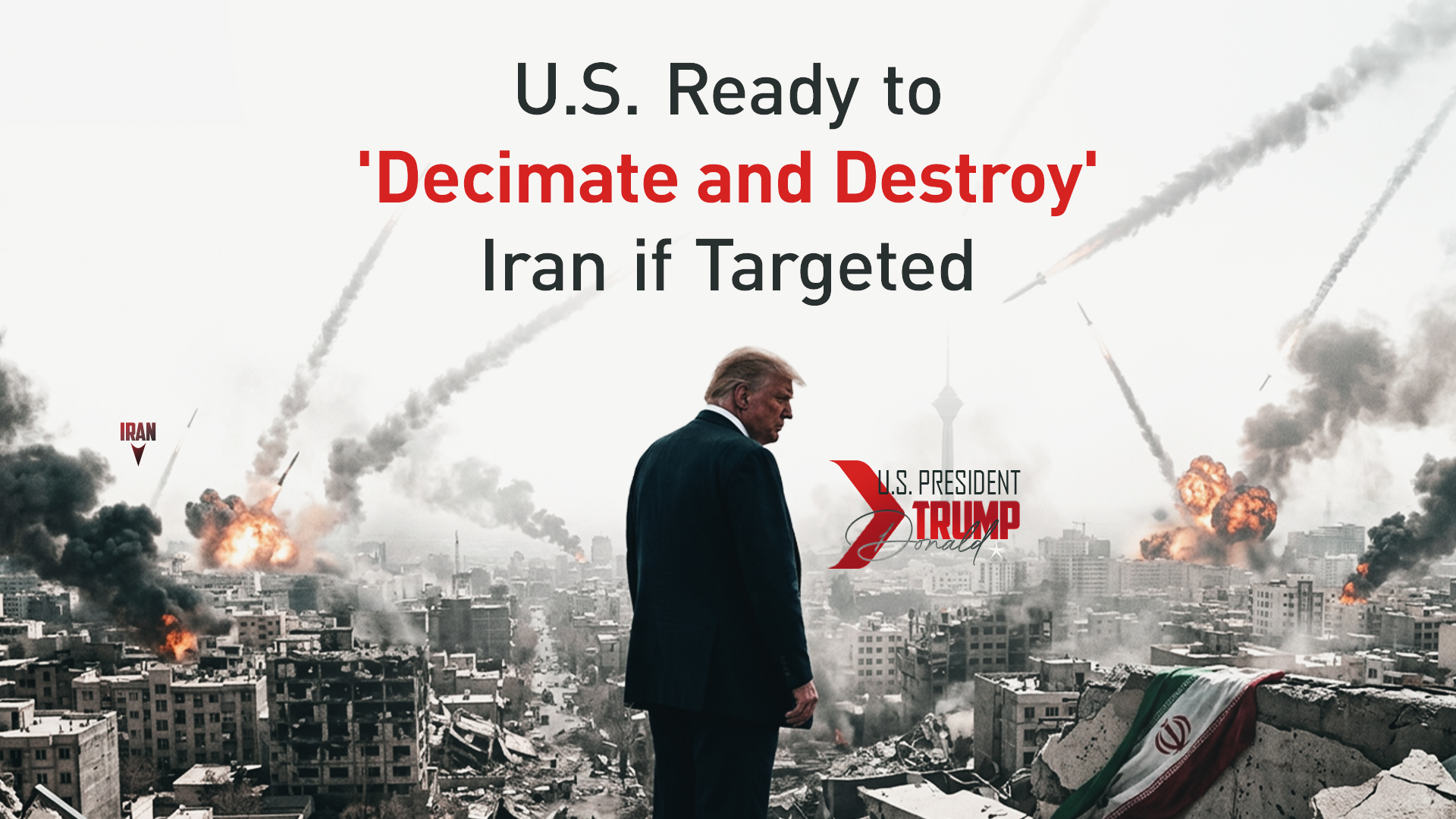
ERBIL (Kurdistan24) - President Donald Trump on Saturday warned that the United States would "completely decimate" Iran if Tehran were to assassinate or attempt to assassinate him, declaring that U.S. military orders have already been issued for an overwhelming response. The remarks, posted on his Truth Social platform, came as Washington increases military pressure in the Gulf while pursuing another round of diplomacy aimed at preventing a broader regional conflict.
Trump wrote that "1000 Missiles are Locked and Loaded" and said the U.S. military stands "ready, willing, and able" for an extended period to retaliate against any such attack.
His statement marks one of his administration's strongest public warnings toward Iran since hostilities between the two countries escalated in recent months.
The latest threat underscores how rapidly efforts to stabilize relations have unraveled.
According to Agence France-Presse (AFP), Washington and Tehran are now openly accusing one another of failing to uphold commitments outlined in their memorandum of understanding.
Trump has maintained that the ceasefire framework is effectively finished, even as his administration remains willing to continue negotiations, while Iran insists it has complied with its obligations.
The competing narratives illustrate the widening gap between the two governments following renewed military exchanges and diplomatic friction.
Trump's warning followed another Truth Social post on Friday in which he declared that the ceasefire was "OVER!" while confirming that U.S. negotiators would continue pursuing discussions with Iran.
His administration has argued that renewed attacks on commercial shipping fundamentally altered the diplomatic landscape and required a stronger response.
A central U.S. demand ahead of planned talks in Oman is that Iran publicly declare the Strait of Hormuz open to commercial navigation and commit to ending attacks on merchant vessels.
Senior American officials have said that restoring confidence in maritime security has become a prerequisite for broader negotiations, according to reporting by Emily Goodin of the New York Post and by Michelle L. Price, Jon Gambrell, and Will Weissert of The Associated Press.
Officials quoted by both outlets said Washington expects Tehran to issue a public statement affirming that vessels can safely transit the strategic waterway without facing attack.
They warned that failure to provide such assurances could trigger further American action, although they did not publicly specify what measures might follow.
The Strait of Hormuz has emerged as the most immediate point of contention after attacks on commercial shipping reignited military confrontation between the two countries.
The passage remains one of the world's most strategically important energy corridors, carrying a significant share of globally traded oil and natural gas.
The Trump administration has linked freedom of navigation directly to ongoing diplomatic efforts, arguing that negotiations over Iran's nuclear program cannot progress if maritime security remains uncertain.
U.S. officials have indicated that any broader agreement would require Iran to halt attacks on commercial shipping before discussions over longer-term issues can advance, according to the Associated Press.
Military deployments have reinforced that message.
American officials say more than 20 U.S. Navy warships are operating across the Middle East as Washington seeks to protect commercial shipping and reassure regional partners.
Reporting by the New York Post said aircraft carriers, including the USS Abraham Lincoln and USS George H.W. Bush, have moved toward the Gulf of Oman as part of the broader pressure campaign, although U.S. Central Command has declined to discuss operational details.
Washington has also intensified economic pressure by revoking a temporary sanctions waiver covering Iranian oil exports.
AFP reported that the move reversed a license announced in June that had permitted Iran to continue producing and selling crude under limited conditions while negotiations continued.
Iran, meanwhile, rejects U.S. accusations that it violated the ceasefire framework.
Foreign Minister Abbas Araghchi said Saturday that Tehran "has so far kept its word," arguing that it is the United States that has departed from provisions of the memorandum by imposing new sanctions and increasing its regional military presence, according to AFP.
He maintained that lasting progress depends on reciprocal compliance rather than unilateral demands.
Diplomatic efforts nevertheless continue.
Iranian officials are expected to meet Omani counterparts on Saturday to discuss developments surrounding the Strait of Hormuz, while regional mediators, including Qatar and Pakistan, remain engaged in efforts to prevent another cycle of escalation, AFP reported.
Washington has likewise signaled that negotiations remain possible, although administration officials have emphasized that President Trump is prepared to pursue alternative options should diplomacy fail.
The administration has also reiterated that any eventual nuclear agreement would require Iran to relinquish its stockpile of highly enriched uranium, according to Associated Press reporting.
U.S. officials say progress on that issue will depend first on restoring confidence that commercial shipping can safely navigate the Gulf without renewed attacks.
Trump's latest warning therefore extends beyond personal security, reflecting an administration that is increasingly tying military deterrence, maritime security, sanctions policy, and nuclear diplomacy into a single negotiating framework.
Whether planned discussions in Oman can narrow those differences may determine whether the current confrontation moves back toward diplomacy or enters another period of heightened military tension.
|
Summary President Donald Trump warned the U.S. would "completely decimate" Iran if Tehran attempts to assassinate him, as Washington presses for guarantees on Strait of Hormuz shipping, expands military pressure, and prepares for new Oman talks amid deepening nuclear tensions. |