KDP's Hawrami Calls for Constitutional Action to End Kurdistan Parliament Deadlock
KDP Politburo member says reactivating Parliament is the constitutional prerequisite for forming the Kurdistan Region's Tenth Cabinet and restoring institutional governance.
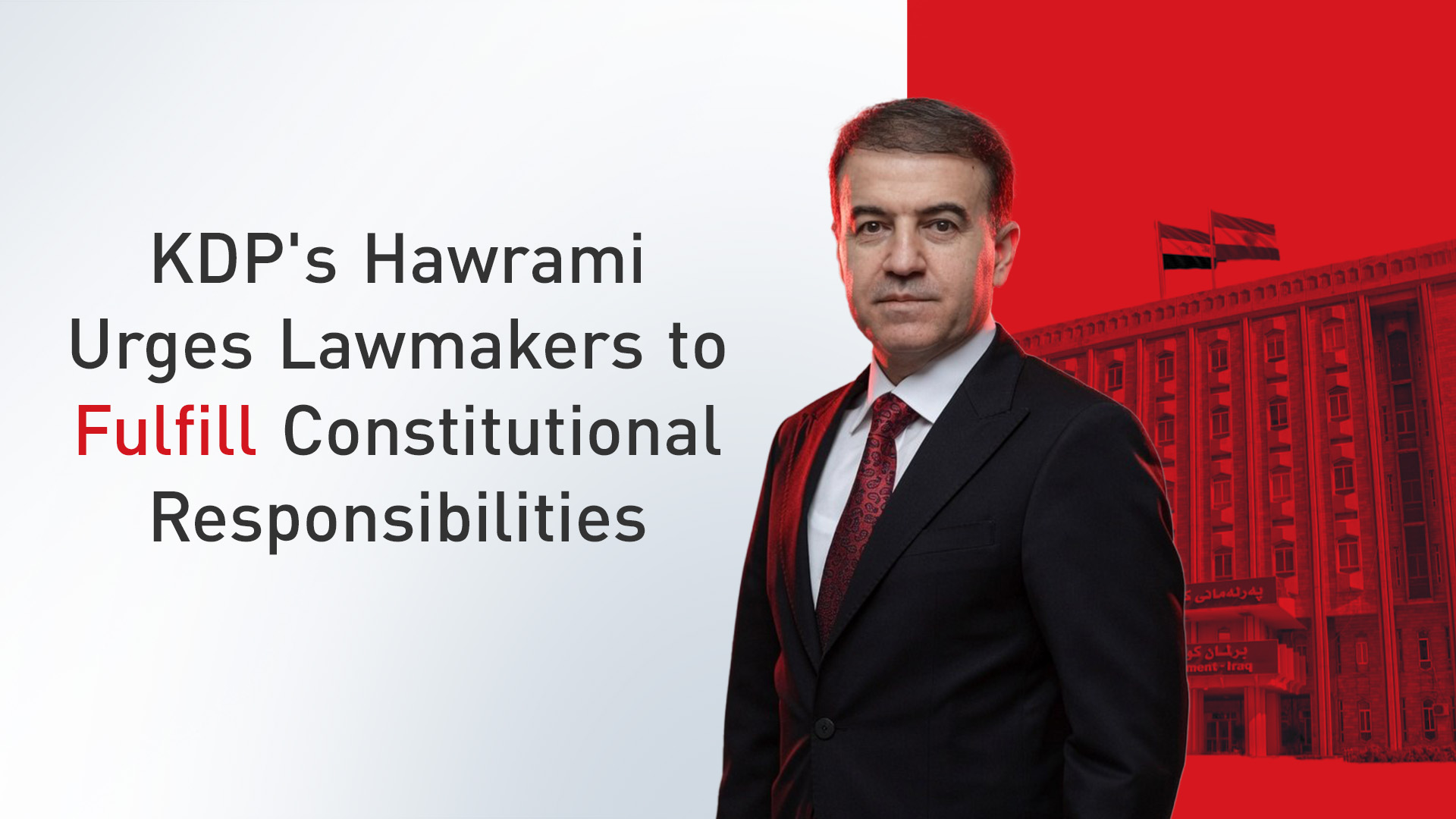
ERBIL (Kurdistan24) - Nearly twenty months after voters elected a new Kurdistan Parliament, Dr. Hemn Hawrami says the central political question confronting the Kurdistan Region is no longer how parties negotiate among themselves, but whether they are prepared to fulfill the constitutional obligations entrusted to them by the electorate.
Following a meeting on Tuesday with Dutch Ambassador to Iraq Janet Alberda and Dutch Deputy Consul-General in Erbil Bertrille Snoeijer, the Kurdistan Democratic Party (KDP) Politburo member delivered what amounted to a renewed appeal for institutional normalcy, arguing that the continued suspension of Parliament has become increasingly difficult to defend after months of negotiations, political understandings, and repeated discussions among the Region's principal political forces.

His message centered on a single proposition: the elected legislature must return to work before any meaningful progress can be made toward forming the Kurdistan Region's Tenth Cabinet.
Hawrami said the KDP stands ready for Parliament to resume its sessions immediately and called on every parliamentary bloc to return to the chamber, describing attendance not as a political concession but as a legal, constitutional, and national responsibility.
In his view, the legislative institution represents the constitutional gateway through which the next phase of government formation must proceed.
That argument reflects a broader position the KDP has consistently advanced throughout the prolonged post-election negotiations.
While political parties remain divided over power-sharing arrangements and other outstanding issues, KDP officials maintain that those disagreements cannot supersede the constitutional process governing the legislature and executive formation.
During his meeting with the Dutch delegation, Hawrami also stressed that extensive dialogue has already taken place since the parliamentary elections.
After numerous meetings involving the Patriotic Union of Kurdistan (PUK) and other political actors, as well as agreements built on principles of partnership and consensus, he argued that continued institutional paralysis no longer carries a convincing political rationale.
Rather than portraying Parliament's return as a partisan objective, Hawrami framed it as a necessary step toward restoring the Region's constitutional institutions and rebuilding public confidence in representative governance.
The emphasis on constitutional procedure echoes remarks made days earlier by Kamal Kerkuki, the KDP's Head of Public Relations, who argued that lawmakers who have taken the parliamentary oath are obligated to carry out their legislative responsibilities.
Kerkuki likewise maintained that Parliament must be reactivated before the constitutional process of selecting a new government can legally begin.
Read More: KDP Official Says Parliament Boycott Delays Constitutional Path to New Kurdistan Government
Under the Kurdistan Region's institutional framework, Parliament's first session, the election of its leadership, and subsequent constitutional procedures precede the nomination of the largest parliamentary bloc to form a cabinet.
From the KDP's perspective, reversing that sequence would undermine the constitutional order governing the Region's political institutions.
The disagreement over that process lies at the heart of one of the Kurdistan Region's longest periods of political uncertainty in recent years.
Although parliamentary elections concluded nearly two years ago, negotiations between the KDP and the PUK have yet to produce agreement on establishing the next regional government.
The legislative stalemate has consequently delayed not only cabinet formation but also Parliament's broader role in legislative oversight and institutional governance.
The impasse has also become intertwined with wider political debates over coalition-building and parliamentary arithmetic.
Recent cooperation between the PUK and the New Generation Movement has altered the dynamics of post-election negotiations and intensified discussion about how political alliances should influence government formation.
Kurdistan24 previously reported on a document published by former New Generation official Sebur Mantk that he alleged outlined a confidential agreement between New Generation leader Shaswar Abdulwahid and PUK President Bafel Talabani.
The authenticity of the document and the allegations it contains remain disputed, but its publication has added another layer to an already complex political landscape.
Read More: Leaked Document Purports to Detail Secret PUK–New Generation Pact
The emergence of closer coordination between the two parties has prompted renewed debate over whether post-election alliances can reshape political influence independently of electoral outcomes.
Hawrami has repeatedly rejected that interpretation.
Earlier this month, responding to suggestions that new political alignments had fundamentally altered the balance of power, he argued that democratic legitimacy derives from voters rather than political arrangements negotiated after elections.
He questioned why parties that believe they command sufficient parliamentary strength would hesitate to reconvene Parliament and test those claims through constitutional procedures.
That position reinforces the KDP's broader argument that electoral mandates remain the foundation upon which any governing coalition must ultimately be constructed.
The parliamentary deadlock has been accompanied by competing political narratives surrounding responsibility for the legislature's continued inactivity.
Kurdistan24 previously reported, citing sources, allegations that the PUK had sought to discourage lawmakers from attending prospective parliamentary sessions and that some members of other parties had faced pressure not to participate.
Those allegations have been reported as source-based claims and have not been established as confirmed facts. The PUK has continued to argue that broader political agreements should precede Parliament's return, while the KDP insists that legislative reactivation itself provides the constitutional forum in which outstanding disputes should be addressed.
Read More: Sources: PUK Pressures Lawmakers to Boycott Parliament Sessions
For Hawrami, that distinction carries broader institutional significance.
His latest remarks suggest that the longer Parliament remains inactive, the greater the risk that public confidence in constitutional governance will continue to erode. The issue, in his assessment, is no longer confined to negotiations between political parties but concerns the functioning of the Region's democratic institutions themselves.
His discussions with the Dutch diplomatic delegation also reflected that wider perspective.
While outlining the KDP's reading of the current political landscape, Hawrami expressed appreciation for Ambassador Alberda's longstanding engagement with the Kurdistan Region and welcomed the Netherlands' continued support for strengthening bilateral relations.
He noted her previous service in Erbil and praised the Dutch diplomatic mission's contribution to cooperation between the Kurdistan Region and the Netherlands.
Those diplomatic discussions, however, remained secondary to the central political message emerging from the meeting.
At a time when coalition negotiations continue without a breakthrough, Hawrami's argument places constitutional responsibility at the center of the debate.
Rather than calling for new political formulas or fresh rounds of negotiations, he contends that the next step has already been defined by law: Parliament must return to session, lawmakers must discharge the responsibilities entrusted to them by voters, and the constitutional process of government formation must be allowed to proceed.
Whether that appeal succeeds depends not only on the willingness of individual parties to return to the legislative chamber, but also on whether competing political calculations can ultimately give way to the institutional imperatives that Hawrami argues have been waiting nearly twenty months to resume their proper place in the Kurdistan Region's democratic system.
|
Summary Dr. Hemn Hawrami says the prolonged suspension of the Kurdistan Parliament no longer has political justification, urging all elected parties to fulfill their constitutional responsibilities so the legislative process can resume and the formation of the Kurdistan Region's Tenth Cabinet can proceed. |