U.S. Strikes Hit Bushehr and Southwestern Iran as India Protests Ship Attacks, Britain Moves Against IRGC Support
Washington expands military campaign while diplomatic tensions deepen over attacks in the Strait of Hormuz and new UK security legislation
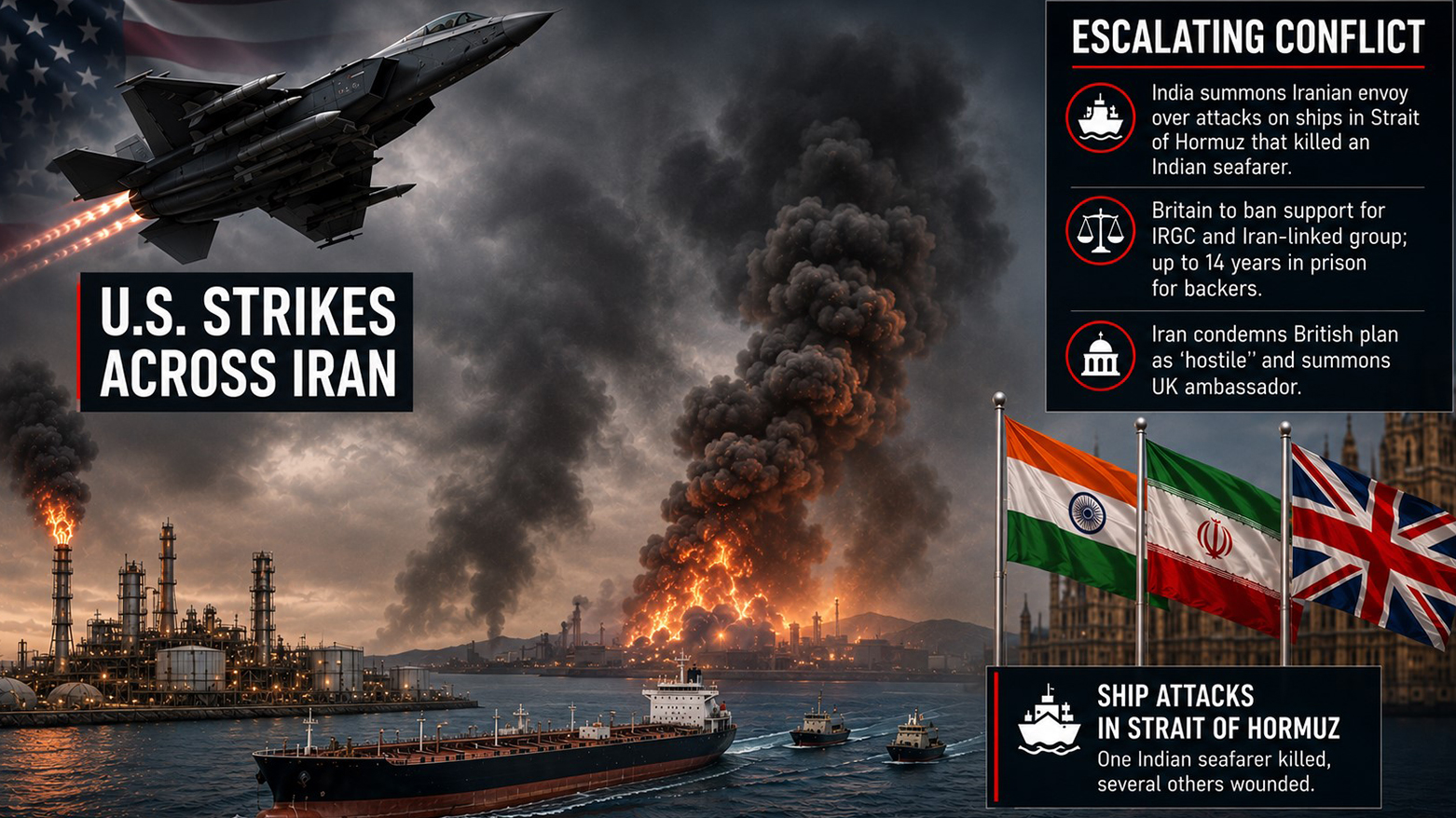
ERBIL (Kurdistan24) — The United States expanded its military campaign against Iran on Tuesday, striking the southern port city of Bushehr and targets in southwestern Khuzestan province, as India lodged a formal protest over deadly attacks on commercial vessels in the Strait of Hormuz and Britain unveiled legislation targeting support for Iran's Islamic Revolutionary Guard Corps (IRGC).
Iranian officials said U.S. strikes hit four locations in Bushehr, home to Iran's only civilian nuclear power plant, although there were no immediate reports of damage to the nuclear facility itself.
"Four points in the city of Bushehr were hit by enemy projectiles at noon," Bushehr Deputy Governor Ehsan Jahanian said, according to Iran's official IRNA news agency, blaming the attacks on the United States.
The strikes came as Washington continued its third consecutive day of military operations aimed at degrading Iran's military capabilities following renewed hostilities between the two countries.
Oil and port facilities targeted
Iranian authorities also reported U.S. strikes in Khuzestan province near the Iraqi and Kuwaiti borders.
According to Deputy Governor Valiollah Hayati, the attacks targeted the city of Abadan, home to the Middle East's oldest oil refinery, as well as the nearby port city of Mahshahr.
The strikes underscore the widening geographic scope of the U.S. campaign, which has increasingly focused on Iran's strategic coastal and energy infrastructure.
India protests deadly ship attacks
Meanwhile, India summoned Iran's senior diplomat in New Delhi to deliver what it described as a "strong protest" following Iranian missile attacks on two commercial vessels in the Strait of Hormuz.
The attacks killed one Indian seafarer and wounded several other crew members aboard the ships, further escalating international concern over security in one of the world's busiest maritime trade routes.
The diplomatic protest reflects growing international pressure on Tehran following repeated attacks on commercial shipping in the Gulf.
Britain targets support for IRGC
Separately, Britain announced plans to criminalize support for the Islamic Revolutionary Guard Corps and several other foreign state-linked organizations accused of threatening British national security.
Prime Minister Keir Starmer said anyone found supporting or assisting the designated groups could face up to 14 years in prison under legislation scheduled to be introduced in Parliament this week.
The proposed law would also apply to proxies and volunteers linked to Russia's GRU military intelligence agency, as well as the Islamic Movement of Companions of the Right, an Iran-linked organization that has claimed responsibility for attacks on Jewish properties in London.
According to the UK Home Office, the legislation would provide the government with expanded powers to designate foreign state proxies involved in espionage, foreign interference, sabotage, and physical attacks against Britain.
"The move will step up the government's ability to counter state threats linked to foreign powers," the Home Office said in a statement.
The proposal follows a series of anti-Semitic attacks in London earlier this year, including arson attacks targeting synagogues, community ambulances, and other Jewish sites.
It also comes shortly after a London court sentenced two Romanian nationals for the 2024 stabbing of Pouria Zeraati, a presenter for the Persian-language broadcaster Iran International, in an attack prosecutors said was carried out on behalf of Iran.
Tehran condemns British measures
Iran strongly condemned Britain's proposed legislation, describing it as a politically motivated measure that violates international law.
The Iranian Foreign Ministry said it "condemns the hostile act of the British government... as unjustified, irresponsible and contrary to the fundamental principles and rules of international law."
Tehran also summoned the British ambassador to protest what it called London's "baseless accusations."
The latest military strikes and diplomatic confrontations come as tensions between Washington and Tehran continue to intensify, raising concerns over regional stability, maritime security, and the potential for further disruption to global energy markets.