Iran Says It Strikes U.S. Bases Across Gulf as Washington Expands Military Campaign
Tehran claims attacks on U.S. facilities in Kuwait, Bahrain, and Jordan after Washington launches fresh strikes targeting Iran's military infrastructure
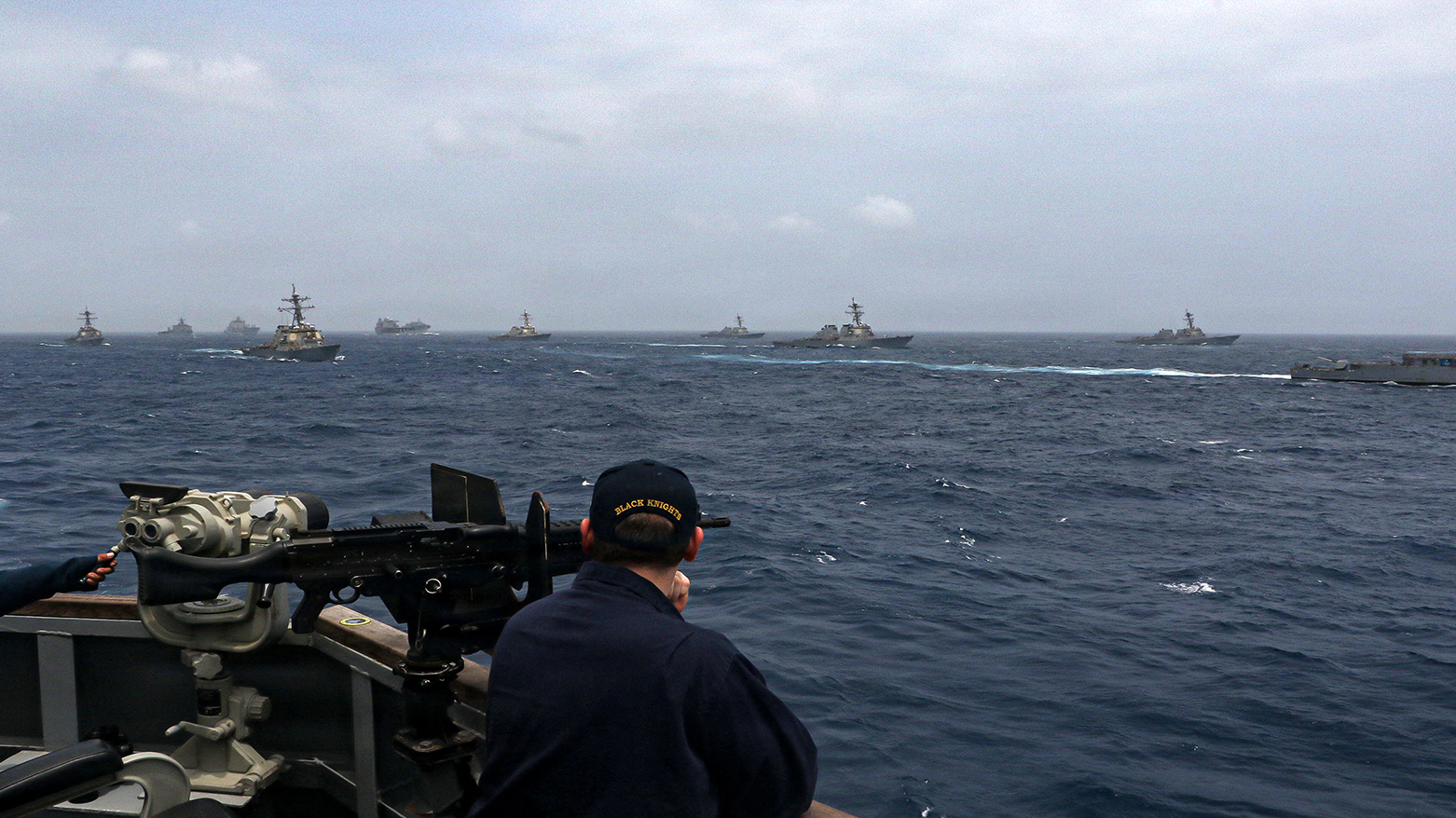
ERBIL (Kurdistan24) — Iran announced Thursday that it had launched drone attacks against U.S. military facilities in Kuwait, Bahrain, and Jordan, marking another sharp escalation in the conflict after the United States carried out a new wave of strikes targeting Iranian military assets linked to threats against shipping in the Strait of Hormuz.
According to Iranian state media, the Iranian Army said it struck radar systems, a Patriot air defense battery, fuel storage facilities at Ali Al Salem Air Base in Kuwait, and U.S. military installations at Sheikh Isa Air Base in Bahrain.
Tehran also said it targeted U.S. military communication systems and fuel storage facilities in Jordan using what it described as "suicide (kamikaze) drones," calling the attacks retaliation for continued American military operations against Iran.
The claims came as air defenses were activated across parts of Tehran on Thursday morning. Iranian state media reported explosions in northern and western districts of the capital, while additional blasts were heard in Lorestan province in western Iran and Semnan in the country's north. Iranian authorities said no casualties had been reported in Tehran.
The latest developments followed a new wave of U.S. strikes launched Wednesday evening, which Washington said were aimed at degrading Iran's military capabilities used to threaten commercial shipping through the Strait of Hormuz.
U.S. Central Command (CENTCOM) said the operation began at 1900 GMT and focused on military infrastructure connected to attacks against vessels navigating one of the world's most strategically important waterways.
The U.S. military also announced that one of its aircraft disabled an empty Curacao-flagged oil tanker, the M/T Belma, after firing Hellfire missiles into its smokestack. CENTCOM said the vessel had been attempting to breach the U.S. naval blockade of Iranian ports and was no longer sailing toward Iran.
Iranian media reported explosions in several cities, including Bandar Abbas, Rask, Chabahar, Qeshm, Bandar Imam Khomeini, and Bushehr, home to Iran's only civilian nuclear power plant, as U.S. strikes continued across multiple regions.
The renewed hostilities come less than a month after Washington and Tehran signed a memorandum of understanding intended to reduce regional tensions and halt the months-long conflict. However, fighting has intensified again despite ongoing diplomatic contacts.
Iran's Revolutionary Guards separately claimed responsibility for targeting the U.S. Fifth Fleet headquarters in Bahrain. Bahraini authorities activated air raid sirens as air defense systems intercepted incoming attacks.
Jordan's armed forces said they intercepted and destroyed three Iranian missiles launched toward the kingdom.
In Iraq's Kurdistan Region, Kurdish security forces said the U.S.-led international coalition intercepted and destroyed eight explosive-laden drones over Erbil. Residents reported hearing multiple explosions and seeing smoke near the U.S. Consulate, though officials said no casualties were recorded.
The Iraqi Prime Minister Ali Faleh al-Zaidi on Thursday strongly condemned the drone attack that targeted the airspace over Erbil, reaffirming that it will not tolerate any attempts to undermine security and stability in the Kurdistan Region.
U.S. President Donald Trump warned that Washington was prepared to intensify its military campaign if Tehran refused to resume negotiations.
"Next week it gets really bad for them," Trump said in an interview with Fox News, warning that U.S. forces could expand attacks to include Iranian power plants and bridges unless Iran returned to the negotiating table.
Despite the renewed fighting, diplomatic channels remain formally open.
Iranian Parliament Speaker Mohammad Bagher Ghalibaf, who has played a leading role in negotiations, questioned the future of last month's memorandum of understanding.
"A memorandum of understanding only has meaning when its clauses are valid and being implemented," Ghalibaf said.
"If Iran is not to derive any benefit from the memorandum of understanding, we have no reason to adhere."
Strait of Hormuz remains at center of crisis
The Strait of Hormuz continues to serve as the central flashpoint in the confrontation.
Iran has maintained varying levels of restrictions on maritime traffic since the war erupted following U.S.-Israeli strikes on Feb. 28. Although shipping briefly resumed after last month's agreement, Tehran recently declared the strategic waterway would remain closed until what it described as U.S. aggression ends.
Shipping activity has fallen sharply, with maritime tracking firm Kpler reporting only 21 vessel transits on Tuesday, while global oil prices rose amid growing concerns over disruptions to one of the world's most critical energy corridors.
The United States has also reinstated its maritime blockade of Iranian ports, a move reinforced by Wednesday's interception of the M/T Belma.
Iranian Deputy Foreign Minister Kazem Gharibabadi said the renewed U.S. blockade had effectively undermined last month's memorandum reached in Islamabad.
Civilian fears grow across the region
The escalating conflict has heightened anxiety among civilians across Iran and neighboring Gulf states.
Khadijeh, a 31-year-old artisan from Qasr-e Shirin, said children in her community had become increasingly traumatized by the constant explosions.
"The little children are so frightened by the sound of explosions that they don't sleep until morning," she said.
"If, God forbid, the war becomes more intense, then perhaps it will take several generations before we can get back on our feet."
In Kuwait, residents also expressed growing concern after repeated Iranian attacks targeted the country.
"Every day, I wake up wondering whether the situation will de-escalate or worsen," said Mustafa Mohamed, a Sudanese accountant living in Kuwait.