White House Prepares for Trump Election Address Amid Iran Conflict
As President Trump prepares a primetime address on voting security, the administration defends near-daily military operations targeting Tehran while keeping diplomatic channels nominally open.
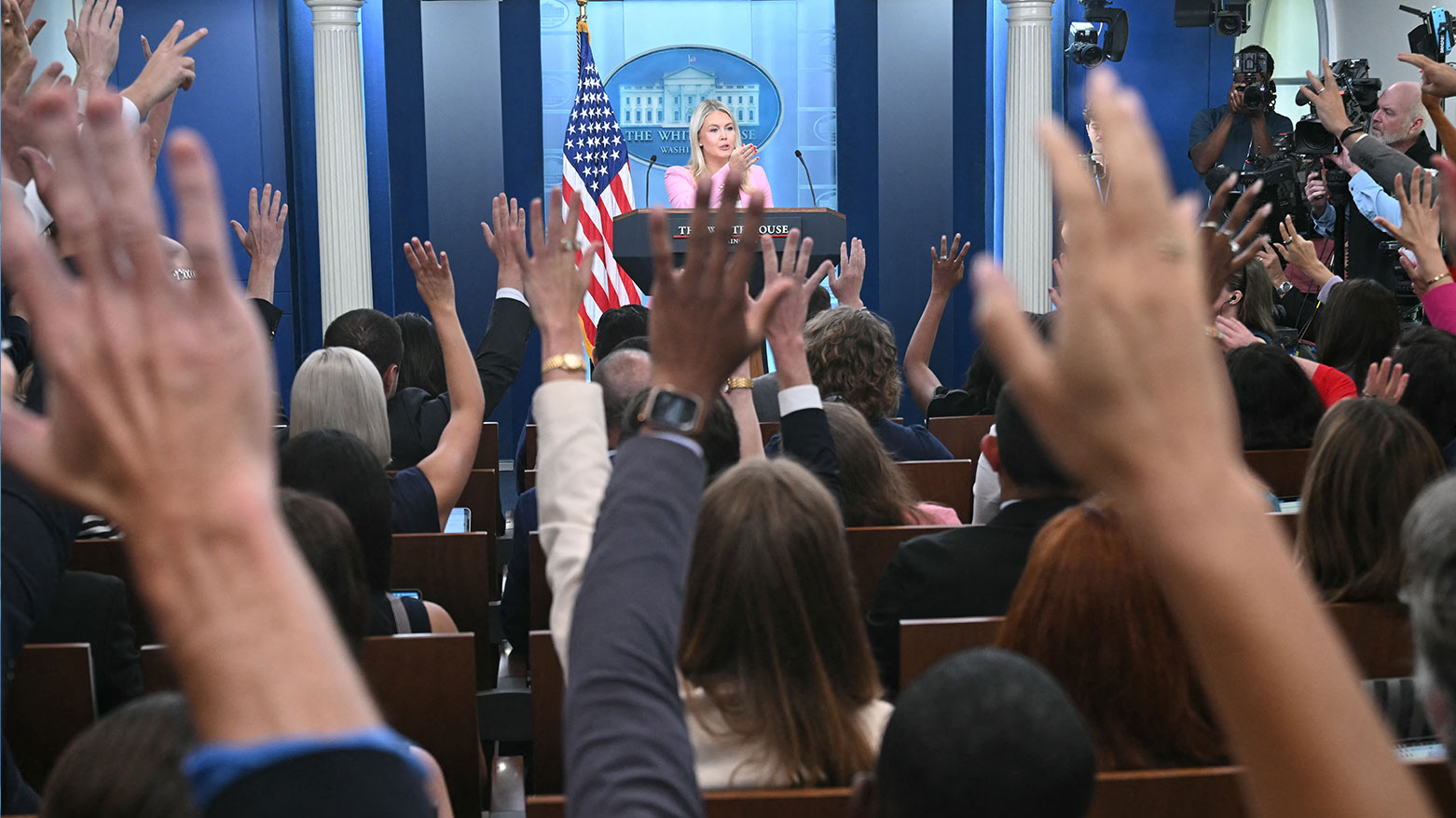
ERBIL (Kurdistan24) - U.S. President Donald Trump will deliver a primetime address Thursday focused on the "integrity" of U.S. elections, while the White House said he remains open to diplomacy with Iran despite renewed hostilities.
"President Trump will deliver a major address to the nation on protecting the integrity of our elections, and we encourage every American to tune in," White House Press Secretary Karoline Leavitt told reporters.
Separately, Leavitt said Trump continues to pursue diplomatic engagement with Tehran even as Washington responds to recent attacks linked to Iran.
"The president will hold them accountable when they turn their back on the words that they state to the United States. But he is always open to diplomacy at the very same time," she said.
The press briefing presented a starkly divided tableau of American executive power, highlighting an administration aggressively managing expectations for a highly anticipated domestic political broadcast while prosecuting a rapidly expanding military confrontation abroad.
The gravity of that overseas conflict was thrown into sharp relief when the briefing turned to an Iranian drone assault targeting American facilities in Erbil.
Responding to inquiries about the immediate threat posed to both U.S. personnel and the Kurdistan Region, which remains one of Washington's most steadfast Middle Eastern allies, Leavitt delivered a blunt warning.
She declared that Tehran had broken its direct commitments to the president and is currently suffering the kinetic consequences of that betrayal through a sustained wave of authorized U.S. retaliatory strikes.
The Primetime Push for Election Integrity
The immediate domestic focus of the administration centers almost entirely on the President's scheduled evening address to the nation, an event Leavitt characterized as a pivotal moment for the American constitutional system.
Seeking to preemptively shape the narrative before the broadcast, the press secretary forcefully pushed back against reporters' suggestions that the commander-in-chief simply intended to relitigate past political grievances.
Instead, Leavitt framed the integrity of the ballot box as an essential, nonpartisan bedrock of the republic that should inherently unite rather than divide the electorate.
She repeatedly declined to offer specific previews of the speech's contents, insisting that the American public must tune in directly to hear the President outline his concerns and present newly compiled supporting data.
Dismissing preemptive criticism from the media, she promised that the forthcoming evidence presented by the Oval Office would genuinely startle anyone viewing the broadcast with an objective mindset.
The administration's messaging strategy heavily links the evening's rhetoric to tangible legislative action on Capitol Hill.
Leavitt emphasized that securing the electoral process is not merely a rhetorical talking point but a central, immediate policy objective, firmly anchored by the SAVE America Act.
The legislation, which held profound importance for the late Senator Lindsey Graham, has evolved into a rallying cry for the administration following the lawmaker's sudden passing.
White House officials are currently coordinating closely with congressional leadership to integrate vital components of the voting security legislation into the upcoming Budget Reconciliation 3.0 package.
By tethering the election integrity measures to a broader legislative vehicle that includes crucial funding streams for the agricultural sector and the armed forces, the administration aims to force a decisive, unavoidable vote on the matter.
When pressed repeatedly by journalists on whether the President would unequivocally accept the outcomes of the impending November elections, Leavitt sidestepped the premise.
She argued that true democratic stability relies entirely on verifiable electoral mechanisms, suggesting that the current system requires immediate, evidence-based adjustments before the administration will offer blanket assurances.
The White House's position remains resolute: widespread public anxiety regarding election security is a valid, systemic issue that requires aggressive executive and legislative intervention.
Operation Epic Fury and the Confrontation with Tehran
While domestic political battles consumed a significant portion of the briefing's oxygen, the most geopolitically consequential elements of the administration's messaging centered on the rapidly deteriorating security architecture in the Middle East.
The White House utilized the podium to firmly articulate its justification for "Operation Epic Fury," a sustained military campaign characterized by near-daily U.S. strikes against Iranian targets.
According to the administration, the current hostilities were entirely precipitated by Tehran's aggression.
Leavitt asserted that Iran flagrantly violated an established diplomatic memorandum of understanding, crossing a critical threshold by firing upon commercial maritime traffic navigating the strategic Strait of Hormuz.
The American response has been swift and severe.
The press secretary detailed a comprehensive naval blockade designed to systematically isolate Iranian maritime infrastructure.
Under the direction of U.S. Central Command, a coalition of thousands of American service members, supported by a robust deployment of warships and aircraft carriers, has effectively sealed off Iranian ports to non-compliant vessels.
The operation aims to redirect compliant commercial traffic and ensure safe passage through the vital waterway, while simultaneously choking off Tehran's economic lifelines.
The strike on Erbil served as a grim reminder of the expanding geographical scope of this shadow war. By launching drones toward the capital of the Kurdistan Region, Tehran directly threatened a critical node of the U.S.-Kurdish security partnership.
Leavitt's confirmation that the United States is exacting a heavy toll on Iran in response to these provocations signals Washington's zero-tolerance policy for asymmetric attacks against its regional footprint and its sovereign allies.
Despite the intense military escalation, the administration maintains a complex rhetorical posture regarding diplomacy.
Leavitt indicated that while Tehran has recently expressed a desire to negotiate an end to the hostilities, Washington will not tolerate acts of terrorism in critical shipping lanes without establishing deterrence.
The White House flatly rejected any suggestions of moral equivalence between the two nations, drawing a sharp contrast between the U.S. military's stringent protocols to avoid civilian casualties and Tehran's long-documented history of targeting innocents.
Furthermore, the administration remains heavily invested in the safe return of American citizens wrongfully detained by the Iranian regime.
While Leavitt refused to publicly establish rigid preconditions for a cessation of hostilities, she reiterated that securing the release of hostages remains a top-tier priority for the President, pointing to his administration's track record of successfully repatriating Americans over the past year and a half.
Projecting Stability Amidst Overlapping Crises
The administration's broader strategy during the briefing appeared meticulously designed to project a sense of resolute executive competence, ensuring that neither the high-stakes election address nor the Middle East crisis overshadowed the President's domestic policy achievements.
To that end, Leavitt devoted considerable time to highlighting favorable economic indicators.
She pointed to a newly released Consumer Price Index report showing a significant 0.4 percent monthly decline in inflation, the sharpest drop in over six years, impacting everyday expenses from gasoline to medical care.
The White House was quick to claim credit for this economic relief, citing the President's pro-growth agenda and praising major corporate retailers like Walmart for initiating sweeping price reductions at the administration's direct urging.
Similarly, the White House touted the rapid implementation of the "Trump Accounts" initiative. Described as a transformative wealth-building program for American minors, the federal initiative has already enrolled over 6.5 million children.
Funded initially by a public-private partnership featuring prominent domestic investors, the program utilizes a $1,000 seed deposit from the Treasury, allowing parents and employers to contribute tax-advantaged funds that could theoretically mature into hundreds of thousands of dollars by a child's eighteenth birthday.
When pressed on whether the children of undocumented immigrants would be eligible for these accounts, the administration reiterated its strict opposition to birthright citizenship for the children of illegal border crossers, signaling an intent to pursue future legislative remedies to end the practice.
This stringent stance on immigration was further bolstered by new data from the Department of Homeland Security.
Leavitt announced that for the fourteenth consecutive month, the administration had released zero undocumented migrants into the interior of the United States.
Emphasizing historic lows in border apprehensions, she detailed a string of recent arrests by immigration enforcement targeting foreign nationals with severe criminal convictions, fulfilling a central mandate of the President's platform to secure the homeland.
Leavitt also confirmed that routine vehicle stops by immigration enforcement remain fully operational, with body cameras expected to be deployed to all field offices within the next sixty days to ensure accountability.
The administration's desire to project unyielding discipline was briefly tested by ethical controversies within its own ranks.
Reporters pressed the press secretary on recent revelations that a White House teleprompter operator had been placed on unpaid administrative leave following an investigation by the Commodity Futures Trading Commission.
The staffer allegedly utilized privileged inside information to profit on political prediction markets like Kalshi, specifically trading on the contents of the President's upcoming speeches.
Leavitt condemned the behavior as a disgrace, noting that the administration maintains strict ethical guidelines and that the individual in question was swiftly removed from duty upon discovery of the breach.
Even as the administration fielded questions ranging from domestic health concerns, specifically an ongoing federal tracing effort regarding a parasite outbreak linked to raw produce, to the President's upcoming attendance at the FIFA World Cup final in New York City, the underlying narrative remained remarkably consistent.
The White House is navigating a uniquely volatile moment in the American presidency. As President Trump prepares to look directly into the camera to challenge the structural integrity of the nation's electoral framework, his administration is simultaneously marshaling the full weight of the U.S. military to enforce its will in the Middle East.
Whether addressing the voters at home or adversaries abroad, the administration is signaling an era of aggressive executive action, demanding that both domestic institutions and foreign powers brace for the consequences of its unyielding agenda.
|
Summary U.S. President Donald Trump will deliver a major national address on election integrity, as the White House simultaneously navigates an escalating military conflict with Iran. Press Secretary Karoline Leavitt defended domestic priorities while detailing Middle East strikes and Erbil attacks. |
This article was updated on Thursday, Jul. 16, 2026, at 10:43pm.