Rubio Opens 60-Nation Ministerial on Resurgence of Political Terrorism
Secretary of State Marco Rubio convened a 60-nation ministerial in Washington, urging global alignment against the transnational rise of far-left terrorism.
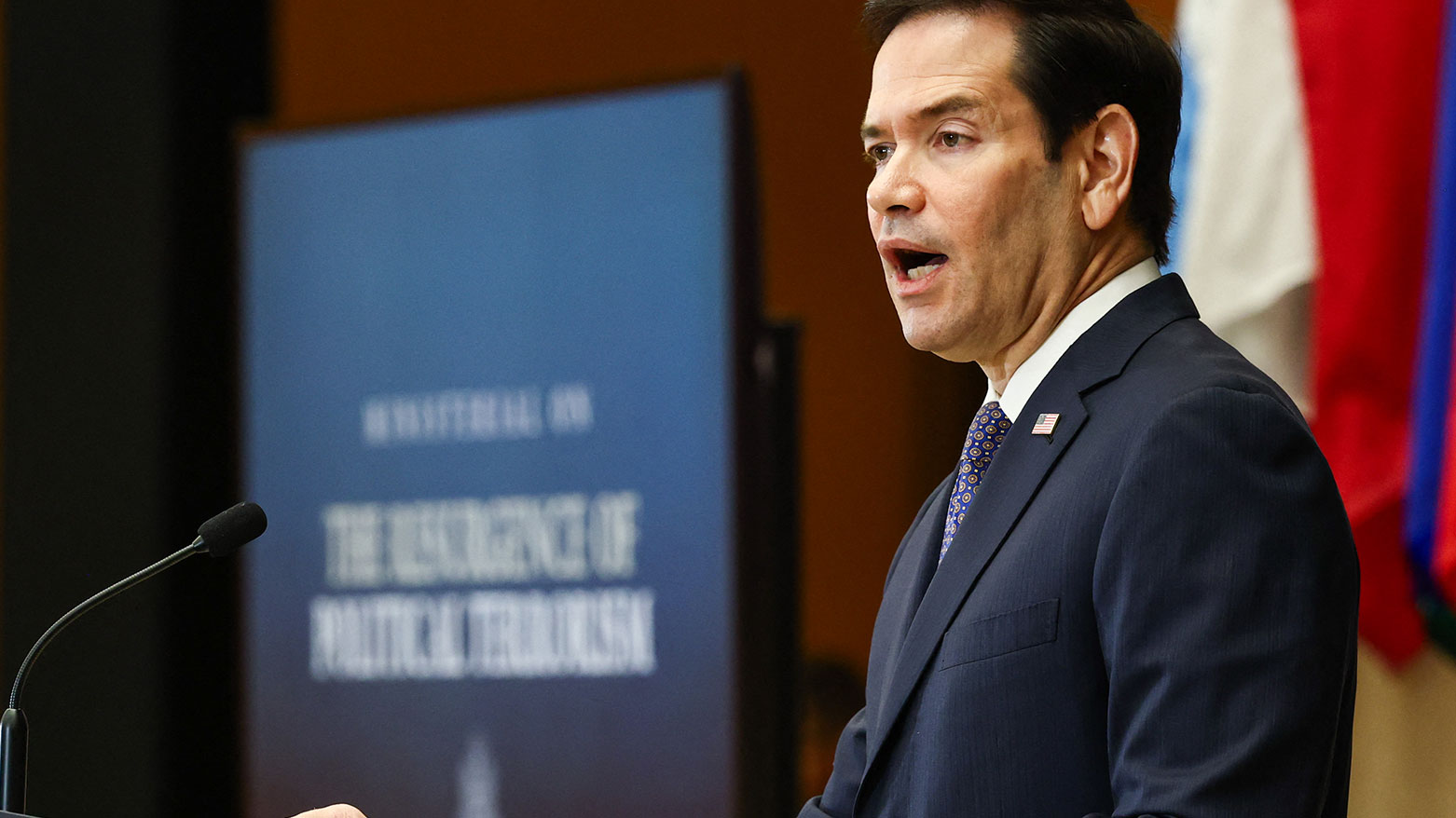
ERBIL (Kurdistan24) - The United States has initiated a sweeping diplomatic and security campaign intended to fundamentally reshape the global counterterrorism paradigm. Convening a high-level ministerial at the State Department's Loy Henderson Conference Room, the Trump administration gathered senior diplomats, intelligence officials, and law enforcement executives from more than 60 nations to confront what it describes as a dangerous and accelerating resurgence of transnational political terrorism.
The international gathering signals a deliberate pivot in American foreign policy and security doctrine.
For nearly a quarter-century following the attacks of September 11, 2001, global counterterrorism architectures were built almost exclusively around the suppression of radical Islamist extremism.
While acknowledging the historical necessity and clear tactical successes of that effort, American officials at the ministerial argued that the focus has left Western democracies vulnerable to an ideological blind spot: the rise of highly organized, technologically sophisticated, and violent far-left and anarchist networks operating across sovereign borders.
Opening the conference, Secretary of State Marco Rubio framed the initiative not as a localized law enforcement concern, but as an urgent geopolitical necessity.
He asserted that the primary obligation of any sovereign government is the physical protection of its citizens, a fundamental duty that he stated must supersede contemporary trade disputes, energy disagreements, or domestic political divisions.
The ministerial, according to American organizers, is designed to establish an enduring multi-national framework to map, disrupt, and ultimately dismantle these emerging security threats through unprecedented levels of international cooperation.

Redefining the Paradigm: From Global Jihad to Transnational Radicalism
The strategic rationale for the conference rests on the administration's assessment that the traditional threats that dominated the post-9/11 era have been significantly mitigated, allowing state adversaries and non-state radicals to exploit new operational gaps.
Reviewing the historical trajectory of Western security policy, Secretary Rubio noted that the comprehensive restructuring of intelligence agencies and law enforcement bureaus after 2001 succeeded in degrading major transnational networks.
He pointed to a drop of nearly 97 percent in casualties resulting from jihadist terrorism in Europe between 2015 and 2024, alongside a two-thirds reduction in domestic plots within the United States since the peak of the ISIS caliphate.
However, U.S. officials contend that this singular focus allowed an ideological prejudice to take root within legacy institutions, think tanks, and academic circles, leading to the minimization of systemic violence perpetrated by radical left-wing actors.
The administration argues that while violence from the extreme right is correctly categorized as a nefarious security threat, identical tactics employed by Marxist or anarchist factions have frequently been dismissed by cultural and political establishments as mere excesses of misplaced idealism.

To challenge this conventional wisdom, the State Department presented the ministerial as an objective, data-driven response to a sharp statistical escalation in political violence.
According to figures highlighted during the proceedings, far-left and anarchist-driven violence has surged significantly across the West, recording a 40 percent increase in Germany over the past year alone, while accounting for more than 80 percent of radical violence in Greece.
By anchoring the conference in these metrics, the administration sought to move the conversation away from localized partisan debates and position it firmly within the realm of global threat assessment.
Historical Echoes and Contemporary Casualties
The ministerial deliberately connected modern security challenges to the urban guerrilla movements that destabilized parts of the West during the latter half of the twentieth century.
Deputy Secretary of State Christopher Landau provided historical context for the discussions, drawing direct parallels between current security disruptions and the wave of political terrorism that defined the 1970s.
He reminded the delegation of the historical trauma inflicted by groups such as the Red Brigades in Italy, the Baader-Meinhof Group in Germany, November 17 in Greece, and various Marxist insurgencies like the FARC and the Shining Path in Latin America.
The administration's core thesis is that these old ideologies have reemerged, rearmed with modern digital tools, and are actively targeting critical infrastructure and civic stability across Europe and the Western Hemisphere.
Secretary Rubio detailed a series of recent international incidents to illustrate the real-world consequences of this resurgence, including a coordinated assault on the power grid in Berlin that triggered the city's longest blackout since the Second World War, resulting in the death of an elderly resident.
He also cited lethal firebombings targeting political families in Greece and fatal street violence carried out by militant factions in France.
Within the United States, officials noted a parallel escalation, describing a pattern of armed ambushes on immigration enforcement officers, sniper attacks, and direct attempts on public figures.
The administration characterized this wave of violence as a fundamental assault on civilizational achievements, driven by a deep-seated resentment toward the infrastructure, legal order, and historical achievements of Western societies.
The Transnational Syndicate: Encryption, Sovereignty, and State Sponsors
A central focus of the ministerial was the documentation of the highly integrated, transnational nature of modern political extremism.
The State Department argued that contemporary radical groups can no longer be viewed as isolated, domestic cells acting within a single country's borders.
Instead, intelligence briefings presented at the conference outlined a fluid international network where actors routinely cross borders, share operational infrastructure, and exploit the legal friction points between sovereign jurisdictions.
According to American intelligence assessments, organizations like Antifa operate as interconnected global syndicates.
Militants frequently travel between Europe and the Americas to participate in coordinated street actions, share tactical intelligence, and distribute training materials.
These operations are sustained through sophisticated underground networks, utilizing encrypted communication channels to coordinate logistical details and bypass state surveillance.
Furthermore, the Trump administration raised alarms over the growing nexus between these non-state militant networks and hostile foreign governments.
U.S. officials specifically pointed to the external support systems provided by state actors, alleging that Cuban intelligence apparatuses continue to maintain deep ideological and logistical ties with radical organizations across the Western Hemisphere.
Additionally, the conference highlighted increasing intersection points between far-left militant groups and Iranian-backed proxy networks, suggesting that state-sponsored adversaries are actively exploiting domestic political radicalism to weaken Western security from within.
The Architecture of Counteraction: Law, Finance, and Domestic Enforcement
To counter this evolving threat, the ministerial served as a platform for the United States to outline its newly constructed domestic and international enforcement mechanisms.
Central to this strategy is National Security Presidential Memorandum 7 (NSPM-7), a directive signed by President Trump that mandates a unified, interagency approach to investigating, disrupting, and prosecuting political terror networks.
White House Deputy Chief of Staff and Homeland Security Advisor Stephen Miller elaborated on the domestic implementation of this strategic framework.
Mr. Miller emphasized that left-wing political terrorism ultimately aims to subvert constitutional governance and institutional stability.
He warned that radical factions frequently employ a disingenuous appeal to civil liberties as a tactical shield to evade criminal accountability while utilizing the explicit threat of physical violence to intimidate judicial bodies and public figures.
Mr. Miller underscored the necessity of unwavering legal clarity, criticizing past institutional inaction and warning against vulnerabilities like jury nullification in metropolitan jurisdictions, which he argued allow political violence to fester unchecked.

Complementing the domestic legal push, the administration highlighted the aggressive deployment of economic leverage to choke off the financial lifelines of transnational networks.
Drawing on the institutional framework outlined by Treasury Secretary Scott Bessent, the administration detailed how the Department of the Treasury is integrating its regulatory authorities with international financial enforcement bodies.
The strategy relies heavily on systemic "debanking" policies, aggressive asset freezes, and the utilization of global sanctions to isolate illicit capital flows.
The State Department emphasized its recent formal designation of four prominent far-left extremist groups as Foreign Terrorist Organizations, promising additional listings in the near future.
To incentivize the dismantling of these networks, the U.S. highlighted its Rewards for Justice program, which offers up to $10 million for actionable intelligence that disrupts the underground funding mechanisms supporting these organizations.
Diplomatic Horizons and Future Coalitions
The assembly of delegates from over sixty nations underscores a calculated diplomatic effort by the United States to embed its revised counterterrorism priorities into the fabric of international security alliances.
U.S. officials acknowledged that many of the governments participating in the ministerial maintain sharp public disagreements with Washington on foundational issues such as international trade, energy security, and immigration policy.
However, the administration structured the conference around the premise that the containment of violent political radicalism represents a shared sovereign interest that must transcend routine diplomatic friction.

The ministerial is designed to yield immediate operational outcomes rather than functioning merely as a forum for political rhetoric.
The United States pointed to the institutionalization of the Counter Terrorism Law Enforcement Workshop series as a primary vehicle for future multilateral action.
Following a successful initial session that brought together American law enforcement officials and international counterparts to map extremist networks, the State Department announced that the next iteration of the operational workshop will be co-hosted alongside the government of Germany.
Ultimately, the Washington ministerial signals that the United States intends to make cooperation against transnational political terrorism a benchmark for its future bilateral and multilateral security partnerships.
By establishing new channels for real-time intelligence sharing, harmonizing financial regulatory actions, and aligning cross-border law enforcement strategies, the administration is attempting to construct a modernized global defense system.
The success of this initiative will depend on the willingness of international partners to sustain this high level of operational coordination, bridging their broader geopolitical differences to confront a common, evolving threat to state stability.
|
Summary At a landmark State Department ministerial, Secretary of State Marco Rubio urged more than sixty nations to rebuild global counterterrorism frameworks. The Trump administration outlined an expansive strategy utilizing financial sanctions and intelligence sharing to combat political terrorism today. |