A Century of Denial: Today Marks 103 Years Since the Treaty of Lausanne
The 1923 accord replaced an earlier promise of Kurdish independence and split Greater Kurdistan among four states, a division still felt across the region today.
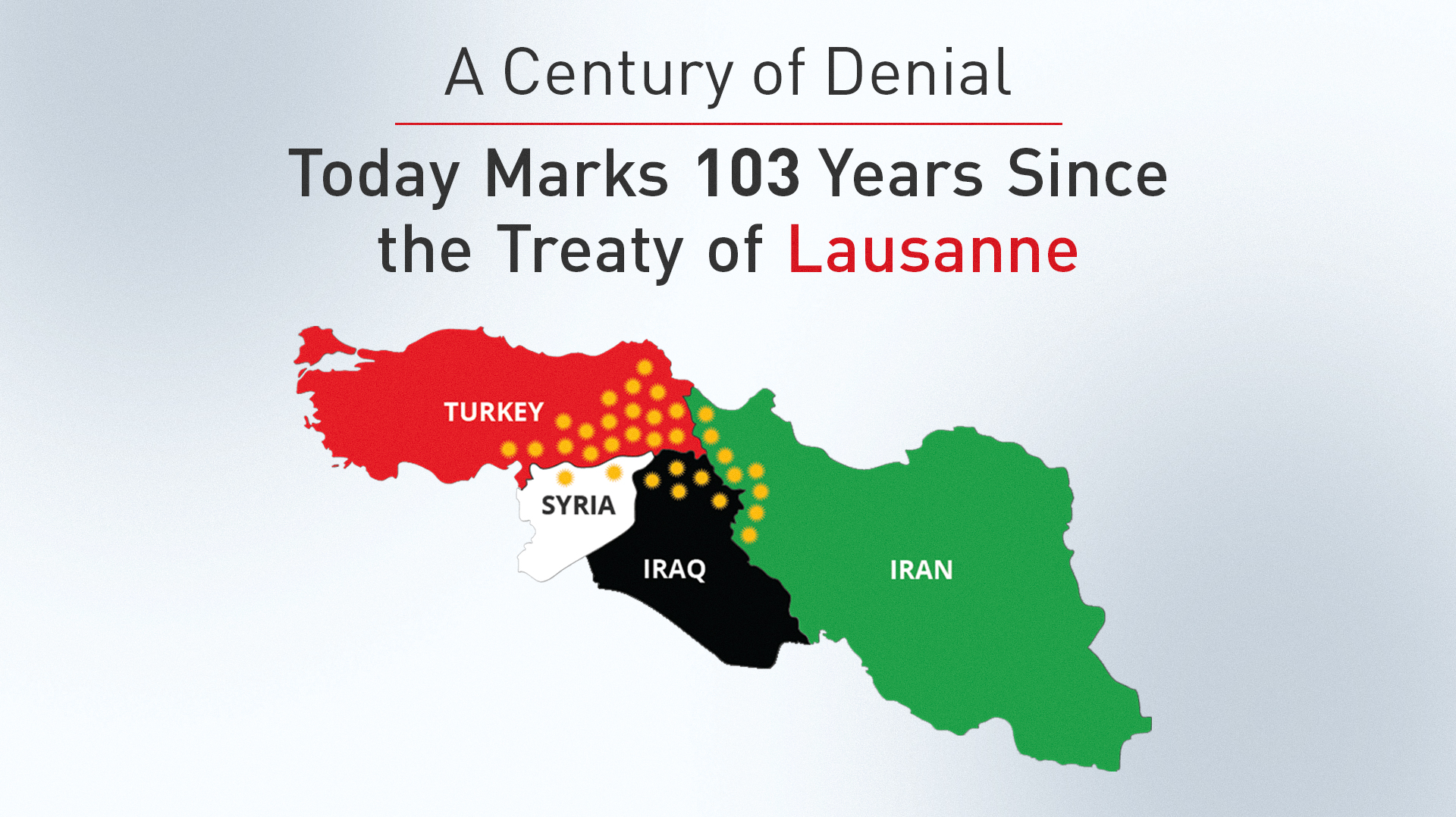
ERBIL (Kurdistan24) - One hundred and three years ago, on July 24, 1923, delegates gathered in the Swiss city of Lausanne to sign a treaty that would reshape the map of the Middle East and, with it, the fate of the Kurdish people.
The Treaty of Lausanne was struck between the victorious powers of the First World War and the newly formed Republic of Türkiye, and Kurds mark its anniversary this week as a defining, and painful, turning point in their modern history.
The Treaty of Lausanne was negotiated to formally settle territorial and political disputes left unresolved after World War I, replacing an earlier, unratified settlement, the 1920 Treaty of Sèvres. According to the account marking the anniversary, Lausanne was not simply a routine diplomatic agreement but a negative historical turning point that undid the aspirations the Kurdish people had held under Sèvres.
Lausanne was not the first setback for Kurdish national ambitions. As early as 1916, Britain and France had already divided the Middle East between themselves through the Sykes-Picot Agreement. But Lausanne is remembered as the final blow to Kurdish national rights in that era.
The Treaty of Sèvres, signed in 1920, had recognized in its Articles 62, 63 and 64 the right of Kurds to establish an independent state on roughly 20 percent of the territory of Greater Kurdistan. Lausanne reversed that outcome entirely.
Turkish leader Mustafa Kemal Atatürk, through sustained diplomatic pressure and by securing the backing of the Soviet Union, persuaded the Allied powers — chiefly Britain and France — to abandon the Sèvres framework.
Ankara's central condition for settling Middle Eastern territorial disputes and fixing its borders was the non-implementation of the Sèvres provisions. As a result, across Lausanne's 143 articles, the Kurdish name and Kurdish political rights were removed entirely.
The Treaty of Lausanne was signed among 13 states: Türkiye, Britain, France, Italy, Greece, Belgium, Romania, Japan, Bulgaria, Portugal, the Soviet Union and Yugoslavia. The outcome of this international consensus was a renewed partition of Kurdish land.
Kurdistan had already been divided once before, following the 1514 Battle of Chaldiran, which split it in two. Lausanne went further, dividing Greater Kurdistan across four states: Türkiye, Iran, Iraq and Syria. A fifth portion, historically known as "Red Kurdistan," fell under Soviet control and today lies scattered across the territories of Armenia, Azerbaijan, Georgia and Turkmenistan.
Beyond the broader territorial division, Lausanne left one issue unresolved: the status of Mosul province, corresponding to today's southern Kurdistan. That question was not settled until 1926, when the province was annexed to Iraq.
The treaty is remembered not only as a severe blow to the Kurdish cause but as the document that drew a new political and geographic map for the region, one that has fueled conflict and deep-seated tension among the peoples of the Middle East for a century since.
Lausanne formally cemented, at the international level, a policy of denying Kurdish national identity, leaving Kurds as the world's largest stateless nation.
Since 1923, the Treaty of Lausanne has also been the primary document that forced the Kurds to split up and defined the borders of the modern Turkish, Syrian, Iraqi and Iranian states, a situation that they still maintain today.