Survivors Face Heat, Power Outages as Japan Earthquake Toll Reaches 28
Rescue crews continue searching the collapsed Aeon Mall Kumamoto as survivors endure extreme heat, utility outages, and displacement following Japan's powerful earthquake.
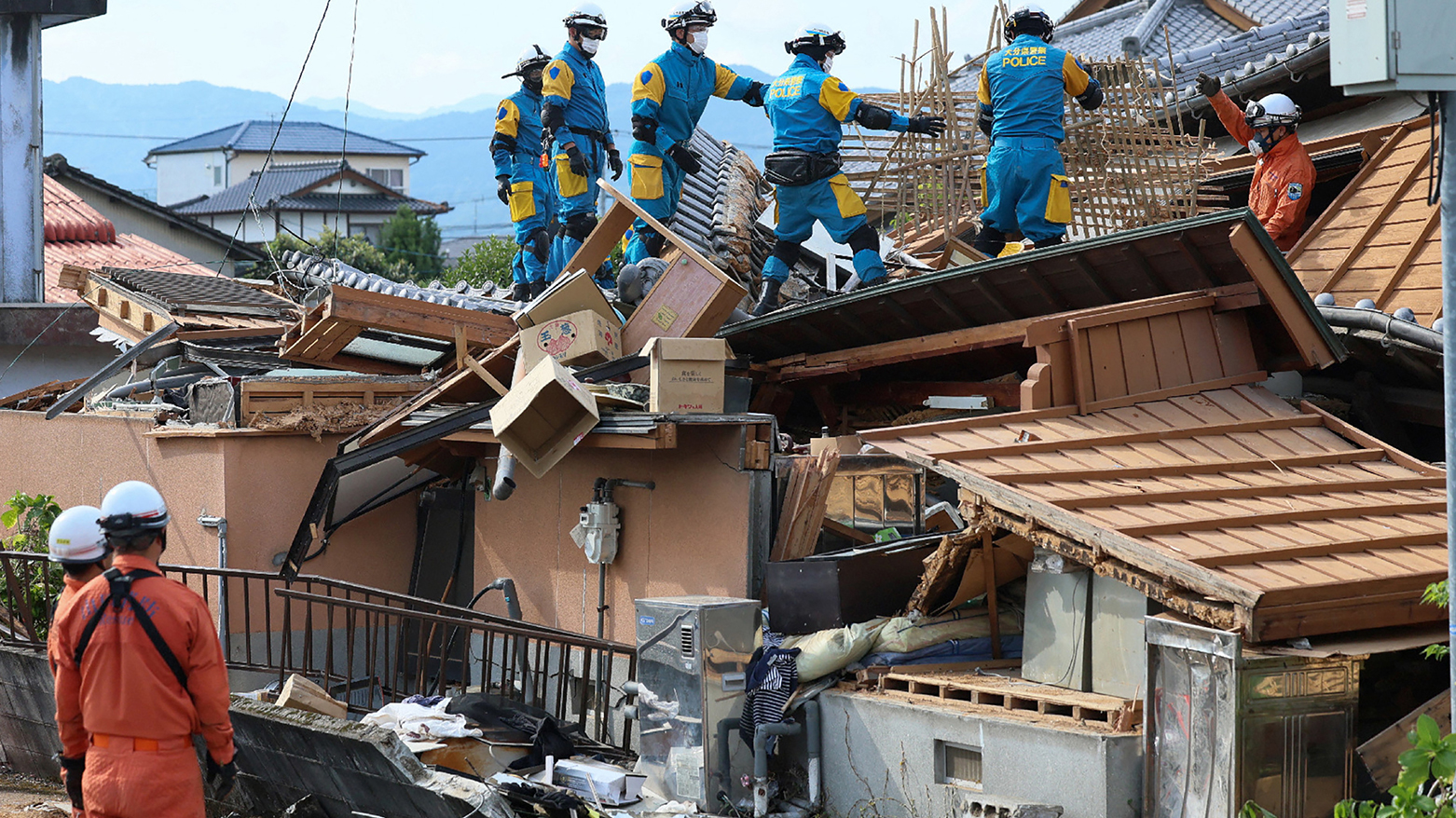
ERBIL (Kurdistan24) - Japan's earthquake disaster entered a critical new phase on Thursday as authorities confirmed that at least 28 people had died, while emergency crews continued painstaking efforts to reach anyone still trapped beneath the collapsed Aeon Mall Kumamoto, one of the hardest-hit sites following the powerful earthquake that struck the country's southwest.
According to Agence France-Presse (AFP), the revised death toll comes as rescue workers confront increasingly difficult conditions inside the heavily damaged shopping complex, where unstable concrete, twisted steel, and hanging cables continue to complicate operations.
Officials have recovered additional bodies from the wreckage while warning that the search remains ongoing and the final human toll has yet to be determined.
A regional disaster management official told AFP that rescuers have so far pulled 10 people from the mall.

The Aeon shopping mall in Kumamoto had only reopened in June, gleaming, stronger and safer thanks to the latest renovations following earthquakes in 2016, promising a place where generations could "share smiles". But despite extensive reinforcement works on the facility that suffered severe damage a decade ago, a blast triggered by a fresh quake on July 28, in the southwestern Japanese region has left it in ruins. (AFP)
Four were confirmed dead, one showed no vital signs, and five others sustained injuries ranging from minor to serious. The operation remains focused on locating anyone who may still be trapped inside the shattered structure.
The shopping center has become the focal point of Japan's emergency response after suffering catastrophic structural damage in the aftermath of Tuesday's magnitude 7.1 earthquake.
Earlier reporting indicated that a suspected explosion preceded the partial collapse of the building, prompting fears from Japanese authorities that casualties at the site could rise significantly as rescue teams gradually gain access to previously unreachable sections.

The Aeon shopping mall in Kumamoto had only reopened in June, gleaming, stronger and safer thanks to the latest renovations following earthquakes in 2016, promising a place where generations could "share smiles". But despite extensive reinforcement works on the facility that suffered severe damage a decade ago, a blast triggered by a fresh quake on July 28, in the southwestern Japanese region has left it in ruins. (AFP)
Read More: Death Toll Feared to Rise After Earthquake Brings Down Japan's Aeon Mall
The challenge extends well beyond the collapsed mall. Across Kumamoto Prefecture, emergency responders continue working through damaged neighborhoods, destroyed infrastructure, and multiple disaster sites while balancing rescue operations with growing humanitarian needs.
The earthquake flattened homes, damaged transport links, and ignited fires across several communities.
Although emergency crews have restored some essential services, tens of thousands of households remain without reliable electricity or running water, leaving many residents dependent on public shelters and emergency aid.

For those displaced by the disaster, Japan's intense summer weather has become an additional threat.
Temperatures are expected to climb toward 38 degrees Celsius in the coming days, increasing concerns for elderly residents and others sheltering in public facilities after losing access to air-conditioned homes.
Community centers have become temporary refuges where hundreds of evacuees sleep on mats spread across gymnasiums and public halls. Many are relying on emergency cooling equipment delivered by authorities as prolonged power outages make returning home impossible.

One evacuee told AFP she initially attempted to remain at her residence before spending time inside her vehicle, but ultimately sought shelter because of the oppressive heat and swarms of mosquitoes.
Another resident, supermarket employee Hiroyuki Matsushima, said enduring the high temperatures without electricity or air conditioning had become especially difficult for families already coping with the earthquake's aftermath.
The disaster has also disrupted daily life across the region. Television footage showed residents lining up for drinking water and fuel while local authorities worked to restore damaged utility networks.

As of Thursday morning, more than 22,000 households and facilities remained without electricity, while water service disruptions continued to affect roughly 84,000 homes.
Despite the widespread destruction, officials have reported no damage to nuclear facilities, easing concerns that the earthquake might trigger a broader industrial emergency.
Japan, situated along the seismically active Pacific "Ring of Fire," experiences frequent earthquakes, though only a small proportion result in widespread destruction.

Kumamoto itself still carries vivid memories of the devastating earthquakes that struck the prefecture in 2016, making the latest disaster another painful chapter for communities familiar with rebuilding after major seismic events.
For now, the immediate priority remains the rescue operation at Aeon Mall Kumamoto, where firefighters, engineers, and specialist search teams continue working through unstable debris in hopes of finding additional survivors.
Authorities have repeatedly cautioned that casualty figures remain subject to change as inaccessible sections of the building are cleared and victims are formally identified.

As recovery efforts expand across the prefecture, emergency officials face the dual challenge of sustaining life-saving rescue operations while addressing the humanitarian needs of thousands of residents displaced by one of Japan's deadliest earthquakes in recent years.
With extreme heat compounding the crisis and large areas still struggling with disrupted utilities, the coming days are expected to test both emergency responders and affected communities as the country moves from rescue toward long-term recovery.

|
Summary Japan's earthquake death toll has risen to 28 as rescue teams continue searching the collapsed Aeon Mall Kumamoto. Survivors face extreme heat, widespread utility outages, and displacement while authorities warn that casualty figures may still rise as operations continue. |