BCF President Accuses Baghdad, UN of Failing Sinjar as Thousands of Ezidis Remain Displaced
On the 12th anniversary of the Ezidi genocide, BCF President Musa Ahmed says years of international pledges have not translated into lasting recovery, urging greater action on displacement, services, and reconstruction.
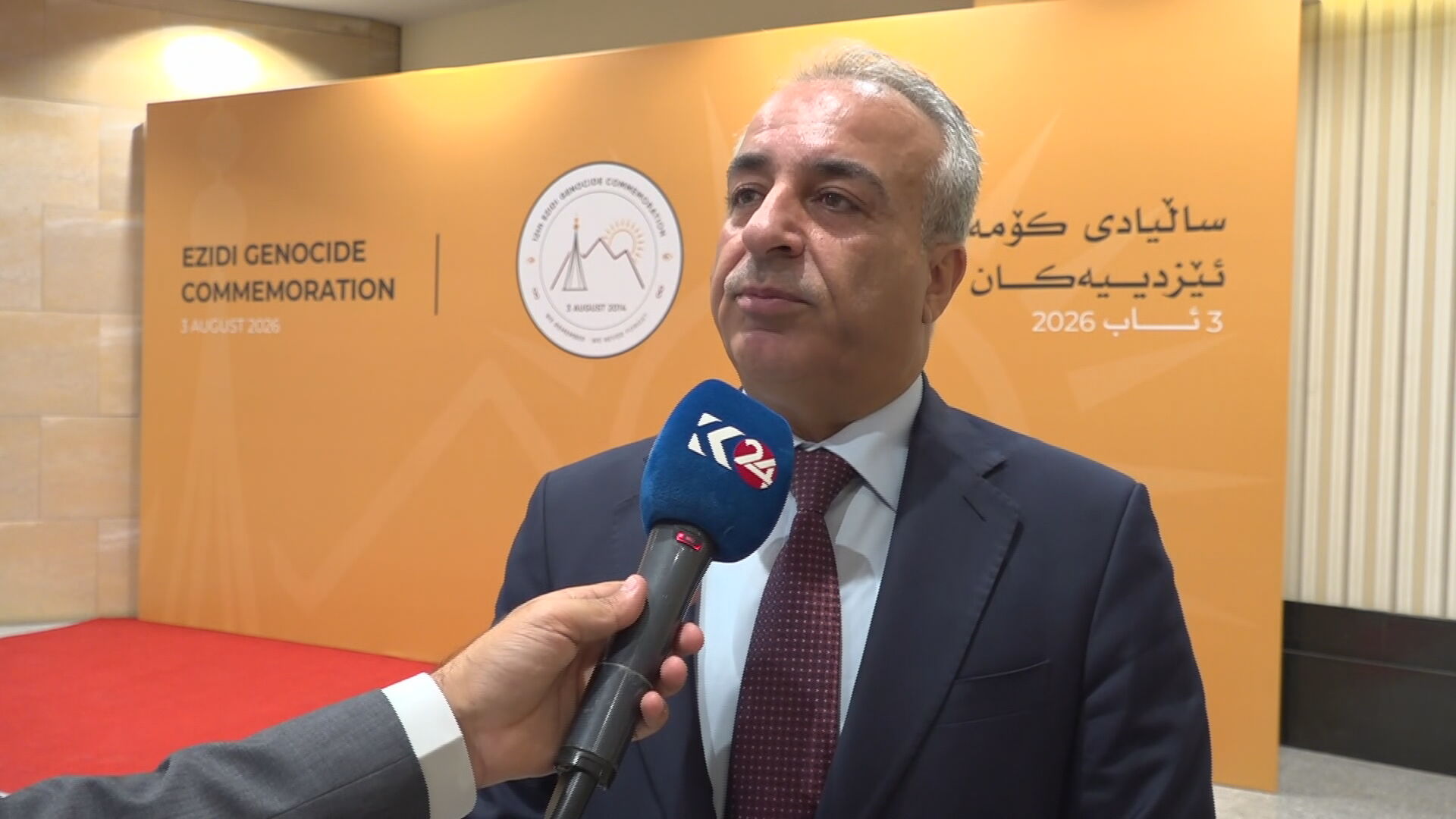
ERBIL (Kurdistan24) - Twelve years after ISIS carried out its genocidal assault on Sinjar, Barzani Charity Foundation (BCF) President Musa Ahmed sharply criticized both the Iraqi federal government and the United Nations, arguing that years of promises have failed to deliver meaningful improvements for the Ezidi (Yazidi or Yezidi) community, which continues to grapple with displacement, inadequate services, and an uncertain future.
Speaking to Kurdistan24 during Monday's ceremony marking the 12th anniversary of the Ezidi genocide, Ahmed said the anniversary should not only commemorate the victims but also serve as a reminder that many of the community's most urgent humanitarian needs remain unresolved.
"On this anniversary, we direct our grievances to the relevant bodies within the United Nations and the Iraqi government," Ahmed said. "They have failed to fulfill their obligations toward the displaced persons and victims of Sinjar. Even after all these years, the displaced continue to live in tents across various camps."
His remarks come as survivors continue to press for justice, reconstruction, and conditions that would allow families to return safely to Sinjar, more than a decade after ISIS militants overran the district on Aug. 3, 2014.
Ahmed argued that shortcomings extend well beyond housing, pointing to persistent gaps in healthcare, education, and psychological support for survivors who endured one of the region's most devastating campaigns of violence.
"There are significant deficiencies in the health and education sectors, as well as other essential services," he said, stressing that specialized psychological care for survivors remains a fundamental responsibility of the Iraqi state.
Describing the genocide as a tragedy with international consequences, Ahmed said global organizations also bear responsibility for supporting long-term recovery rather than limiting their engagement to emergency humanitarian assistance.
"Beyond providing aid, we take pride in representing them at all international forums and seminars, and we will continue to do so," he said.
His comments echo broader concerns surrounding Sinjar's slow recovery. Although ISIS was militarily defeated and Kurdish Peshmerga forces liberated Sinjar in November 2015 with support from the International Coalition, many of the conditions necessary for sustainable returns remain absent.
Large parts of the district continue to struggle with damaged infrastructure, fragmented security arrangements, weak public services, and unresolved governance issues, factors that survivors consistently cite as reasons they have not returned home.
According to figures cited by Kurdistan24, more than 400,000 Ezidis fled to the Kurdistan Region during the initial ISIS offensive. While roughly 100,000 have returned to Sinjar, more than 270,000 remain in displacement camps, and another 100,000 have sought refuge abroad.
Recovery has also been complicated by delays in implementing the 2020 Sinjar Agreement between Baghdad and the Kurdistan Regional Government. The accord envisioned coordinated administration, security restructuring, reconstruction, and the removal of illegal armed groups from the district, but survivors and community leaders have repeatedly argued that progress has been limited.
The humanitarian toll also remains profound. Official figures indicate that more than 5,000 Ezidis were killed during the ISIS assault, while thousands of women and children were abducted. More than 2,800 people are still missing, and nearly 100 mass graves have been discovered in and around Sinjar, underscoring the scale of the atrocities and the continuing search for answers.
Ahmed said the BCF has remained engaged with displaced Ezidis since the earliest days of the crisis, overcoming logistical and security challenges to deliver assistance across camps in the Kurdistan Region.
He added that, under the direction of Prime Minister Masrour Barzani in his capacity as Chairman of the BCF Board of Directors, the foundation has also sought to raise international awareness of the genocide.
"At the direction of Masrour Barzani, Chairman of the BCF Board of Directors, we have consistently represented the rights of Ezidi citizens at international conferences," Ahmed said. "We consider it our duty to bring the story of the Ezidi genocide to every global and international platform. This mission will continue."
As commemorations continue across the Kurdistan Region, Ahmed's appeal reflects a broader message voiced by many Ezidi survivors: remembrance alone is not enough. Twelve years after the genocide, they argue that meaningful recovery will depend on stronger political commitment, effective reconstruction, comprehensive support for survivors, and lasting security that enables displaced families to return home with dignity.