Iran Cleric Says 'Maximum Pressure' Failed as Deterrence Shifted U.S. Strategy
Ayatollah Seyyed Hassan Ameli, speaking in Ardabil and quoted by Fars News Agency, alleged that Iran's military posture has undermined Washington's "maximum pressure" strategy while accusing the United States and Israel of seeking to destabilize the region.
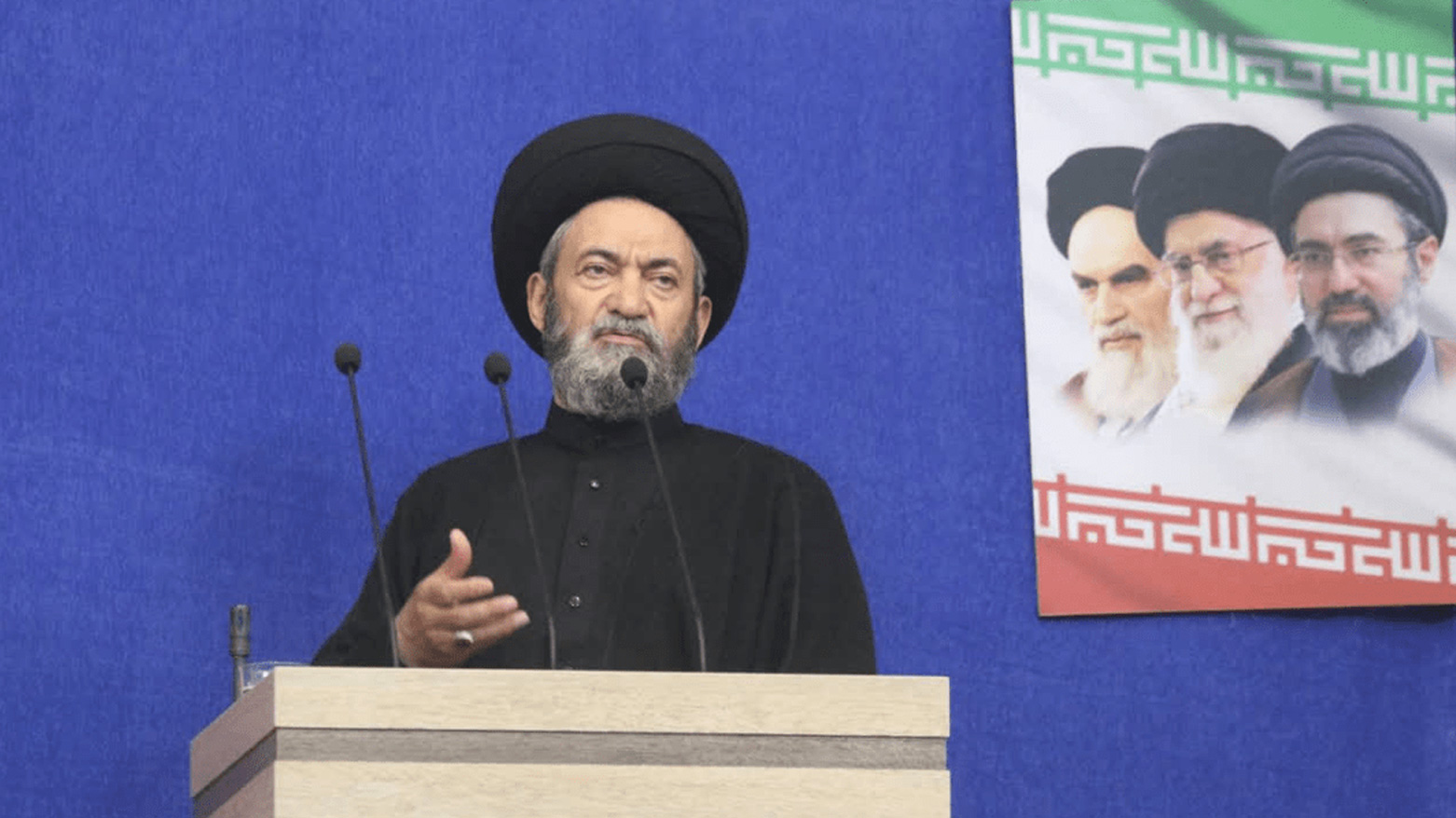
ERBIL (Kurdistan24) - Iran's policy of military deterrence has rendered Washington's long-standing "maximum pressure" strategy ineffective, according to Ayatollah Seyyed Hassan Ameli, the Supreme Leader's representative in Ardabil, north west of Iran, who argued during Friday prayers that the United States has increasingly relied on political and psychological pressure after failing to achieve its objectives through military means.
The remarks, reported by Iran's state-affiliated Fars News Agency, presented a sweeping defense of Iran's regional posture while accusing the United States and Israel of orchestrating instability across the Middle East.
Throughout his address, Ameli framed his assertions as evidence that Iran's military capabilities had altered the strategic balance, though many of his allegations were presented without publicly available evidence and have not been independently verified.
Allegations Surrounding Saudi Oil Facility Attacks
Ameli devoted part of his sermon to recent attacks targeting Saudi oil facilities, alleging that they were "false flag" operations carried out by the United States and Israel rather than by the groups publicly accused of involvement.
According to Ameli, Ukrainian operatives were allegedly used in the attacks with the intention of blaming Iraq's Popular Mobilization Forces (Hashd al-Shaabi).
He further claimed that the broader objective was to provoke confrontation between Saudi Arabia and Iraq while fueling wider divisions among Muslim countries.
"The bombing... is undoubtedly the work of America and Israel," Ameli claimed, according to Fars. He offered no publicly available evidence to support the allegation, and the accusations have not been independently verified.
Netanyahu Visit Interpreted as Bid for More Pressure
Turning to Israeli Prime Minister Benjamin Netanyahu's recent visit to Washington, Ameli offered his own interpretation of the discussions, emphasizing that his remarks reflected personal analysis rather than confirmed information.
According to Fars, Ameli alleged that Netanyahu sought to persuade U.S. President Donald Trump to intensify pressure on Iran by portraying the country as internally divided, claiming it was on the verge of acquiring a nuclear weapon and possessed missile capabilities capable of threatening the United States.
"Netanyahu surely brought a fabricated map and told Trump: 'Look closely here. This is the Kolang Mountain site in Isfahan, and Iran is only hours away from a nuclear bomb. Hurry up, hurry up, act swiftly, or in a few days we will face a nuclear Iran, and we will all be trapped by Iran,'" Ameli said, according to Fars News Agency.
Ameli further claimed that Netanyahu had long relied on similar tactics to influence Western governments.
"In the past, his modus operandi was also to frighten America and Europe using this exact method, even taking his fabricated maps and childish drawings to his speeches at the United Nations. Based on certain news agencies, it appears a third point was also made: threatening Trump with Iran. He told him: 'Appreciate me. I have stopped Iranian missiles from hitting America. Iran has missiles with an 8,000-kilometer range and could easily strike your home. I have held Iran back!'" Ameli said, as cited by Fars News Agency.
Ameli did not provide evidence to support his assertions, and Fars did not present independent verification that such exchanges took place during Netanyahu's meeting with Trump.
Warning Against Renewed Diplomacy
Ameli also rejected renewed negotiations with Washington, portraying diplomatic engagement under current circumstances as another form of coercion rather than genuine dialogue.
According to his remarks, the United States is attempting to obtain politically what it allegedly failed to achieve through military means. He urged Iranian officials not to return to negotiations under existing conditions.
"Negotiation under pressure is humiliation," Ameli said, arguing that any talks conducted while military and economic pressure remained in place would serve American objectives rather than produce a balanced outcome.
Maritime Pressure and Economic Leverage
The cleric also addressed strategic waterways, arguing that continued disruption affecting the Bab el-Mandeb Strait and the Strait of Hormuz constituted significant leverage against Western governments.
According to Ameli, prolonged instability along those maritime routes could have serious consequences for international energy markets and industrial economies if regional tensions continue.
He presented that assessment as evidence that economic pressure can flow in both directions, though he offered it as his own strategic evaluation rather than an independently verified forecast.
Operation Nasr-2 and Iran's Deterrence Narrative
The centerpiece of Ameli's address focused on what he described as Operation Nasr-2, which he portrayed as a defining demonstration of Iran's military deterrence.
According to Fars, Ameli claimed the operation disrupted American military planning, demonstrated Iran's readiness to conduct preemptive strikes, and established what he described as a new strategic equation in which Washington should no longer threaten Iran.
"Operation Nasr-2 broke America's back," he claimed, adding that the operation sent the message that "you do not even have the right to threaten us."
Ameli further alleged that U.S. missile defenses proved incapable of intercepting Iranian attacks and claimed Washington subsequently relocated military equipment farther from Iran because of concerns over Iranian missile capabilities.
He also asserted that American military deployments had been shifted to more distant locations, presenting the alleged movements as evidence that U.S. planners had been forced to revise their regional posture.
None of those claims were independently substantiated in the report carried by Fars.
Regional Balance and the 'Maximum Pressure' Debate
In the final portion of his sermon, Ameli argued that President Trump increasingly relies on threats while ultimately avoiding direct confrontation with Iran. He also claimed that attacks on civilian infrastructure reflected frustration after military setbacks rather than strategic strength.
According to Ameli, Arab governments are increasingly pursuing alternative security arrangements because confidence in U.S. protection has weakened, a development he argued signals a broader shift in the regional balance of power.
He concluded by presenting those developments as proof that Washington's "maximum pressure" doctrine had failed to achieve its objectives, contending that Iran's military deterrence had compelled the United States to rely instead on political messaging and psychological pressure.
While those arguments reflect Ameli's assessment, they remain part of the political narrative advanced in his address as reported by Fars News Agency rather than independently verified conclusions.