Thirteen Years After His Death, Sherko Bekas Still Gives Kurdish Literature a Global Voice
On the 13th anniversary of his passing, Sherko Bekas' poetry continues to shape Kurdish literature while expanding its influence through translations, scholarship, and readers across the Middle East and beyond.
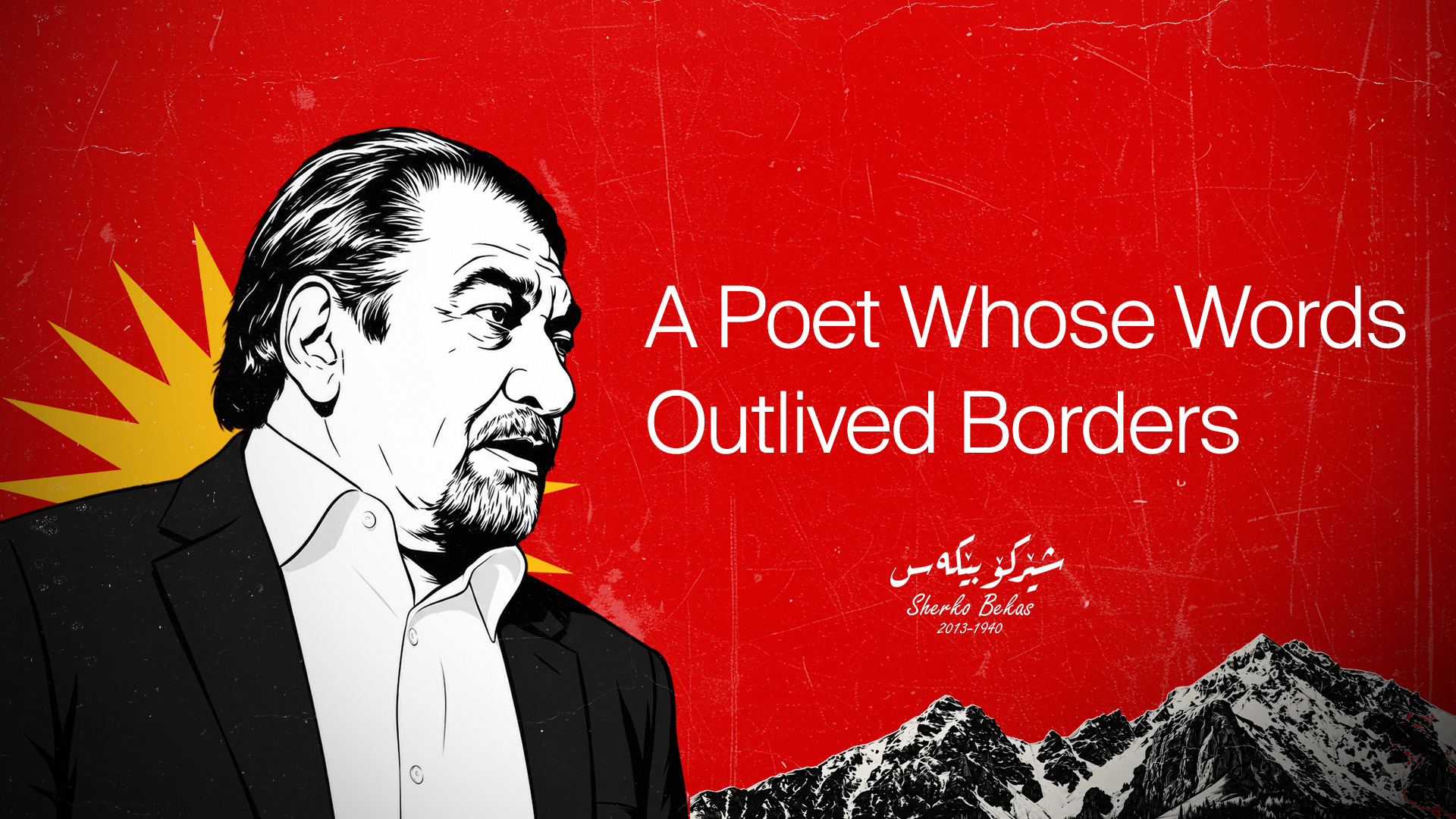
ERBIL (Kurdistan24) - Thirteen years after the death of Sherko Bekas, his words continue to travel far beyond the mountains and cities that inspired them, carrying Kurdish literature into classrooms, publishing houses, and literary circles across the world.
For generations of Kurdish readers, August 4 is more than the anniversary of the passing of a celebrated poet. It is a moment to reflect on the legacy of a writer who fundamentally reshaped modern Kurdish poetry, transforming it from a regional literary tradition into one with global resonance.
Through an unmistakable poetic voice rooted in freedom, justice, memory, and the natural world, Bekas helped establish Kurdish literature as an enduring presence on the international cultural stage.
Born in Sulaimani on May 2, 1940, Bekas grew up in a household where literature was woven into everyday life.
His father, the renowned Kurdish poet Fayeq Bekas, introduced him to a world in which poetry carried both artistic beauty and social responsibility. That foundation would eventually inspire a career that challenged literary conventions while remaining deeply connected to Kurdish identity.
Rather than following established poetic forms, Bekas became one of the leading architects of a new literary movement.
In 1970, he joined fellow writers in founding the Rwange (Vision) movement, an initiative that helped redefine Kurdish poetry through free verse, experimental forms, poster-poems, and expansive narrative works that blurred the boundaries between poetry and prose.
His innovations broadened both the language and possibilities of Kurdish literature, influencing generations of writers who followed.
Political upheaval forced Bekas into exile in Sweden during the 1980s, but distance from his homeland did not diminish his literary voice. If anything, exile sharpened it.
From abroad, he continued writing about the landscapes, people, and collective memories of Kurdistan, transforming deeply personal experiences into works that spoke to universal questions of displacement, dignity, and hope.
Some of his most influential collections emerged from this period.
The Butterfly Gorge (Derbendî Pepûle) became a powerful literary response to the Anfal campaign and the chemical attack on Halabja, using poetic imagery to preserve memories of suffering while refusing to surrender to despair.
Other landmark works, including The Ray of Poetry (Tirîfey Helbest), Meadow of Wounds Meadow of Sun (Mêrgî Zam Mêrgî Hetaw), The Chair (Kursî), and Now a Girl is My Homeland (Êsta Kçêk Nîştîmanme), explored power, humanity, nature, and belonging through a style that combined philosophical reflection with vivid symbolism.
Rather than documenting tragedy alone, Bekas sought to elevate Kurdish experiences into themes recognizable to readers everywhere. His poetry consistently returned to questions of justice, homeland, love, and human dignity, allowing local history to become part of a broader global conversation.
That universal outlook helped carry his work well beyond Kurdish-speaking audiences.
Over the years, his poetry has been translated into Persian, Arabic, English, Swedish, French, German, Italian, Danish, Dutch, Turkish, and several other languages, introducing readers around the world to Kurdish literature through one of its most influential voices.
International recognition followed.
Swedish PEN honored Bekas with the Kurt Tucholsky Prize, while the Italian city of Florence granted him honorary citizenship, acknowledging both his literary achievements and his commitment to freedom of expression.
Literary critics frequently compared him with globally renowned poets whose work transcended national boundaries. Many viewed Bekas as a humanitarian voice whose writings blended lyrical beauty with moral conviction.
Arab critic Safaa Diab described him as "the poet of our era," adding that Bekas "belongs to the entire world," an assessment reflecting the growing international appreciation for his work.
His influence has also continued to expand across neighboring Iran, where Persian-language readers have engaged with his poetry for more than three decades.
Since the 1990s, Iranian publishers have steadily introduced Bekas' collections through new translations, helping establish a lasting readership that extends beyond Kurdish communities.
Among those contributing to that effort are translators Naseh Sharifian, Mohammad-Raouf Moradi, Aziz Naseri, and Reza Karim-Mojavar, whose translations have brought many of Bekas' major works into Persian. Multiple reprints of comprehensive editions suggest sustained interest among readers and scholars alike.
Prominent Iranian poet Seyyed Ali Salehi, who collaborated on adaptations of Bekas' work, famously characterized him as being "simultaneously dew and rock," capturing what he saw as the delicate emotional qualities of Bekas' lyrical poetry alongside the resilience and resolve found in his social and political verse.

The growing body of academic research surrounding Bekas has reinforced his standing beyond the publishing world. Universities and literary journals have examined his symbolism, imagery, political thought, and environmental themes, while comparative studies have explored common threads between his work and that of leading Persian poets.
Scholars have highlighted recurring motifs, including mountains, rain, rivers, trees, homeland, freedom, and justice, as central elements in a poetic language that speaks simultaneously to Kurdish history and universal human experience.
His influence has also fostered cultural dialogue, with translations serving not simply as literary exercises but as bridges connecting Kurdish and Persian readers through shared regional histories and artistic traditions.
Bekas died in Stockholm on August 4, 2013, at the age of 73. In accordance with his wishes, he was laid to rest in Azadi (Liberty) Park in his native Sulaimani, bringing his journey back to the city where his literary imagination first took shape.
Today, thirteen years after his passing, Sherko Bekas remains far more than one of Kurdistan's greatest poets.
His work continues to cross linguistic, political, and cultural boundaries, giving Kurdish literature an enduring place in world letters while inspiring new generations of readers, translators, scholars, and writers.
Through his poetry, the Kurdish language found an international audience without sacrificing its distinctive voice, a legacy that continues to grow with every translation, every study, and every reader who discovers his words.