China Opens Arctic Route to Europe
The Dubai Tower's inaugural voyage cuts Asia-Europe transit time in half, as Beijing and Moscow welcome a northern corridor that bypasses both the Strait of Hormuz and the threatened Red Sea
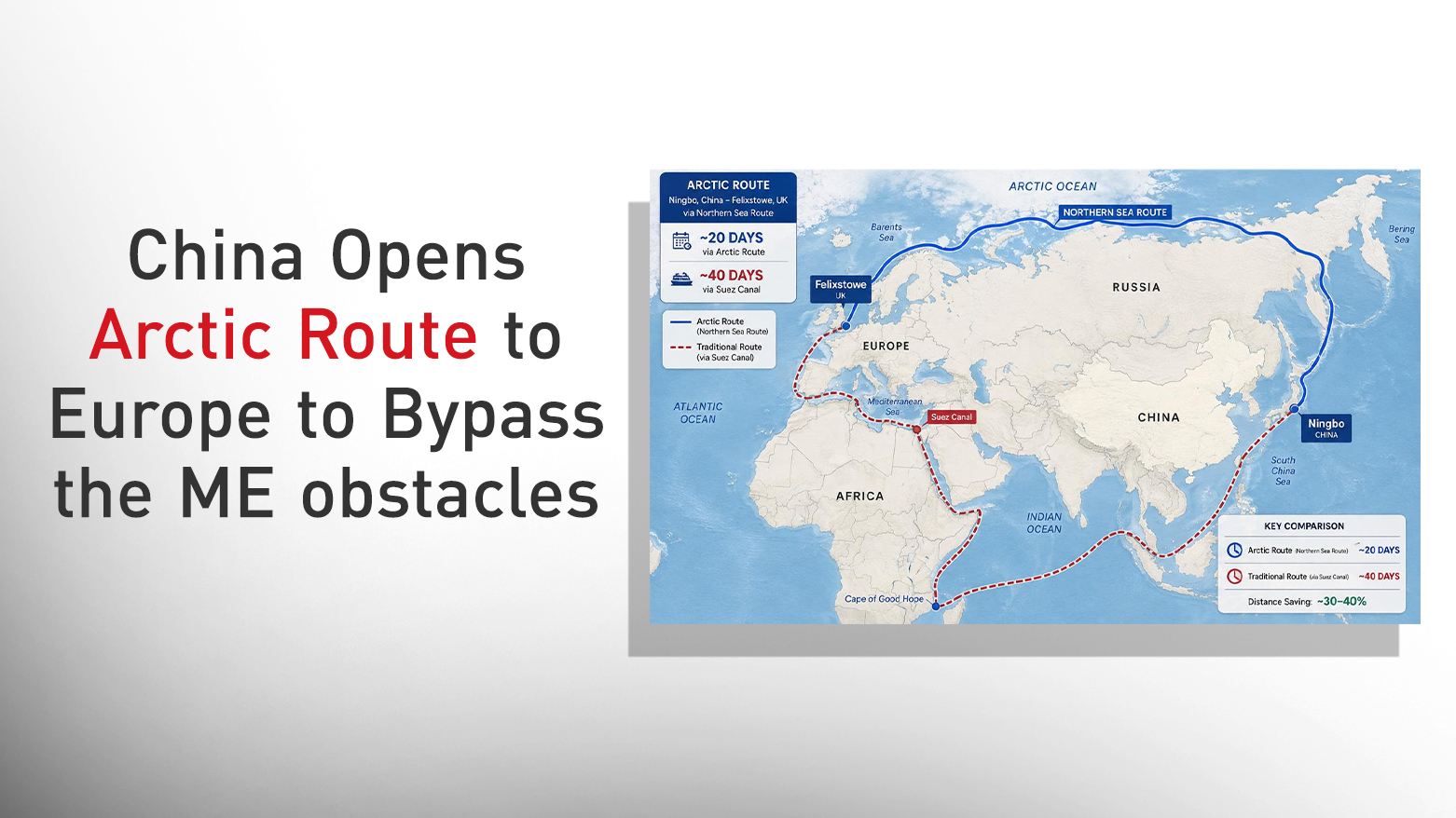
ERBIL (Kurdistan 24) - China launched its first regular commercial shipping service through the Arctic's Northern Sea Route on Saturday, marking a milestone in global trade infrastructure as the US-Iran war continues to threaten two of the world's most critical maritime chokepoints and force shippers to seek alternatives to the traditional Asia-Europe corridors.
The inaugural vessel on the regular service, the Dubai Tower, departed carrying high-value cargo produced across China's Yangtze River Delta, including energy-storage cabinets, traction batteries, photovoltaic modules, and new-energy components, according to China's state-run Xinhua news agency. The operator, Sea Legend, confirmed the vessel will make port calls in the Netherlands, Germany, and Poland during its journey.
The Northern Sea Route runs along Russia's northern Arctic coast and offers a significant time advantage over conventional shipping routes. A voyage from Ningbo on China's southeast coast to Felixstowe in the United Kingdom takes just 20 days via the Arctic corridor, approximately half the time required for vessels transiting the Suez Canal through the Red Sea, and five days faster than the land-based China-Europe Railway Express, Xinhua reported.

"When it comes to time efficiency and supply-chain security, the NSR delivers notable advantages," Xin Jianning, general manager at Zhejiang Seaport Logistics Group, told Xinhua. "The route effectively circumvents both volatile transit times and mounting costs caused by geopolitical disruptions."
The launch of the regular Arctic service comes as the Iran war has simultaneously placed both traditional Asia-Europe shipping corridors under sustained threat. The Strait of Hormuz, through which roughly one-fifth of the world's seaborne oil normally flows, has been effectively closed since February 28, 2026, disrupted by Iranian attacks on commercial vessels and the US naval blockade of Iranian ports. At the same time, Reuters reported in July 2026 that Tehran had asked Yemen's Houthi militants to remain on standby to shut down oil shipping lanes in the Red Sea if the United States launched strikes on Iranian power infrastructure, placing the Suez Canal corridor under a separate but connected threat.
The Northern Sea Route bypasses both chokepoints entirely, routing vessels along a path that is geopolitically insulated from the Middle East conflict and has seen dramatically increased ice-free navigation windows as a result of Arctic warming. Russia, which administers the route and collects transit fees from vessels using it, has welcomed the development, viewing Chinese engagement with the NSR as both commercial revenue and strategic validation of Moscow's Arctic infrastructure investment.
The Dubai Tower's cargo profile, dominated by batteries, photovoltaic modules, and new-energy components, reflects another dimension of the route's significance. These are precisely the categories of Chinese exports that have grown most rapidly in recent years, and that carry both high value and time sensitivity, making the 20-day Arctic transit economically compelling even when compared with alternative land and sea routes that were themselves considered fast before the Iran war disrupted the conventional shipping calculus.
Whether the regular Arctic service remains commercially viable year-round, given the seasonal constraints of Arctic navigation and the infrastructure requirements of the route, will determine how significant a role it plays in the long-term restructuring of Asia-Europe trade flows that the Iran war has accelerated.