IRGC: Hormuz Will Not Open Under Any Circumstances If US Rejects Iran's Conditions
Revolutionary Guard spokesman confirms Iran and Oman agreed on revenue shares and territorial waters, declares all enemy warships are at least a kilometer from the strait, and warns Washington's interference is the only obstacle to reopening
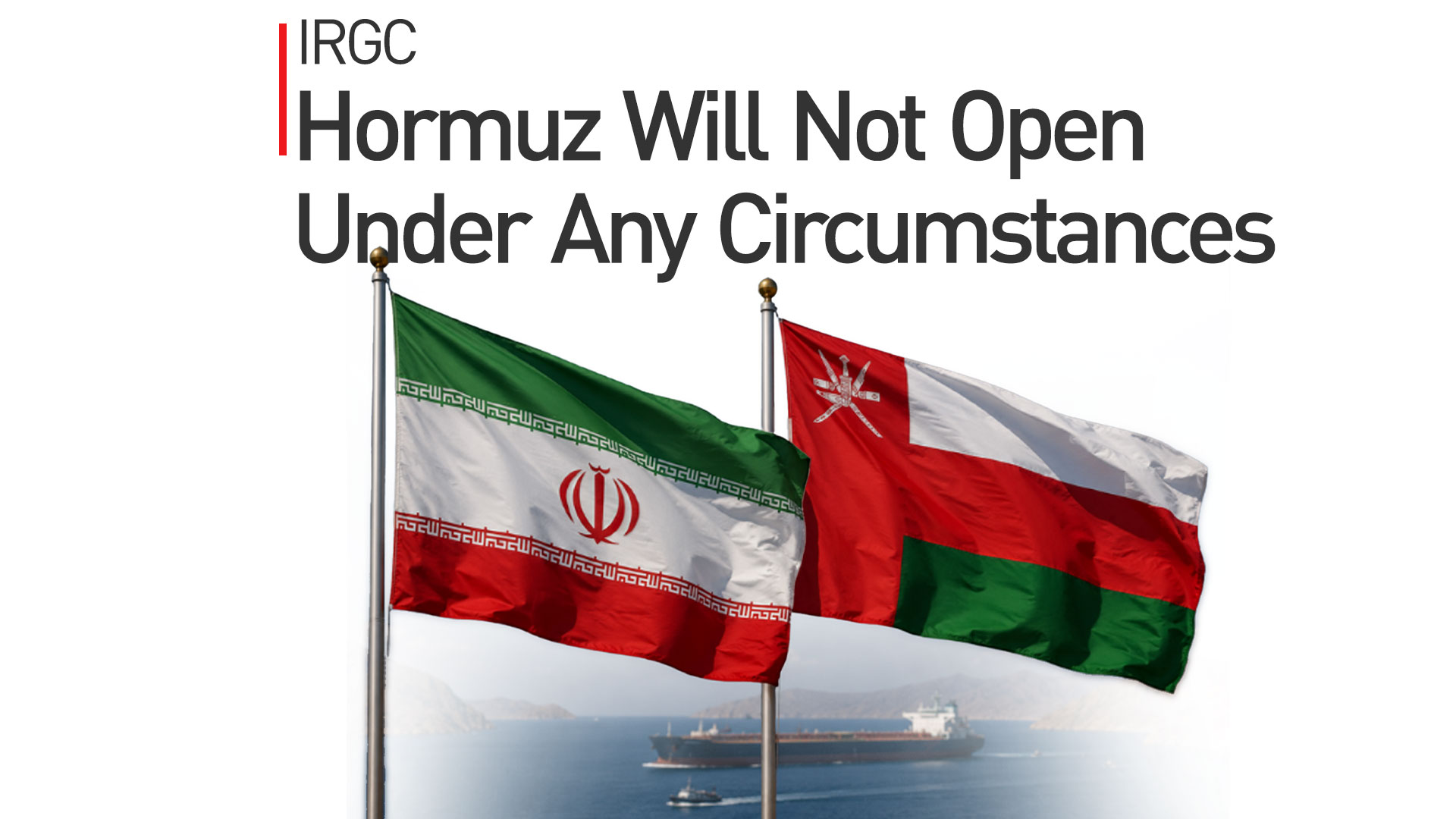
ERBIL (Kurdistan 24) - The Islamic Revolutionary Guard Corps issued its most definitive statement yet on the Strait of Hormuz on Wednesday with its spokesman declaring that the waterway will not be opened under any circumstances if the United States does not accept Iran's conditions, while simultaneously confirming that Iran and Oman have reached agreements on their respective shares of the strait's territorial waters and revenues, and blaming Washington's interference for the delays in finalizing the framework.
"If the United States does not accept our conditions, the Strait of Hormuz will not be opened under any circumstances," the IRGC spokesman said in a statement on Wednesday. "The Strait of Hormuz is under our control, and there are no enemy military vessels in it. All enemy war vessels are at least a kilometer away from the strait, and from a military and territorial point of view, no vessel can cross this sea route without Iran's approval and management."
The IRGC spokesman provided the most detailed public confirmation yet of what the Iran-Oman negotiations have produced. "During the negotiations with Oman, agreements were reached regarding the share of each of the two countries in the waters of the strait, as well as the share of Iran and Oman in the revenues arising from it," he said. "The United States is interfering with this process, and this is causing delays."
He then laid out Iran's position on the path forward with rare clarity. "If the United States stops the disruption and returns to the agreement, we can open the Strait of Hormuz within the framework of the agreement reached. Therefore, our conditions must be accepted by the United States. If it does not accept our conditions, the Strait of Hormuz will not be opened under any circumstances."
The repetition of the phrase "under any circumstances" twice in the same statement is deliberate and significant, signaling that Tehran views its position as non-negotiable and is not leaving open any ambiguity about the conditionality of a Hormuz opening regardless of the economic pressure being applied through Operation Economic Outcast.
The IRGC spokesman's claim that all enemy warships are at least a kilometer from the strait directly contradicts the US Navy's operational posture throughout the conflict, in which American vessels have escorted commercial shipping through the waterway and conducted minesweeping operations. It also directly contradicts President Trump's Truth Social post declaring that all mines have been removed and the strait is "open and operating," a claim that Iranian Deputy Foreign Minister Kazem Gharibabadi dismissed on the same day as "propaganda deception," warning that Iran would target US minesweepers entering the area.
The revenue-sharing confirmation from the IRGC spokesman adds a critical financial dimension to what had previously been described as a technical agreement on geographic coordinates and navigational routes. The settlement of revenue shares between Iran and Oman transforms the bilateral maritime framework from a purely operational shipping arrangement into a formal joint management and revenue-sharing structure, one in which both coastal states claim a financial stake in the transit of commercial vessels through the waterway.
The announcement directly reinforces and expands the position that Iran's Supreme National Security Council Secretary Mohsen Rezaei articulated on Saturday, August 22, 2026, when he declared that any opening of the Strait of Hormuz will be managed by Tehran and will carry a fee, adding explicitly that this position has no connection to the separate Iran-Oman route agreement. The IRGC's Wednesday confirmation that revenue shares have now been agreed between the two countries suggests that the fee-based management framework is no longer merely a declared intention but a bilaterally agreed financial arrangement with Oman as a co-beneficiary.
Oman's willingness to formally share in Hormuz revenues with Iran places Muscat in a more complex diplomatic position relative to Washington. The sultanate has served throughout the conflict as the most trusted intermediary between the United States and Iran. A revenue-sharing agreement that gives Oman a direct financial stake in the Iran-managed toll system creates a structural interest for Muscat in seeing that system succeed, which may not align perfectly with Washington's goal of restoring pre-war conditions under which no toll authority existed.
Omani Foreign Minister Badr Albusaidi had said on Tuesday that he hoped Iran and Oman would "soon announce" the temporary corridor in the strait, adding that "future management of the strait and a permanent solution will follow in due course." The IRGC spokesman's Wednesday statement that the framework is essentially ready and only Washington's interference is causing delays is a direct inversion of the American narrative, which frames Iran's conditions as the primary obstacle to reopening.
As maritime intelligence firm Kpler confirmed, traffic through the Strait of Hormuz has surged nearly 400 percent over two weeks to nearly 200 ships, with more than 80 percent of liquid cargoes using the US-backed Omani corridor that Iran does not formally recognize. The IRGC's revenue-sharing announcement, arriving as that traffic surge continues, signals Tehran's intent to claim financial authority over vessels transiting the strait regardless of which route they use or whether they have Iran's explicit approval.
Iran's Deputy Foreign Minister Gharibabadi had separately expanded Tehran's conditions for a full Hormuz reopening on Wednesday to include not only the lifting of the US naval blockade and the end of the war on all fronts, including Lebanon, but also the resolution of the situation in Yemen, where Iran-backed Houthis upended a 2022 truce in July 2026. The IRGC spokesman's statement, placed alongside Gharibabadi's expanded conditions and Rezaei's earlier fee declarations, presents a unified and escalating Iranian position that links Hormuz reopening to a comprehensive regional settlement on Tehran's terms.