Iran's Political Leadership Defends Negotiations Against Hard-Line Critics
Iran's President Masoud Pezeshkian and Parliament Speaker Mohammad Baqer Qalibaf defended diplomacy with the US as Qatar and Oman intensify mediation and Hormuz becomes central to ending the Iran war.
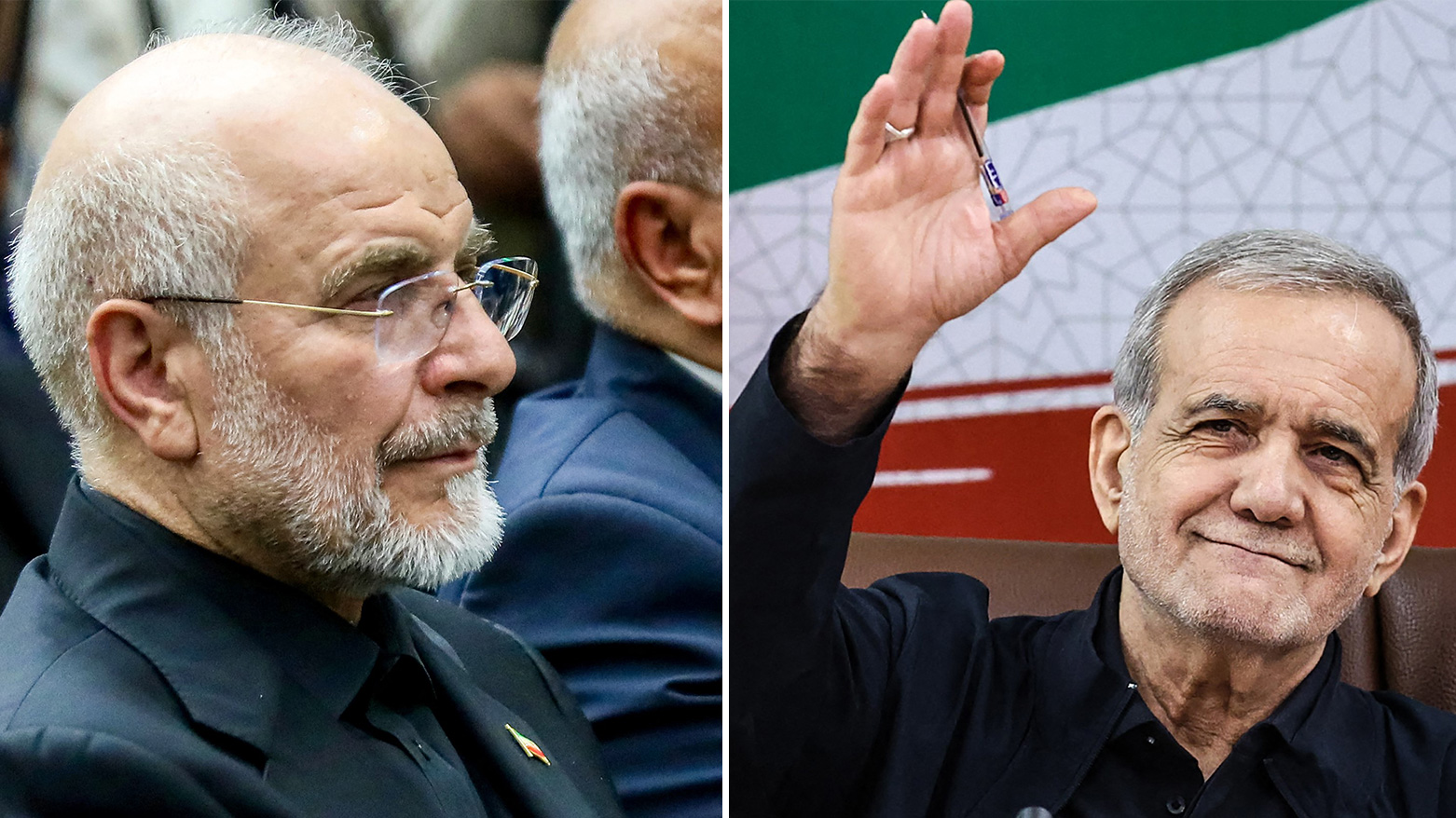
ERBIL (Kurdistan24) - Iranian President Masoud Pezeshkian and Parliament Speaker Mohammad Baqer Qalibaf have mounted unusually explicit defenses of diplomacy with the United States, pushing back against hard-line opposition as regional mediators intensify efforts to revive negotiations nearly six months into the Iran war.
Their remarks come as Qatar prepares a new diplomatic push in Tehran and Iran and Oman negotiate a temporary shipping corridor through the Strait of Hormuz, the strategic waterway that has moved to the center of efforts to contain the conflict.
Speaking at Tehran's International Conference Center, Pezeshkian defended negotiations as a necessary instrument of statecraft and argued that military confrontation could not resolve every dispute.
"War is not always the way to resolve problems," he said.
Pezeshkian said his government's approach remained based on mutual understanding and resolving disagreements through engagement.
"A knot that can be untied by hand should not be untied with the teeth," he said, invoking a popular proverb to argue against unnecessarily escalating disputes that could still be settled politically.
The president also defended efforts surrounding the memorandum of understanding reached with the United States in June, saying the diplomatic initiative served Iran's highest national interests and strengthened the country's international position.
The public defense is significant because opposition to negotiations with Washington remains powerful within Iran's political establishment, particularly among hard-line voices that view renewed engagement after months of war as either futile or dangerous.
Qalibaf pushes back against hard-liners
Qalibaf, himself a prominent conservative figure, adopted a similarly forceful position.
His intervention amounted to an indirect response to Hossein Shariatmadari, editor-in-chief of the hard-line Kayhan newspaper and a representative of Supreme Leader Ali Khamenei, who had argued against dialogue with American officials.
"Negotiation has value and is not forbidden," Qalibaf said.
He criticized political figures who avoid responsibility for conducting difficult negotiations with adversaries and then label achievements by Iran's negotiating team as "treason."
Qalibaf argued that opposition to dependence on Western powers should not be confused with rejecting diplomacy altogether.
Iran, he said, could negotiate "from a position of strength" and pursue the rights and interests of Iranians without such engagement amounting to compromise or capitulation.
The convergence between Pezeshkian and Qalibaf is politically notable.
Although they come from different political traditions, both are now presenting negotiations as compatible with Iranian sovereignty and national strength rather than as a concession to Washington.
That argument is becoming more urgent as mediators attempt to reconstruct a diplomatic process that unraveled after the June memorandum.
Qatar's prime minister was expected in Tehran on Thursday as part of efforts to reopen diplomatic channels, while Pakistan has also been involved in attempts to move Washington and Tehran back toward negotiations, according to the supplied reporting.
Hormuz becomes diplomatic test
The most immediate diplomatic activity, however, is centered on the Strait of Hormuz.
Iran and Oman are negotiating arrangements for a temporary shipping corridor and the removal of mines from the largely blockaded waterway, AFP reported Thursday.
The two countries have not yet agreed on the terms of reopening the strait, but their foreign ministers discussed a framework in Tehran on Tuesday.
Omani Foreign Minister Badr Albusaidi said he hoped a temporary corridor and "practical arrangements to restore safe navigation" could be announced soon.
Under the proposal described by Iranian Deputy Foreign Minister Kazem Gharibabadi, vessels entering the Gulf would pass through Iranian waters, while outbound vessels would travel through Omani and then Iranian waters.
If an interim arrangement is reached, Iran and Oman would then have between 30 and 60 days to negotiate a permanent route.
Iran's Revolutionary Guards are participating in the discussions, Gharibabadi said, and the maps under consideration were prepared by the armed forces.
The Guards have also said Iran and Oman agreed in negotiations to share revenue from possible fees imposed on shipping through the strait, an idea opposed by Washington.
The talks demonstrate how Hormuz has become inseparable from the wider conflict.
The narrow waterway previously carried around one-fifth of the world's oil supplies, making prolonged disruption a global economic issue rather than solely an Iran-US military dispute.
A June US-Iran memorandum of understanding provided for reopening the strait and assigned Iran and Oman a role in defining its future administration and maritime services in consultation with Gulf states and under international law.
But the agreement subsequently broke down as wider disputes persisted.
Tehran now insists that full reopening cannot be separated from broader US concessions.
"Before any action is taken to reopen the Strait of Hormuz, the United States must fully implement all the commitments it has breached," Gharibabadi said Tuesday.
He linked reopening to an end to the war, lifting the blockade on Iran and resolving the situation in Yemen.
Iran has also sought sanctions relief, compensation for war damage and security guarantees as part of a broader settlement.
US war aims have shifted
The diplomatic maneuvering comes as the United States itself has altered its priorities nearly six months after the conflict began on Feb. 28.
The Associated Press reported Thursday that the Trump administration entered the war with objectives centered on Iran's nuclear program, missile capabilities, defense industry, armed forces and regional allies.
The Strait of Hormuz was not initially among Washington's main publicly stated goals.
It is now one of the central issues.
The prolonged disruption of shipping has contributed to higher fuel and fertilizer prices and created economic and political pressure beyond the Middle East.
Washington has also shifted toward intensified economic pressure after months of military operations depleted important US weapons stockpiles, according to AP.
US airstrikes have been suspended during the relative military lull of the past month, while pressure on Iran's trading partners has increased.
Despite repeated US claims that Iran's military capabilities have been severely damaged, Tehran has retained an ability to conduct drone and missile operations and to exert pressure through Hormuz.
That reality helps explain why negotiations over the waterway have assumed such importance.
Rather than functioning simply as a maritime technical issue, control over navigation has become one of Tehran's most significant remaining sources of leverage.
Oman is attempting to separate freedom of navigation from the broader conflict.
Omani researcher Abdallah Baaboud told AFP that Muscat and Tehran were effectively negotiating elements of a postwar security and governance structure for Hormuz, explaining why agreement has proved difficult.
For Oman, the objective is a regional arrangement guaranteeing navigation rather than a system dependent exclusively on either permanent US military power or unilateral Iranian control.
Diplomacy amid continuing strategic competition
The push for dialogue does not mean Iran is abandoning its other strategic partnerships.
Pezeshkian is expected to meet Russian President Vladimir Putin next week during the Shanghai Cooperation Organisation summit in Bishkek, according to Iranian state media.
Iran's ambassador to Russia, Kazem Jalali, said the meeting would be the sixth between the two presidents.
The planned encounter illustrates Tehran's attempt to pursue several diplomatic channels simultaneously: talks with Gulf mediators over Hormuz, possible renewed engagement with Washington, and continued strategic coordination with Moscow.
At home, however, Pezeshkian and Qalibaf must still contend with political forces deeply suspicious of US negotiations.
The debate is therefore increasingly about more than whether Iran should talk to Washington.
It is about what diplomacy signifies after six months of war: weakness and concession, as some hard-line opponents argue, or a legitimate instrument for preserving Iranian interests after military confrontation failed to produce a political settlement.
Pezeshkian and Qalibaf have now publicly chosen the second interpretation.
With Qatar preparing another mediation effort, Oman negotiating practical arrangements in Hormuz and Washington increasingly relying on economic rather than military pressure, the coming diplomatic moves will test whether that argument can gain enough political space inside Iran to produce a renewed negotiating process.
For now, the war remains unresolved, Hormuz remains constrained and neither Washington nor Tehran has secured the broader political settlement it seeks.
But the public defense of negotiations by two of Iran's most senior elected officials suggests that, despite resistance from powerful hard-line voices, diplomacy is again becoming part of Tehran's immediate strategy.