Iraq Says Formation of New Armed Groups Is Constitutionally Prohibited
Iraq says forming armed groups outside official security forces is constitutionally prohibited as Baghdad pushes state control over weapons ahead of the Sept. 30 coalition deadline.
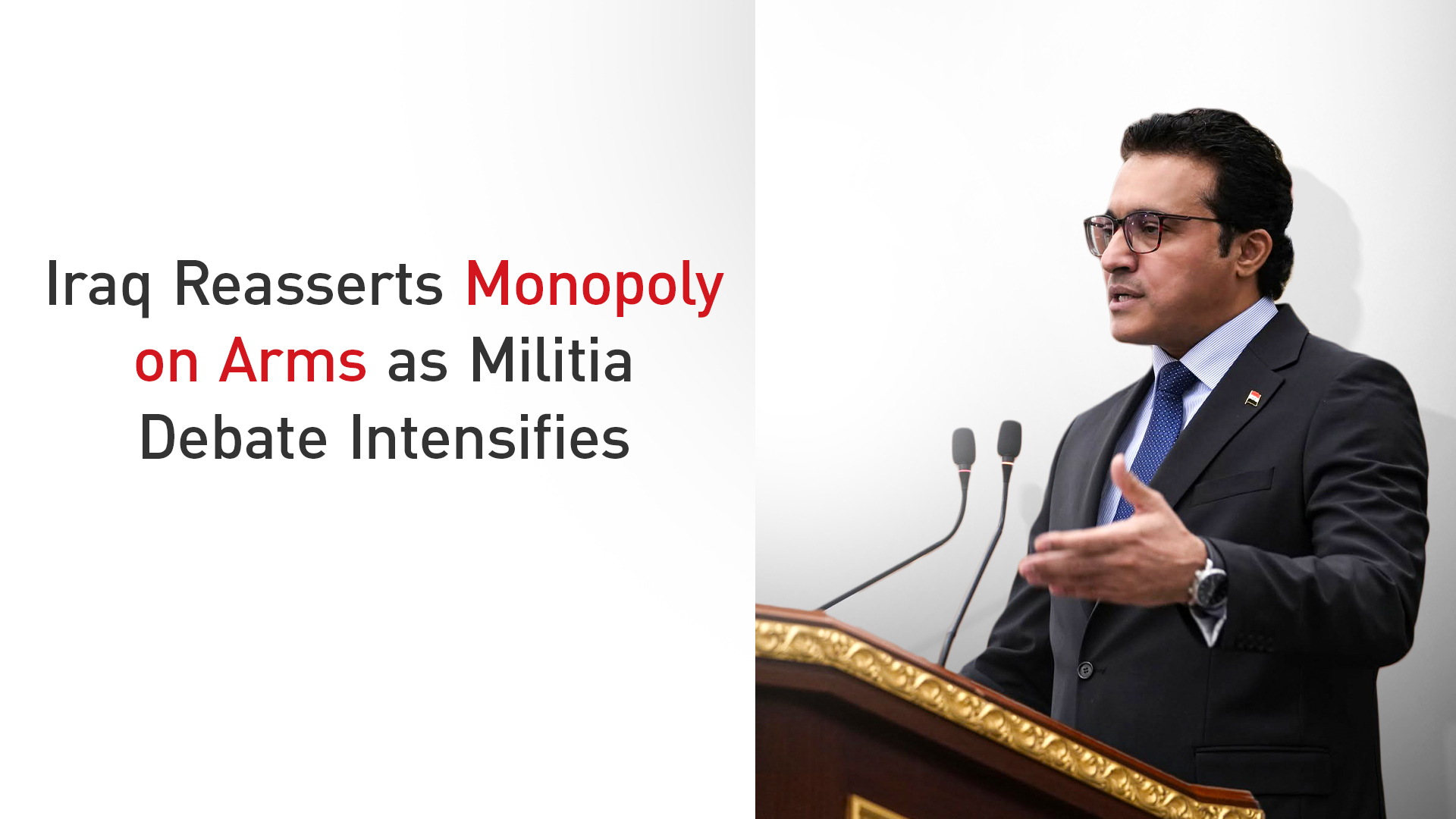
ERBIL (Kurdistan24) - Iraq's government said Monday that the formation of new armed groups outside the country's official security institutions is constitutionally prohibited, reaffirming Baghdad's push to bring weapons under state authority as the Sept. 30 deadline for the end of the international coalition's mission approaches.
Government spokesperson Haider al-Aboudi told the Iraqi News Agency (INA) that controlling weapons is a central priority of the government's ministerial program and should be understood as a return to normal constitutional and state procedures.
The Iraqi Constitution, he said, does not permit the establishment of armed formations operating independently of recognized security institutions.
Aboudi's remarks come as the government of Prime Minister Ali al-Zaidi faces growing pressure to demonstrate that the departure of coalition forces will be accompanied by stronger state control over armed actors operating inside Iraq.
The two issues have increasingly become politically intertwined, with several armed factions linking the future of their weapons to the presence of foreign forces.
Sept. 30 presented as sovereignty milestone
Aboudi said Baghdad was awaiting Sept. 30, when the international coalition's mission on Iraqi territory is scheduled to end under existing agreements.
He described the date as an important milestone for Iraqi sovereignty and the Iraqi people.
The drawdown is already underway. German forces withdrew from Iraq and the Kurdistan Region during August, according to previous Kurdistan24 reporting, as coalition members progressively reduce their presence under the agreed timetable.
Baghdad has intensified discussions with Washington and coalition partners over the transition, while simultaneously seeking to address the status of armed groups that maintain weapons outside direct state command.
For the government, the argument is that the end of the coalition mission removes one of the principal justifications repeatedly cited by armed factions for maintaining independent military capabilities.
Weapons file grows more politically sensitive
Placing weapons under state control was one of al-Zaidi's commitments when forming his cabinet.
The government has since instructed the Interior Ministry and other security institutions to take measures aimed at regulating armed formations, unifying command structures and holding accountable those who operate outside the law.
The issue has become increasingly sensitive as the Sept. 30 deadline approaches.
Several Iran-aligned factions have resisted full disarmament or attached conditions to any agreement.
Kurdistan24 previously reported that Kataib Sayyid al-Shuhada characterized the process as a reorganization of weapons rather than a permanent surrender of arms and asserted that armed groups could rearm if circumstances demanded it.
Other political actors have warned of serious internal consequences if Baghdad fails to reach an agreement with factions before the deadline.
Badr Organization Secretary-General Hadi al-Amiri has meanwhile said there should be no armed confrontation between the state and what he calls the resistance, arguing that the weapons file must remain an Iraqi national matter.
Aboudi's statement places the government's position in constitutional rather than factional terms: armed organizations cannot legally be established outside the recognized state security framework.
Atrushi backs government, separates Peshmerga from militias
The government position has received support from Iraqi Deputy Parliament Speaker Farhad Amin Atrushi, who said in remarks reported by Kurdistan24 that political forces should support al-Zaidi in bringing weapons under state control.
"We support the prime minister and the government in the file of placing weapons under state control, and it is an important Iraqi security matter," Atrushi told the Iraqi National News Agency, NINA.
He also linked the outcome directly to Iraq's international relations, warning that continued proliferation of weapons outside state authority could damage Baghdad's ties with neighboring states and the wider international community.
At the same time, Atrushi firmly rejected efforts to include the Kurdistan Region's Peshmerga forces in the same disarmament category.
He argued that the Peshmerga are part of Iraq's constitutional security structure and derive their legal position from Article 121 of the Constitution, which recognizes the Kurdistan Region's responsibility for regional security forces.
"Dragging the Peshmerga forces into the weapons regulation file is intended to confuse the cards," Atrushi said.
Read More: Iraq's Deputy Parliament Speaker: Dragging Peshmerga Into Disarmament File Is Deliberate Confusion
His comments reinforced an earlier position expressed by Iraqi National Security Adviser Qasim al-Araji, who said Peshmerga weapons fall within Iraq's constitutional framework and are therefore distinct from formations operating outside it.
That distinction has become important as political debate around the weapons file intensifies.
The government's stated objective is not the elimination of constitutionally recognized federal or regional security institutions, but the restriction of armed authority to bodies operating legally within the state structure.
Sovereignty linked to institutional authority
Aboudi's remarks effectively connect two of the government's central security objectives: ending the coalition mission and restoring a clearer state monopoly over the legitimate use of force.
Baghdad has repeatedly framed the coalition withdrawal as evidence that Iraqi security institutions are increasingly capable of assuming responsibility for the country's security.
That argument, however, places greater pressure on the government to address armed actors that continue to retain independent command structures or capabilities.
If foreign military presence is reduced while significant armed formations remain outside direct state control, Baghdad could face continued questions over the practical reach of state authority.
The government is therefore presenting weapons regulation as a constitutional requirement rather than simply a response to U.S. pressure.
Anti-corruption campaign also highlighted
Aboudi also used his INA remarks to point to progress in the government's anti-corruption drive, saying the campaign had achieved major results he described as unprecedented since 2003.
The Federal Integrity Commission has announced a series of arrests, asset seizures and court decisions involving senior officials and former lawmakers in recent weeks.
Kurdistan24 reported Sunday that former lawmaker Talal al-Zubaie and Oil Ministry undersecretary Ali Maarij al-Bahadli were each sentenced to seven years in prison in illicit-enrichment cases and ordered to pay a combined approximately 123 billion Iraqi dinars in restitution and fines.
The government has also said more than 1.359 trillion dinars in money, assets and real estate has been recovered through its wider anti-corruption campaign.
For Baghdad, the weapons and corruption files are being presented as related components of a broader effort to reinforce state institutions.
As Sept. 30 approaches, however, the more immediate test will be the government's ability to translate its constitutional position on armed groups into enforceable state authority without triggering a wider confrontation.