Mazloum Abdi Says Dialogue Channels With Türkiye Are Open
Mazloum Abdi says channels of dialogue with Türkiye are open as the former SDF commander shifts toward constitutional politics, Kurdish rights and a new role in Damascus.
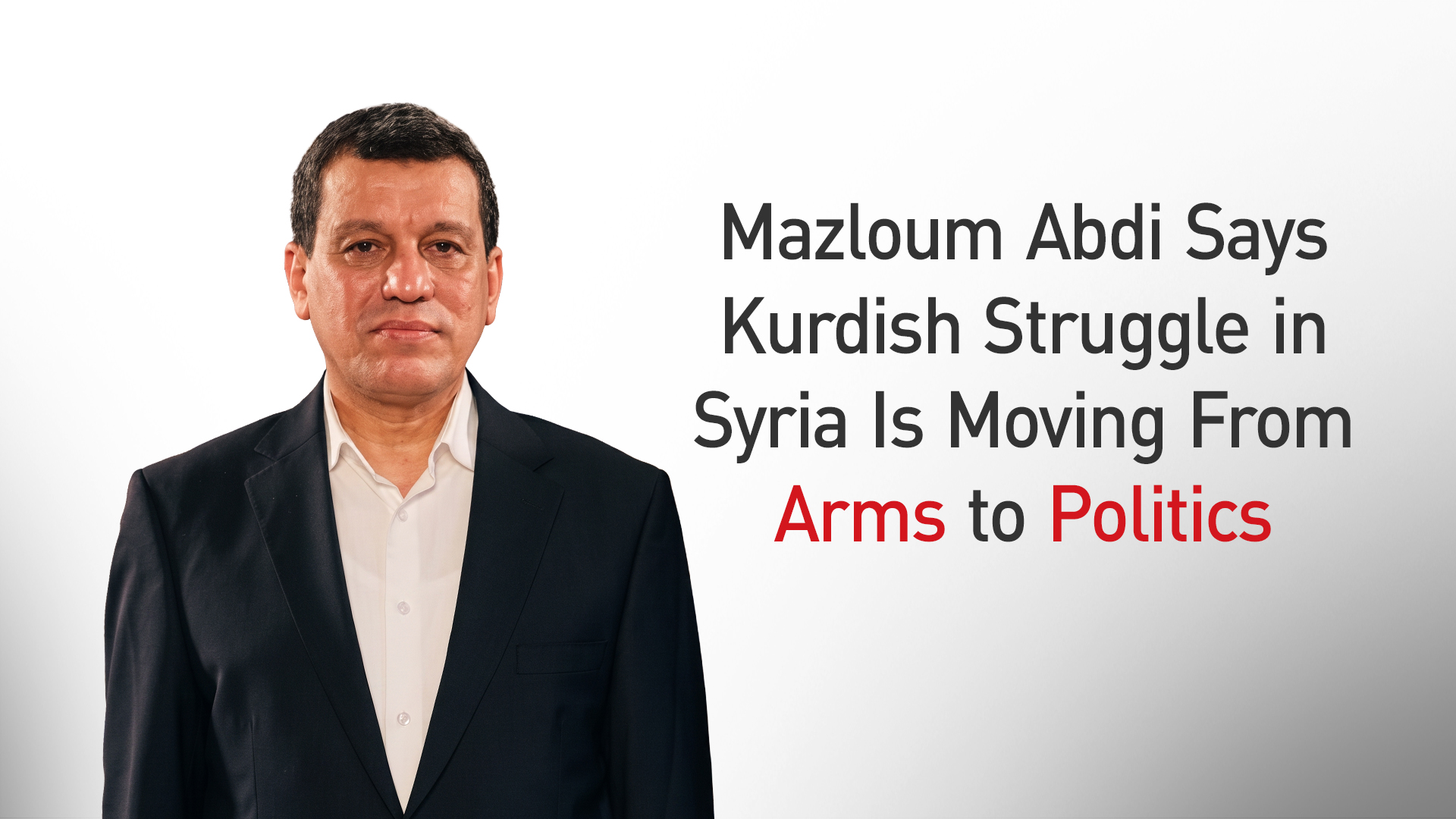
ERBIL (Kurdistan24) - Mazloum Abdi, the former commander of the Syrian Democratic Forces and now an adviser to Syrian President Ahmad al-Sharaa, says channels of communication with Türkiye are open and should develop into a normal and constructive relationship as Kurdish politics in Syria moves from 15 years of armed struggle toward a new phase centered on constitutional rights, diplomacy and political organization.
In his first extensive interviews with journalists from Türkiye, published and broadcasted by Ilke TV on Friday, following the SDF's integration into Syrian state institutions, Abdi presented that transition as neither surrender nor outright victory, but as the beginning of a fundamentally different struggle over the place of the Kurds in the new Syrian state.
"Our relations with Türkiye must be improved and reassessed," Abdi said. "Channels of contact and dialogue between us and Türkiye are currently open."
He said relations should now proceed on a "normal and constructive footing," while making clear that avoiding another war was among his most important personal objectives.
"I made a promise to myself: unless absolutely necessary, I do not want to subject our people to the conditions of war again," he said.
Speaking separately to journalists Banu Güven and Nezahat Doğan of Yeni Yaşam, Abdi addressed the end of the SDF as an independent military formation, Kurdish-language education, constitutional guarantees, relations with Ankara and the need for a new political movement capable of translating the SDF's social base into civilian politics.
His appearance itself reflected the transition. After years in military uniform as commander of the U.S.-backed SDF, Abdi appeared in civilian clothing and spoke in his new capacity as an adviser to the Syrian presidency.
Integration Is 'an Ending, but Also a Beginning'
Abdi rejected descriptions of the SDF's integration into the Syrian army as a surrender.
Speaking to Banu Güven, he said SDF fighters had entered the state military structure together with their commanders and organized units rather than simply abandoning the force individually.
He described the process as "an ending, but also a beginning."
The ending is the SDF's 15-year period as an independent armed force. The beginning, in Abdi's formulation, is a political and constitutional struggle over Kurdish identity and rights inside Syria.
Abdi announced in August that the SDF's independent mission had ended following completion of its integration into Syrian institutions.
He acknowledged that the decision had been difficult for a force that lost thousands of fighters and established substantial military, political and administrative influence across northeastern Syria during the civil war and campaign against ISIS.
But he described the autonomous political and military experience of the past 15 years as a transitional phase rather than an end state.
The central question now, he said, is what status the Kurds will hold inside Syria.
Abdi argued that the current environment differs substantially from the Baath era, when successive governments denied or suppressed Kurdish political and cultural identity.
For the first time, he said, Kurds have an opportunity to enter the emerging Syrian state while being formally recognized as Kurds.
That does not mean all Kurdish objectives have been achieved.
Abdi said national, cultural, administrative and linguistic rights still require durable legal guarantees.
His stated objective is not separation from Syria, but for Kurds to become one of the country's recognized constituent communities while preserving and expanding rights accumulated during the years of autonomous administration.
Why Kurdish-Language Expectations Have Not Yet Been Met
One of Abdi's clearest reservations concerns Kurdish-language education.
Under the former autonomous administration in northeastern Syria, Kurdish students could receive instruction in their mother tongue from primary education through university.
The Syrian government has now formally recognized a degree of Kurdish-language education, but Abdi said the new arrangements fall considerably short of what Kurdish communities had established over the previous decade.
He said Kurdish criticism of the current framework was therefore justified.
For Abdi, the language issue also extends beyond negotiations between Kurdish representatives and Damascus.
He suggested that the policies and concerns of neighboring states also influence how far Syrian authorities are prepared to go in recognizing Kurdish-language education.
Nevertheless, he argued that Kurdish families themselves have an important role in ensuring the language remains part of public and educational life, including by continuing to enroll their children in Kurdish-language programs.
Abdi also connected the issue to his own childhood.
He recalled being detained when he was 13 or 14 after Kurdish-language books were discovered at his school.
The books, he said, dealt with Kurdish history, Newroz and the legend of Kawa. He spent approximately a week in detention.
Against that personal history, even limited state recognition of Kurdish education represents a major change, he said.
But he stressed that recognition should be treated as a starting point, not the final settlement.
His broader argument is that rights initially granted through administrative decisions or presidential decrees can be expanded only if Kurdish society continues pressing for them politically.
Will Kurdish Rights Be Guaranteed in the Constitution?
The next Syrian constitution will therefore be one of the most consequential political battles for the Kurds, according to Abdi.
He said a constitutional drafting committee could be established within the next two or three months, although no definitive timetable has been announced.
Kurdish representatives, he said, want direct participation in that process.
Abdi pointed to earlier agreements between Kurdish representatives and Damascus, including the March 10 and Jan. 29 arrangements, as well as presidential decrees that acknowledged aspects of Kurdish identity and language rights.
His concern is permanence.
Administrative decisions can be changed by future governments. Constitutional protections are harder to reverse.
Abdi therefore wants Kurdish national, cultural, mother-tongue and administrative rights incorporated directly into Syria's new constitutional structure.
He acknowledged that what has been secured so far remains substantially below the full range of Kurdish demands.
The legacy of the previous 15 years, he said, also extends beyond formal political institutions.
During the autonomous period, northeastern Syria developed its own administrative practices, institutions and social structures.
Not every element of that experience will necessarily survive intact under the new Syrian system, but Abdi argued that the social and political culture created during those years cannot simply disappear with the SDF's dissolution.
He also said there were greater possibilities for building a secular, democratic and civilian political system than existed under the Baath government, even while acknowledging the significant obstacles facing such a project.
Syria's desire for stronger international relations and greater conformity with international law, he argued, could create additional space for that transformation.
What Fills the Political Space Left by the SDF?
The end of the SDF as an independent military force creates another immediate challenge: what political structure will represent the constituencies that supported it?
Abdi said that vacuum cannot be ignored.
For 15 years, the SDF was not merely a military organization. It became one of the principal institutions shaping security and political life in northeastern Syria and developed a significant social constituency.
With that military role ending, Abdi said political actors in the region are now discussing the creation of a new organization.
Its name, leadership and structure have not yet been finalized.
But Abdi described establishing such a political body as necessary if the experience and social base accumulated during the SDF period are to move into civilian politics.
The transition from armed struggle to political struggle, in other words, cannot simply mean dismantling military structures.
It requires building institutions capable of contesting elections, influencing constitutional debates, negotiating with Damascus and representing Kurdish demands through peaceful political mechanisms.
That may become one of the defining tests of the post-SDF period.
Abdi's own transition from commander to presidential adviser also places him at the center of that transformation, although he has not said that he will personally lead the proposed political organization.
What Role Could Türkiye Play in Syria?
Abdi devoted significant attention to Türkiye, whose relationship with the SDF was for years defined largely by security confrontation.
Ankara viewed the SDF's principal Kurdish components through the lens of their alleged links with the Kurdistan Workers' Party, or PKK, and considered the force a threat along Türkiye's southern border.
Abdi now argues that the relationship should be reassessed.
Türkiye, he said, will remain one of the most influential external actors in Syria because of geography, economic capacity and its ability to contribute to reconstruction.
Rather than treating Ankara solely as a security adversary, he said there were areas where cooperation could develop around economic recovery and regional stability.
A stable Syria, he argued, is also in Türkiye's interest.
Abdi additionally linked developments in Syria to the wider Kurdish question inside Türkiye.
He said Kurdish political issues in the two countries cannot be considered entirely separately because developments on either side of the border have historically influenced the other.
In his view, the ongoing peace process in Türkiye could therefore have positive consequences for Syria.
A reduction in Turkish-Kurdish tensions inside Türkiye could create more political room for resolving Kurdish issues across the border without renewed military confrontation.
That assessment marks a significant change from the period when Turkish forces and the SDF faced one another as adversaries.
When Could Abdi Visit Türkiye, and What Would Be on the Agenda?
Abdi did not announce an imminent visit to Türkiye, but his remarks made clear that Ankara could become a significant part of his new diplomatic role.
He said he had not yet formally begun all of his duties as presidential adviser because he was still completing work connected to the SDF integration process.
Once that phase is finished, he expects to assume his role in Damascus while continuing to spend time among Kurdish communities in northeastern Syria.
His proposed agenda with Türkiye extends beyond security.
Economic reconstruction, regional stability, Kurdish political rights and broader normalization are among the subjects he believes could form part of future dialogue.
He argued that improved relations between Kurdish political actors and Ankara could contribute to stability across Syria rather than simply easing bilateral tensions.
That possibility has gained further attention after unofficial Turkish media reports claimed that Türkiye's Interior Ministry had removed Abdi from its terrorist list following his appointment to the Syrian presidency.
Kurdistan24 reported Thursday, citing Manşet Haber and other unofficial Turkish outlets, that Abdi was reportedly no longer included on the list.
Read More: Türkiye Reportedly Removes Mazloum Abdi from Terrorist List
Turkish authorities have not publicly confirmed such a decision.
A similar change was reportedly made concerning Sipan Hamo after the senior Kurdish commander received a position in Syria's Defense Ministry.
Without an official announcement from Ankara, however, Abdi's reported delisting should not be treated as confirmed Turkish policy.
If verified, it would nevertheless represent a significant signal of how Türkiye is adapting to the incorporation of former SDF commanders into Syria's internationally recognized state institutions.
'Channels of Contact and Dialogue With Türkiye Are Open'
In his interview with Nezahat Doğan of Yeni Yaşam, Abdi was more explicit about the current state of contact with Ankara.
"Channels of contact and dialogue between us and Türkiye remain open today," he said.
He argued that those contacts should now develop into a normal and constructive relationship.
Abdi again rejected the idea that the SDF had surrendered, saying its units entered the Syrian army as brigades alongside their commanders and would remain responsible for protecting areas where they were stationed.
But his emphasis was no longer primarily military.
The larger objective, he said, is to replace an era defined by weapons with one based on constitutional negotiation and political organization.
His formulation of the Kurdish goal is consequently different from the project of building a separate state or independent territorial entity.
The objective, he said, is "not to establish a separate entity from Syria, but to become one of Syria's founding constituents with their own identity and to expand the gains already achieved by securing constitutional guarantees."
That may ultimately define Abdi's political legacy more than the military command he held during the campaign against ISIS.
The SDF's integration has ended one institutional chapter, but the questions that produced Kurdish armed mobilization, language, identity, governance, security and political representation, remain unresolved.
Abdi is now arguing that those questions must be addressed through the Syrian constitution, negotiations with Damascus and a recalibrated relationship with Türkiye.
And after 15 years in which war shaped almost every major decision in northeastern Syria, his clearest message is that he does not want Kurdish society to return to that cycle.
"Unless absolutely necessary," he said, "we do not want our people to be subjected to the conditions of war again."