Kurdistan Launches Its First National AI Competition With $30,000 in Prizes
Yehya Chali tells Kurdistan 24 exclusively that the competition is open to everyone 18 and above with no degree required, as Korea's Erbil consulate and the KRG Department of Technology back the Region's most ambitious technology talent initiative
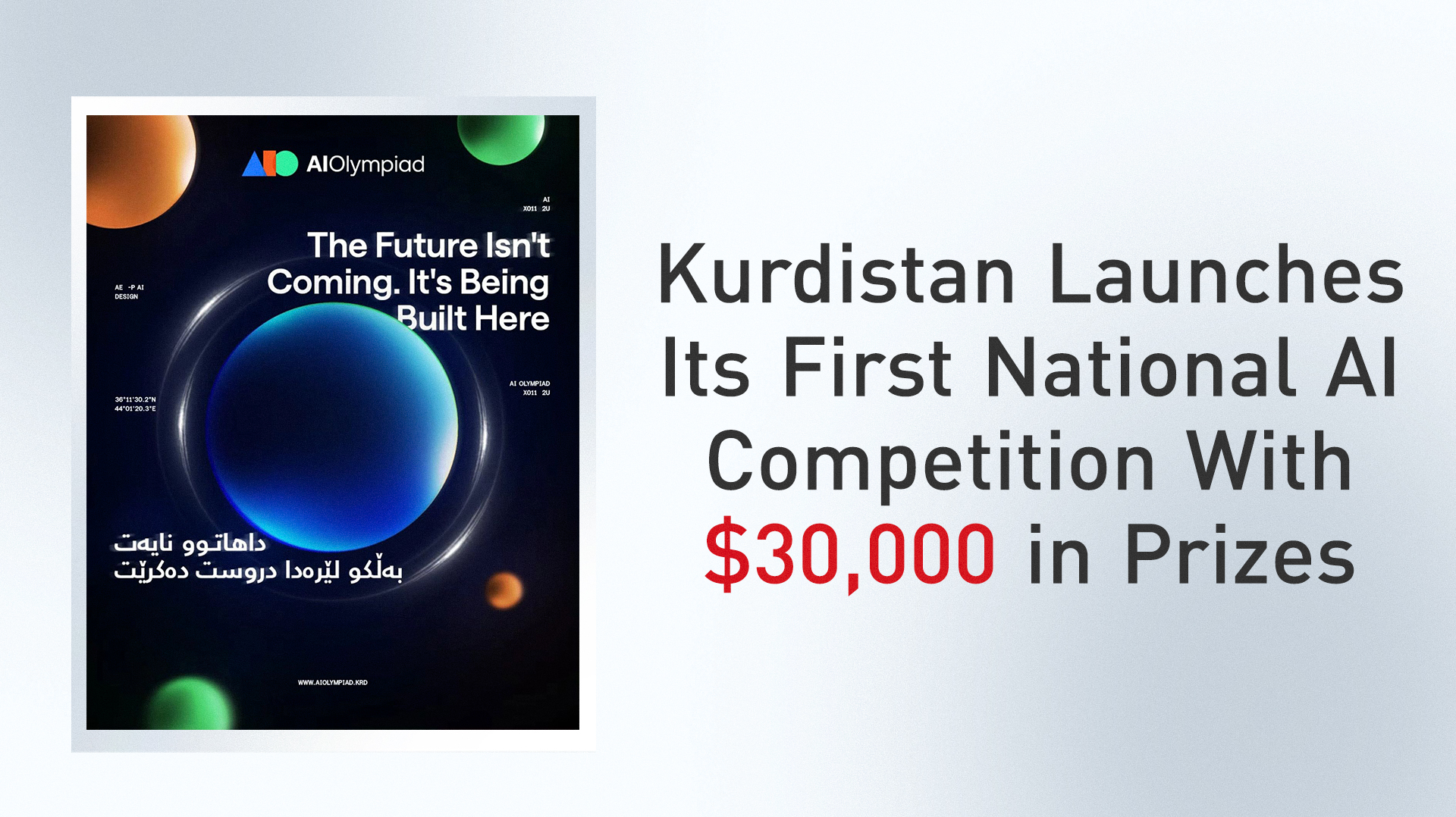
ERBIL (Kurdistan 24) - A new artificial intelligence competition will bring together technology enthusiasts from across the Kurdistan Region between September and the end of November 2026, offering participants six weeks to develop AI-based solutions to real-world problems and a total prize pool of $30,000, with winning teams also earning the opportunity to travel to South Korea and receive a job offer.
The AI Olympiad 2026 is the brainchild of Yehya Chali, CEO of Ovanya, organized in partnership with the Consulate General of the Republic of Korea in Erbil and the Department of Technology of KRG. The competition will be open to anyone aged 18 and above from Erbil, Sulaimani, Duhok, Halabja, and Kirkuk and their surrounding towns, with no university degree, student status, or institutional affiliation required to apply.
Yehya Chali Said:
"There Is No Shortage of Talent in Kurdistan. What Has Never Existed Is a Stage Big Enough to Be Seen On"
Yehya Chali told Kurdistan 24 in an exclusive interview that the competition was born from a recognition that Kurdistan has a generation of young people who can build with artificial intelligence but have never had a national platform on which to demonstrate what they are capable of.
"There is no shortage of talented young people in Kurdistan who can write code and build things," Chali said. "What there has never been is a stage big enough for them to be seen on. The AI Olympiad 2026 is an attempt to build that stage."
Chali stressed that the most important message he wants everyone in the Kurdistan Region to hear is that the competition is genuinely open to all. "Anyone 18 or over, anywhere in Kurdistan, can apply through the official link. No degree requirement, no institution behind you, no connections needed. Many capable people will assume this is not for them. I want to tell them it is," he said.
On what participants will actually be doing, Chali was emphatic that the AI Olympiad is not a theoretical exercise or an examination. "This is not an exam or a quiz," he said. "Participants spend six weeks building working AI solutions to real problems in the Region. That distinction is what makes the competition credible." He confirmed that the three challenge categories will be announced at the kickoff event in mid-September, alongside the rules and the platform, and that participants should not wait to find out the categories before applying.
Chali also emphasized that the competition is designed to reach all five provinces equally, not to be an Erbil-centric event that others are merely invited to attend. Co-working spaces will operate in Erbil, Sulaimani, Duhok, and Kirkuk throughout the six-week development phase, with bootcamps delivered both as pre-recorded online sessions and as on-site sessions in all four cities. "Wherever someone lives, there is a space near them and a route in," he said.
On the prize, Chali confirmed that each of the three winning teams will receive $10,000, for a total prize pool of $30,000 across the three categories, alongside the opportunity to travel to South Korea and receive a job offer. "The prize is real, and so is what comes after it," he said.
The partnership with the Consulate General of the Republic of Korea in Erbil gives the AI Olympiad its international dimension and reflects South Korea's growing engagement with the Kurdistan Region's technology and innovation sector. The Korean connection is not incidental: the winning teams' trip to South Korea and job opportunity represent a direct bridge between Kurdish technology talent and one of the world's most advanced technology economies.
The Competition Timeline
Applications will be accepted throughout September, with approximately 100 participants expected to be shortlisted from across Kurdistan. Participants apply as individuals before being placed into teams of up to three at the mid-September kickoff event, where the categories, rules, and platform will be revealed for the first time.
Following the kickoff, teams will spend six weeks developing their projects from home, university, or the co-working spaces in Erbil, Sulaimani, Duhok, and Kirkuk, supported by bootcamps and mentorship from experienced professionals. An expert panel will assess completed projects in early to mid-November and select the finalists, with the winners announced at an awards gala and closing ceremony at the end of November attended by government officials and industry leaders.