Another Group of Anfal Victims' Remains Returns to Kurdistan
The remains of 153 Kurdish women and children killed during the Anfal campaign are returning from a Samawa mass grave as identification efforts continue.
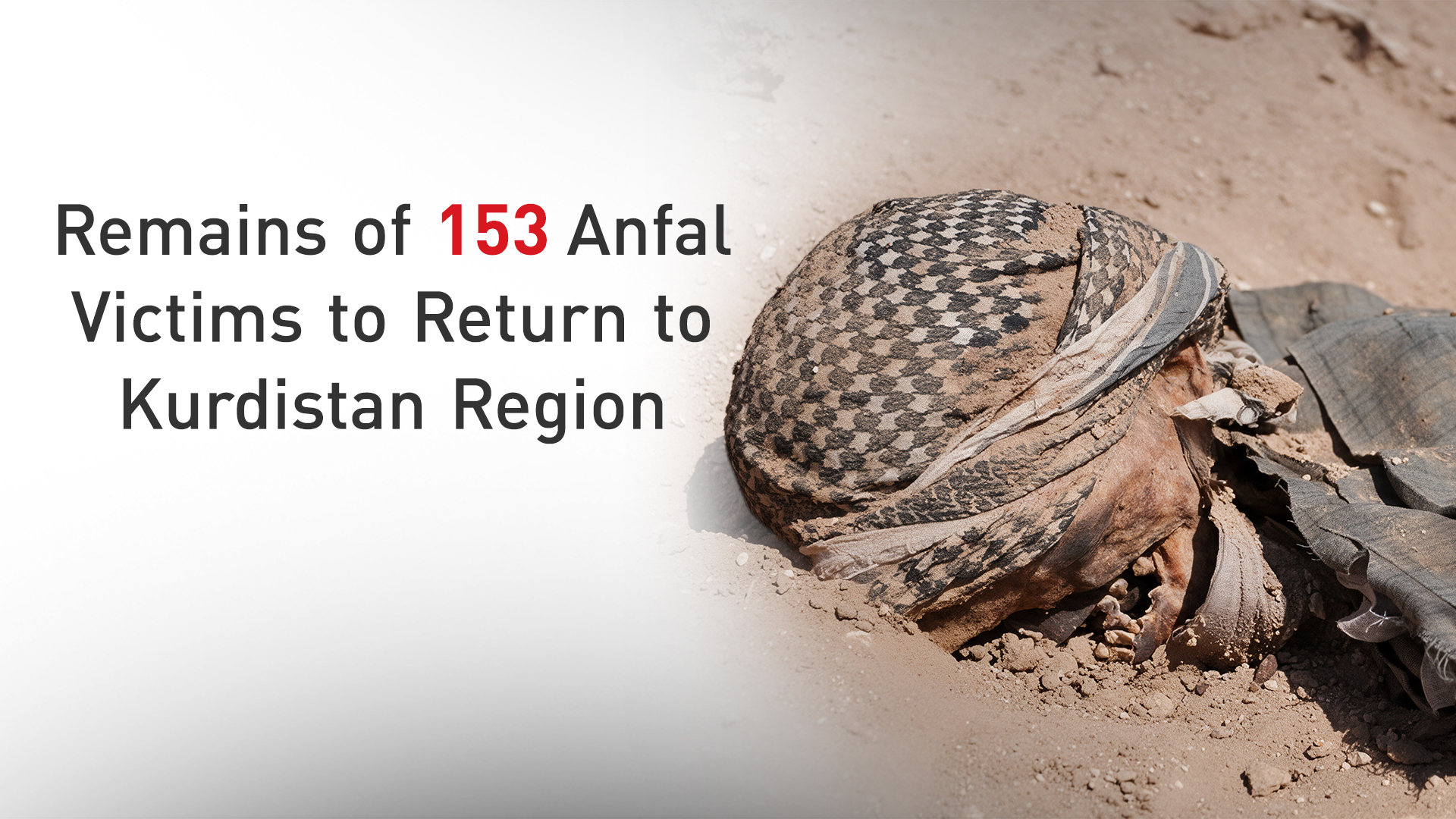
ERBIL (Kurdistan24) - The remains of 153 Kurdish women and children killed during the Anfal campaign are set to be returned to the Kurdistan Region today, decades after they were buried in a mass grave in the Samawa desert.
The Martyrs Foundation and the Forensic Medicine Department are preparing to transfer the remains to the relevant authorities in the Kurdistan Region as part of continuing efforts to locate mass graves, establish the fate of missing victims and document crimes committed during Anfal.
All 153 sets of remains belong to women and children killed by Saddam Hussein's Baathist regime during the campaign against the Kurds.
Search and excavation teams recovered the remains from one of the mass graves in the Samawa desert, where victims of Anfal had been buried far from their homes in Kurdistan.
The remains will initially be transferred to the Kurdistan Region for temporary burial while scientific procedures and specialized examinations continue. The process is intended eventually to establish individual identities so the victims can be returned to their families and buried according to proper procedures.
The transfer is another stage in a process that remains unfinished 38 years after Anfal, with families still waiting for information about relatives who disappeared and with mass graves continuing to form a central part of efforts to document the campaign.
Anfal was a systematic campaign of mass killing, forced disappearance and village destruction carried out against Kurds by Saddam Hussein's regime in 1988.
Its name was taken from a Quranic chapter meaning "spoils of war." The campaign was directed by Saddam's cousin Ali Hassan al-Majid, widely known as Chemical Ali, and unfolded in eight military phases between Feb. 23 and Sept. 6, 1988, during the final stages of the Iran-Iraq War.
Iraqi forces bombarded rural communities, used chemical weapons, rounded up residents and destroyed villages. At detention and processing centers, men and boys were separated from women, children and elderly family members.
Many detainees were transported to execution sites, while others died from hunger, disease and harsh detention conditions.
The Kurdistan Regional Government's representation in the United States said in April 2026 that more than 182,000 Kurds were killed or disappeared during Anfal and more than 4,000 villages were destroyed.
Beyond the death toll, the campaign dismantled rural communities, displaced families and destroyed homes, farms and livelihoods across large parts of Kurdistan.
The final phase targeted Badinan between Aug. 25 and Sept. 6, 1988. In an anniversary statement in August, Kurdistan Region Prime Minister Masrour Barzani said thousands were killed or abducted, hundreds of villages destroyed and tens of thousands of people displaced during that operation.
Anfal forms part of a broader history of persecution against Kurds under the former Iraqi regime. That history includes the disappearance and killing of Barzani men and boys in 1983 and the chemical attack on Halabja in March 1988, although the eight Anfal operations constituted a distinct campaign.
The designation of Anfal as genocide also has a judicial basis. In 2007, the Iraqi High Tribunal convicted senior officials, including al-Majid, of genocide, crimes against humanity and war crimes.
Despite those judgments, the physical recovery and identification of victims remain incomplete.
Kurdistan Region Interior Minister Reber Ahmed said in August that the KRG was working with Baghdad and international institutions to locate mass graves, identify victims and return their remains to their families.
Read More: Reber Ahmed: Kurdistan Working to Exhume Anfal Mass Graves and Identify Victims
For relatives, identification carries significance beyond forensic documentation. Many families have spent decades without knowing where their parents, children or other relatives were buried.
Anfal survivor Zirak Abdul Razzaq told Kurdistan24 in May that his mother had been killed and his father disappeared during the campaign.
"To this day, I do not know where my father rests," he said.
Read More: Where are their Graves? Kurdish Family Still Haunted By Anfal Tragedy
Such cases explain why the recovery of remains continues to occupy a central place in Anfal remembrance. Each identified victim can provide a family with an answer that has been missing for decades and allow relatives to establish an individual grave rather than live indefinitely with uncertainty.
April 14 is observed across the Kurdistan Region each year as Anfal Remembrance Day, while authorities have also sought to preserve sites connected to the campaign.
Read More: On Anfal's 38th Anniversary, the Duty of Remembering
Kurdistan24 reported in August that authorities in Duhok planned to develop Nizarke Fortress, a former military and detention complex associated with Anfal, into a broader genocide museum.
Read More: Duhok's Nizarke Fortress to Become Genocide Museum
Alongside remembrance and documentation, the KRG continues to call for federal compensation and greater support for survivors and victims' families.
Read More: Kurdistan President Renews Call for Compensation on Badinan Anfal Anniversary
The return of the 153 sets of remains therefore does not conclude their cases. Scientific identification still lies ahead before individual victims can be returned permanently to their families.
For now, their transfer from a mass grave in the Samawa desert to the Kurdistan Region brings another group of Anfal victims back to the land from which they were taken, while the search for other missing victims and unidentified remains continues.