On Anfal’s 38th Anniversary, the Duty of Remembering
The 38th anniversary of the Anfal campaigns is marked amid still-open files: thousands missing, graves only partly exhumed, and a state reckoning that officials say remains unfinished.
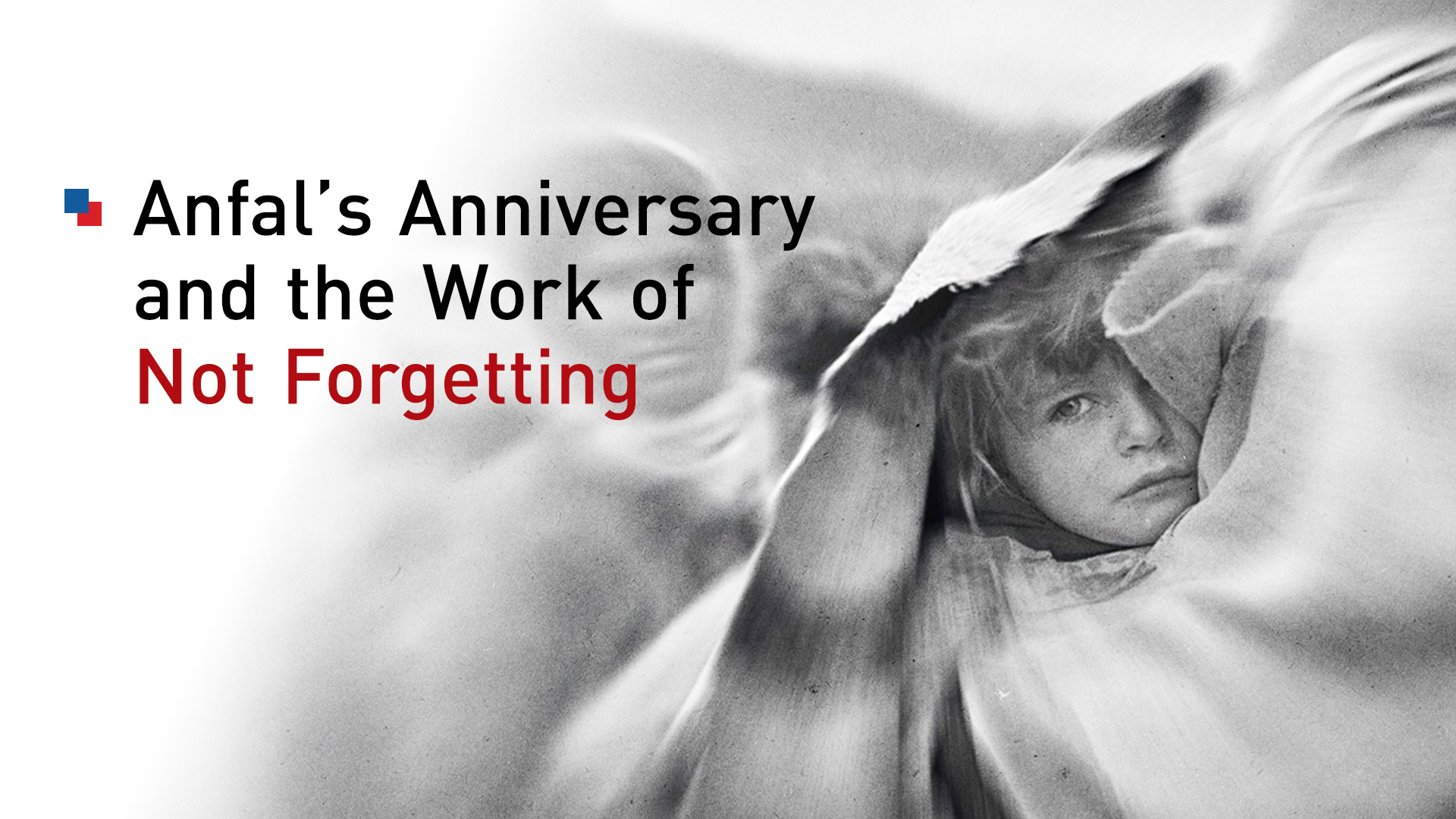
ERBIL (Kurdistan24) - Across the Kurdistan Region, families gathered at memorials and mass-grave sites this week to mark the 38th anniversary of the Anfal Campaigns, the systematic military operation that Iraqi forces under Saddam Hussein waged against rural Kurdish communities in 1988.
In Chamchamal, where the third phase of the onslaught struck hardest, survivors and relatives of the disappeared laid flowers beside newly identified remains returned from southern Iraq. Schools observed moments of silence. Kurdistan Region’s leaders, including President Masoud Barzani, Kurdistan Region President Nechirvan Barzani, and Prime Minister Masrour Barzani, issued statements reaffirming the campaign’s status as genocide and renewing demands that Baghdad fulfill constitutional obligations for compensation and the return of the missing.
The observances were somber but pointed. Officials and activists used the occasion not only to remember but to highlight what they describe as persistent gaps: thousands of Anfal victims still unaccounted for, mass graves only partially exhumed, and reparations that remain largely unfulfilled despite repeated Iraqi parliamentary recognition of the crimes.
Iraqi federal authorities, including Prime Minister Mohammed Shia al-Sudani’s office, have acknowledged the suffering in statements tied to related anniversaries such as Halabja, yet concrete progress on Anfal-specific claims has been slow.
The anniversary thus poses a central question: thirty-eight years on, does this day signal genuine advancement toward justice and reconciliation in Iraq, or does it underscore how political expediency continues to defer full accountability for one of the late 20th century’s clearest cases of genocide?
The Anfal Campaigns—named after the eighth sura of the Quran, evoking “the spoils of war”—unfolded in eight coordinated military phases between Feb. 23 and Sept. 6, 1988, as the Iran-Iraq War drew to a close.
Directed by Ali Hassan al-Majid, also known by his infamous nickname Chemical Ali, Saddam Hussein’s cousin and head of the Ba’ath Party’s Northern Bureau with near-presidential powers in the region, the operations targeted areas under Patriotic Union of Kurdistan (PUK) influence and, later, other Kurdish zones.
The strategic aim, according to captured Iraqi documents analyzed by Human Rights Watch, was to eliminate Kurdish rural support for insurgents, Arabize oil-rich and strategically sensitive territories, and crush any potential for renewed resistance.
Villages were systematically shelled, often with chemical agents, before ground forces moved in. Men and boys of military age were separated from women, children, and the elderly at processing centers such as Topzawa.
The men were trucked south and, in the overwhelming majority of documented cases, executed in desert pits. Women and children endured months in squalid detention camps; many died of disease and starvation.
By the campaign’s end, Iraqi forces had razed between 2,000 and 4,500 villages, depending on the estimate, and displaced at least 1.5 million people.
The scale was staggering.
Human Rights Watch’s seminal 1993 report, based on captured Iraqi documents, survivor testimony, and forensic evidence, concluded that the death toll could not have been lower than 50,000 and may have reached twice that figure.
Kurdish sources, citing internal Ba’athist tallies shared in 1991, have long maintained a figure closer to 182,000. The most infamous single episode, the chemical bombardment of Halabja on March 16, 1988—technically preceding the formal launch of the first Anfal but part of the same scorched-earth policy—killed up to 5,000 civilians in hours and injured thousands more.
Mustard gas, sarin, and tabun left survivors with lifelong respiratory damage, blindness, and cancers that still claim victims today. Similar attacks struck dozens of other villages.
The campaign was not collateral damage of counterinsurgency; it was, HRW determined, a deliberate genocidal enterprise aimed at destroying, in whole or in part, the Kurdish population as a distinct group.
Human stories pierce the statistics.
One survivor interviewed by HRW investigators recalled being separated from his father and brothers at a collection point in Germian, the scene of the third and bloodiest phase in April 1988.
“They took the men away in trucks,” he said. “We never saw them again.”
Another witness, a boy named Taymour Abdullah Ahmad, was the rare exception: captured at age 12, he survived execution by hiding among the dead and eventually escaping. Most did not. In the desert near Samawah or Ramadi, forensic teams later found layered pits containing hundreds of Kurdish men and boys, hands bound, blindfolded, shot in the head. Entire families vanished. The social fabric of rural Kurdistan—its villages, orchards, schools, and mosques—was erased.
Legal reckoning came, but remained incomplete.
In 2007, the Iraqi High Tribunal convicted al-Majid and several senior military figures of genocide, crimes against humanity, and war crimes for their roles in Anfal.
Al-Majid, known as “Chemical Ali,” received multiple death sentences and was executed in 2010. The tribunal explicitly recognized the campaign as genocide under the 1948 Genocide Convention criteria: intent to destroy a group through killing, causing serious harm, and imposing conditions calculated to bring about physical destruction.
Iraq’s parliament followed in 2008 by formally designating Anfal a genocide. The Supreme Court upheld this finding in 2010. Several foreign parliaments—Britain in 2013, Sweden, Norway, and others—have since echoed the designation.
Yet no international court has adjudicated the case in full, and reparations have lagged. Thousands of families still await the return of remains or meaningful financial support.
The legacy shapes Kurdish identity and politics in profound ways.
Anfal accelerated the 1991 uprising that established de facto Kurdish autonomy, laying groundwork for the Kurdistan Regional Government. It is taught in KRG schools as a foundational trauma, reinforcing a collective narrative of resilience and the necessity of self-rule.
Memorials, documentation centers, and the Ministry of Martyrs and Anfal Affairs keep memory alive. Yet the trauma is intergenerational. Anfal widows—many still in black—speak of lost husbands and sons; children born after 1988 carry stories of chemical burns and vanished grandparents.
Mass graves continue to yield bones decades later; DNA identification is painstaking and underfunded. Social consequences include elevated rates of psychological distress, poverty among survivor families, and a lingering distrust of centralized Iraqi authority.
In Iraqi-Kurdish relations, Anfal remains a live fault line. The 2005 federal constitution promises compensation for victims of the former regime and equitable revenue sharing, yet implementation has been uneven.
The KRG has recently revived demands for retroactive compensation estimated in the hundreds of billions of dollars for destruction inflicted between 1963 and 2003, including Anfal’s economic annihilation.
Baghdad’s responses have been symbolic—statements of solidarity, occasional funding for exhumations—rather than systemic. Critics in both Erbil and Baghdad note that some former Kurdish collaborators with the Ba’ath regime receive pensions while victims’ families struggle.
The unresolved file complicates broader federalism debates, from oil revenues to disputed territories, and underscores the fragility of minority protections in a country still negotiating its post-dictatorship identity.
Globally, Anfal offers sobering lessons on genocide prevention and chemical-weapons norms. It demonstrated how a state could deploy banned agents against its own citizens with relative impunity while the world focused on the Iran-Iraq War.
The campaign reinforced the taboo against chemical weapons—later invoked in Syria and elsewhere—yet also exposed the limits of international enforcement. Transitional-justice scholars point to the Iraqi tribunal as a rare example of domestic accountability for mass atrocity, but one hampered by political interference and incomplete reparations.
The experience informs debates on how post-conflict societies balance remembrance with reconciliation, especially when perpetrators’ successors remain embedded in state institutions.
Thirty-eight years later, the anniversary reveals both progress and stasis. Memory has been institutionalized in Kurdish education and governance; legal recognition exists on paper; some remains have been returned to grieving families.
Yet the deeper work—full reparations, exhaustive accounting for the disappeared, and a national Iraqi reckoning that treats Anfal as a shared wound rather than a Kurdish grievance—remains unfinished. In a region where new threats to minorities still arise, the tension between remembrance and reconciliation feels acute.
The enduring weight of memory in a land still negotiating its future is not merely historical; it is a daily political and moral test. Kurds have proven remarkably resilient, transforming devastation into the foundations of self-governance. Whether Iraq’s federal project can match that resilience with genuine justice will shape the next chapter for all its peoples.