Kurdistan’s Electricity Revolution: What Happens After 24-Hour Power?
Runaki expands round-the-clock electricity across the Kurdistan Region, reducing reliance on private generators while creating a new billing and revenue system for households and businesses
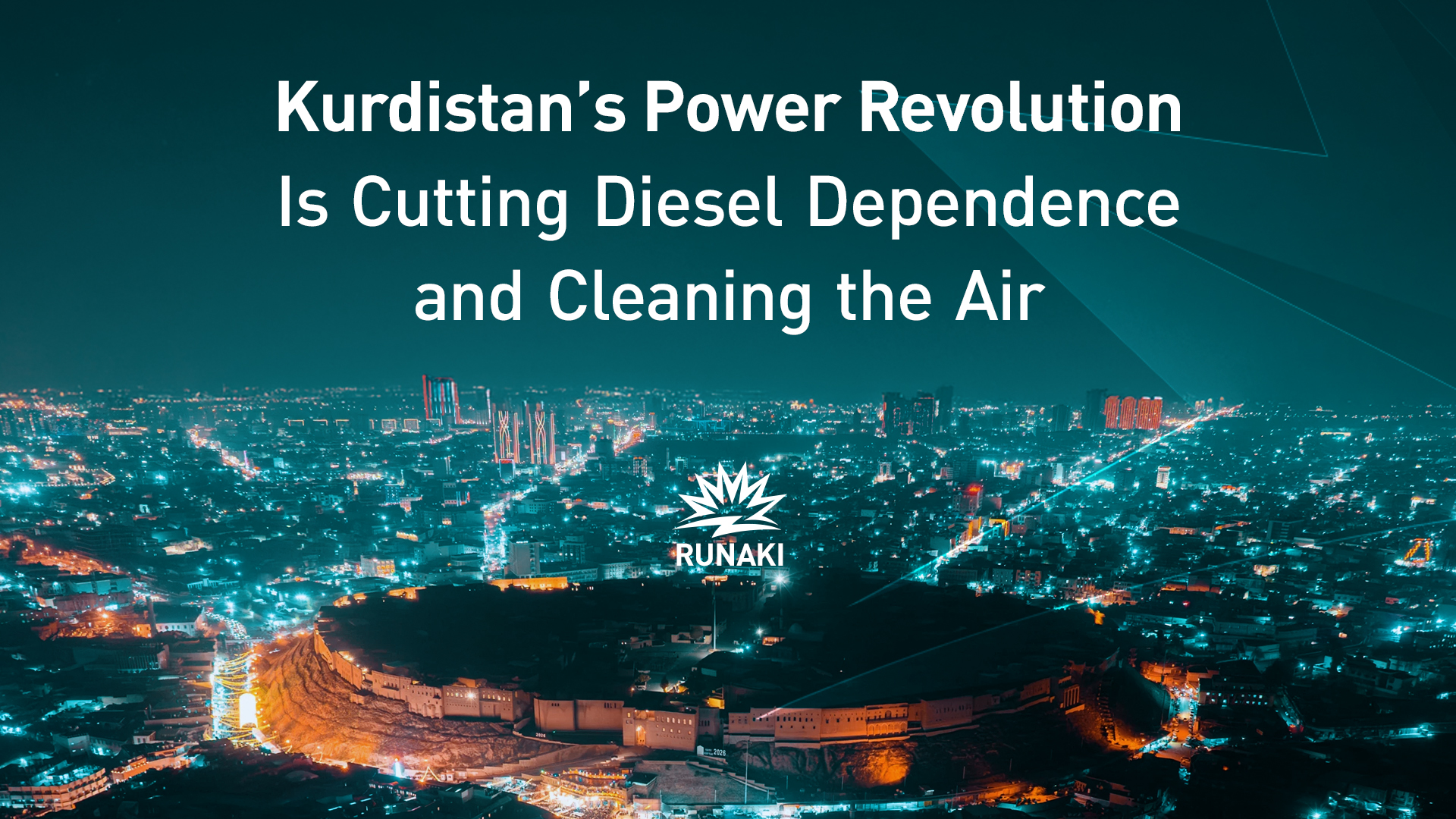
ERBIL (Kurdistan24) — The Kurdistan Regional Government’s Runaki electricity reform has expanded round-the-clock power to millions of residents across the Kurdistan Region, significantly reducing reliance on neighborhood diesel generators and introducing a new electricity billing system for households, businesses and other consumers.
The KRG says nearly 5.5 million people, or more than 85 percent of the Region’s population, now receive 24-hour electricity through the Runaki initiative.
More than 153,000 businesses have also been connected to the system, while the government has set a target of extending continuous electricity coverage across the entire Kurdistan Region by the end of 2026.
The expansion marks a major shift in the Region’s electricity system, which for years relied on a combination of public-grid supply and privately operated neighborhood generators to fill the gap created by limited generation and distribution capacity.
New Electricity Billing System
Under Runaki, electricity consumption is measured through meters and billed according to a progressive tariff system. Household consumers pay 72 Iraqi dinars per kilowatt-hour for the first 400 kWh, with the rate increasing to 350 dinars for consumption above 1,600 kWh.
Separate tariffs apply to commercial, agricultural and industrial consumers.
The KRG says the new system is designed to make electricity costs more predictable while eliminating the need for households to pay separate monthly fees to private generator operators.
The government estimates that around 80 percent of households will pay less under Runaki than they previously paid for electricity from both the public grid and private generators.
In the July billing cycle, the Ministry of Electricity said half of Runaki-connected households were billed less than 29,000 dinars and consumed less than 406 kWh.
Private Generators Being Phased Out
The expansion of 24-hour electricity is also transforming the private-generator sector, which became an essential part of the Region’s power system during years of electricity shortages.
The KRG says nearly 5,900 private generators have already been phased out under Runaki, with more than 7,000 expected to be shut down by the end of 2026.
The transition affects an extensive economic network built around neighborhood generators, including generator operators, fuel suppliers, mechanics and spare-parts businesses. The government has reached agreements with generator owners as part of the transition, while some generators may remain available as emergency backup capacity.
Data from the Kurdistan Region Statistics Office showed that neighborhood generators generated about 726.3 billion dinars in revenue in 2021 and consumed around 755 million liters of fuel, highlighting the scale of the generator economy before the expansion of continuous public electricity.
Cleaner Air, Lower Pollution
The phase-out of private diesel generators is also reducing one of the Kurdistan Region’s longstanding sources of local air pollution. With fewer generators operating in residential neighborhoods and commercial areas, residents are exposed to less diesel exhaust, while noise pollution from generators is also reduced.
The KRG has estimated that shutting down thousands of private generators could cut carbon dioxide emissions by more than 1.1 million tonnes annually, contributing to cleaner air and a lower environmental impact as the Region shifts toward a centralized electricity system.
The environmental impact is particularly significant in densely populated areas where generators have traditionally operated close to homes, businesses and public spaces.
A New Revenue Model
Runaki is also changing how the KRG collects electricity revenues. The centralized metering and billing system gives the government greater oversight of consumption and payments while allowing subscribers to settle outstanding debts accumulated before the program was introduced.
In September, the Ministry of Electricity announced installment plans of up to 24 months for pre-Runaki electricity debts. Nearly 800,000 subscribers had reportedly cleared old debts under a 50 percent discount scheme, while more than 1.2 million of roughly two million subscribers had become debt-free. The KRG said the discounts amounted to about 360 billion dinars.
The system is intended to improve revenue collection and make the electricity sector more financially sustainable while reducing dependence on emergency measures and private generator networks.
Rising Demand Poses New Challenge
The availability of uninterrupted electricity is also likely to increase electricity consumption as households and businesses use air conditioners, heating systems and other electrical appliances more freely.
That creates a new challenge for the KRG: maintaining sufficient generation capacity while strengthening transmission and distribution networks to cope with higher demand.
The success of Runaki will therefore depend not only on extending 24-hour supply but also on ensuring that the electricity system can remain reliable as consumption increases.
With more than 85 percent of the Region’s population already receiving continuous electricity, the KRG is moving toward its goal of full coverage by the end of 2026.
The transition represents a fundamental change in the Kurdistan Region’s electricity model—from a system dependent on public supply supplemented by thousands of private diesel generators to one based increasingly on centralized generation, metering, billing and distribution.