Pakistani National Killed in New Riyadh Airport Strike
A new attack on Riyadh's King Khalid International Airport killed a Pakistani national and wounded 11, as repeated Houthi attacks put regional defense arrangements under renewed scrutiny.
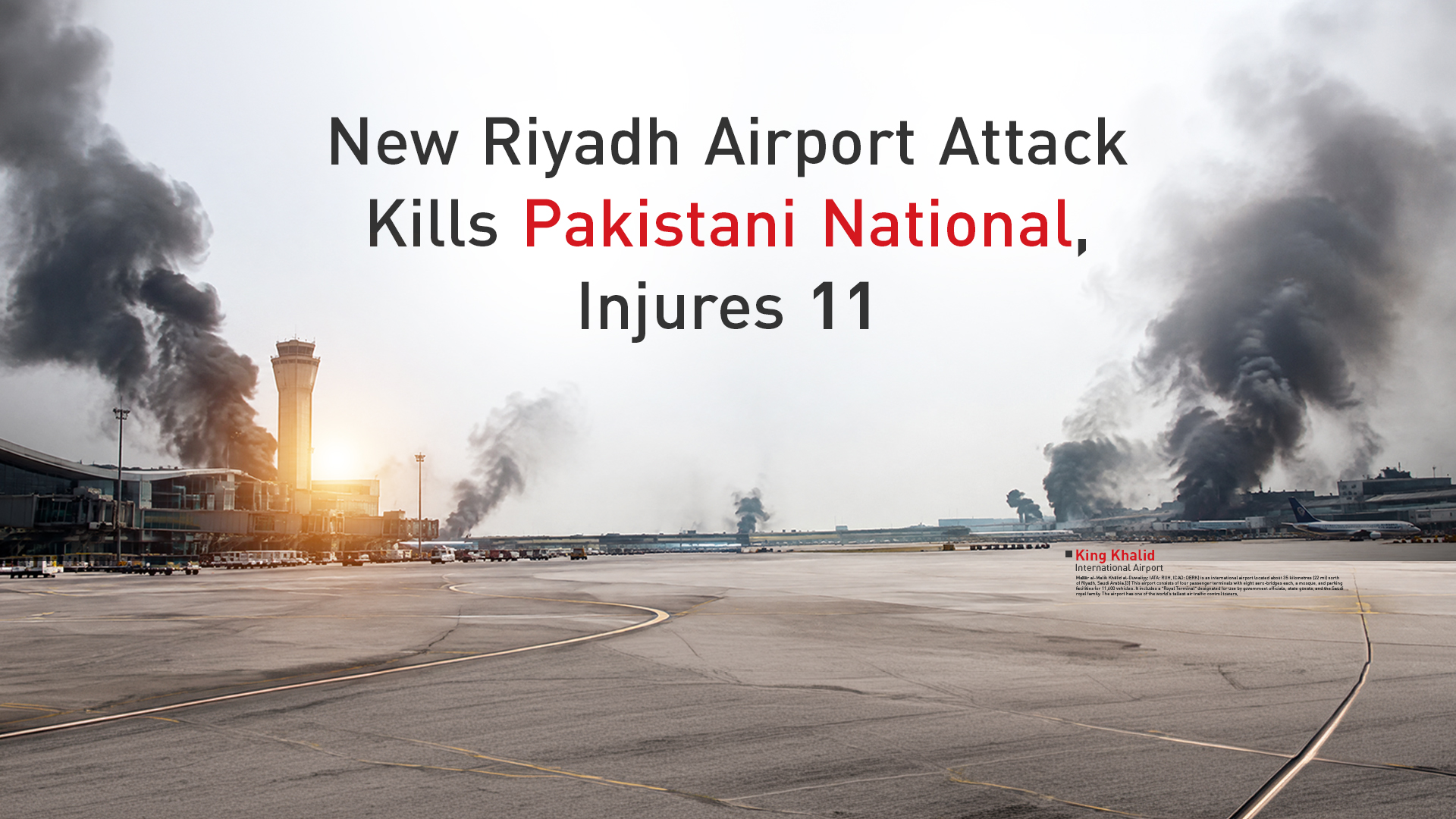
ERBIL (Kurdistan24) - A new attack on King Khalid International Airport in Riyadh killed a Pakistani national and wounded 11 other people on Sunday evening, Saudi Arabia's General Authority of Civil Aviation said, as repeated strikes continue to disrupt the kingdom's main airport and intensify regional security concerns.
In a statement on Monday, Oct. 12, the authority said the attack occurred on the evening of Oct. 11.
The 11 injured people were taken to hospitals for treatment, while relevant Saudi authorities continued assessing the material damage caused by the attack.
The latest casualties came after another major assault on the airport on Saturday, part of a series of attacks that have placed civilian aviation at the center of the escalating confrontation between Saudi Arabia and Yemen's Houthis.
According to the latest Kurdistan24 report, the Houthis claimed responsibility for Saturday's attack, which it said killed 13 people and wounded 309.
Earlier Saudi figures carried by Kurdistan24 had put Saturday's death toll at 12, meaning the latest report reflects a higher fatality figure.
Sunday evening's attack brought another 12 casualties, including one death.

Saudi-led coalition spokesperson Turki al-Maliki also said coalition forces had intercepted a Houthi ballistic missile launched toward Khamis Mushait, underscoring the widening geographical scope of the attacks.
Meanwhile, air traffic monitoring service Flightradar24 reported that King Khalid International Airport would remain closed for another 24 hours.
The airport has faced repeated attacks over two consecutive days, severely disrupting air travel and increasing security concerns for passengers, airlines and airport personnel.
The attacks also bring renewed attention to the Mecca Joint Defence Agreement, signed by Saudi Arabia, Türkiye and Pakistan in Mecca on Aug. 7, 2026.
Under the agreement, the three countries committed to strengthening collective deterrence and agreed that an armed attack against one of them would be regarded as an attack against all three. The pact also provides for broader defense cooperation among the signatories.
The death of a Pakistani national in Sunday's attack adds particular significance to the current crisis given Pakistan's place alongside Saudi Arabia and Türkiye in that collective-defense framework.
The supplied material does not indicate whether the latest attacks have triggered any specific new action under the agreement.
The broader Saudi-Houthi confrontation has nevertheless prompted increasingly strong regional responses.
Yemen's Houthis have warned airlines, aviation employees and travelers against using Saudi airports and airspace, while exempting airports in Mecca and Medina.
Saudi Arabia, in turn, has vowed to respond to attacks on its territory and civilian infrastructure.
The escalation has also drawn reactions from other Gulf states.
On Monday, Anwar Gargash, diplomatic adviser to the president of the United Arab Emirates, said attacks against Saudi Arabia undermine the security of the UAE and the wider Gulf, arguing that regional security is indivisible and calling for stronger collective defense cooperation.
The crisis is unfolding as Iraqi Prime Minister Ali Faleh Zaidi prepares for an official visit to Saudi Arabia on Wednesday.
The visit comes amid heightened political and security tensions, including public support for Houthi operations from Iraq's Kataib Hezbollah.
For Saudi Arabia, however, the immediate challenge remains the security of its airspace and civilian airports.
Two consecutive days of deadly attacks on King Khalid International Airport, combined with missile launches toward other Saudi locations, have deepened concerns that the confrontation with the Houthis is expanding beyond the battlefield in Yemen and increasingly affecting civilians and regional aviation.