KRG Moves to Diversify Economy Beyond Oil
Officials told Kurdistan24 the road-map rests on customs exemptions, land allocation, expanded silos and direct links between factories and farmers.
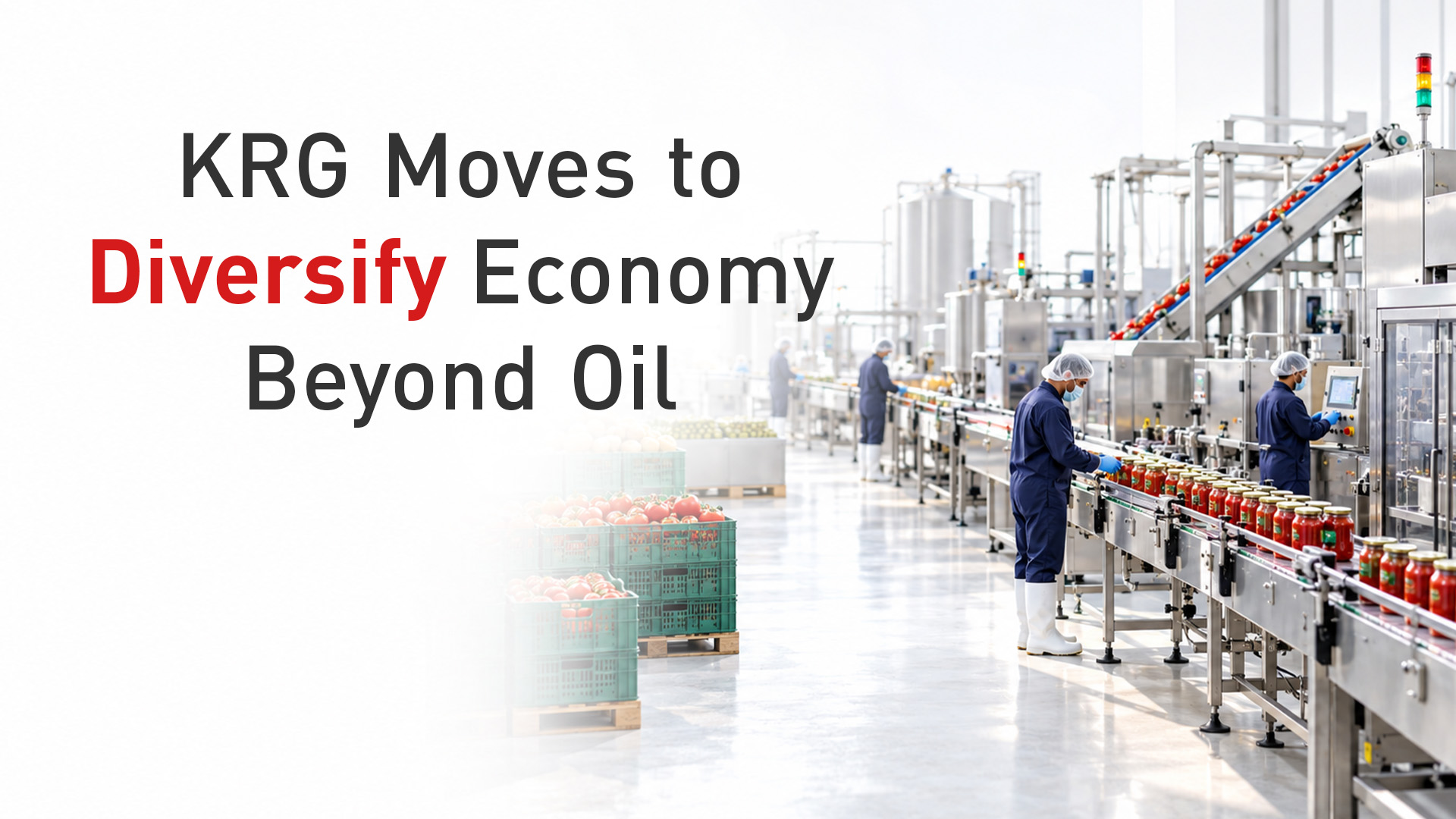
ERBIL (Kurdistan24) - The Ninth Cabinet of the Kurdistan Regional Government (KRG) has identified agriculture and the food industry as one of the main pillars of the economy under its program, plans and policy to diversify revenue sources and end full reliance on oil. Senior officials from the Board of Investment and the ministries of Industry & Agriculture and Water Resources outlined the government’s road-map for reviving the sector, which ranges from generous customs exemptions and land provision to linking factories directly with farmers and expanding silo and storage capacity.
Qaraman Qadir, spokesperson for the Ministry of Agriculture and Water Resources, pointed to the Kurdistan Region’s success in poultry production. “The poultry sector, such as chicken and eggs, in the Kurdistan Region has fully reached the stage of self-sufficiency, and a large part of the products are exported to central and southern Iraq,” he said. He stressed that full facilitation has been provided to cooling and packaging projects in order to create added value for farmers’ produce.
The Ministry of Agriculture and Water Resources has adopted a strict policy to protect domestic produce from foreign imports. Qadir said that during the harvest season for crops such as vegetables, potatoes, tomatoes and fruit, imports are banned or subjected to heavy customs duties so that farmers do not suffer losses.
An extensive network of cold storage facilities has been established across Erbil, Sulaimani, Duhok and Halabja provinces and the independent administrations, through the private sector and in coordination with the ministry. As a result, farmers are not forced to sell their crops cheaply during the harvest season, while the market is supplied with local produce in every season.
According to Ministry of Agriculture statistics, there are more than 11 main silos across the Kurdistan Region, along with a number of bunkers. With the construction of new silos in Kalar, Bardarash and Qushtapa, the overall storage capacity has risen to between 500,000 and nearly one million tons of wheat. This ensures that farmers’ entire annual wheat crop can be received.
On support for domestic industry, Sarwar Hawari, deputy minister of Trade and Industry, said to Kurdistan24, the ministry has set a decisive condition for factories in return for customs exemptions: they must rely on locally grown produce from Kurdistan Region farmers.
Hawari explained that industrial project owners are exempted from customs duties for 10 years on equipment and raw materials that are not available locally. In return, they are obliged to buy key materials such as potatoes, tomatoes and olives from Kurdistan Region farmers.
“Factory owners can, through contracts, provide farmers with seedlings and seeds specific to the industrial sector and then take their products from them, and this creates a strong economic complementarity between the agricultural sector and factories,” the deputy minister said.
Special committees have also been formed in all provinces and independent administrations to allocate land for these factories. They are chaired by governors, with membership from municipalities, the Board of Investment and chambers of commerce. Projects licensed by the Board of Investment must obtain the approval of the Ministry of Trade and Industry and abide by its conditions.
Mohammed Shokri, head of the KRG Board of Investment, said the Ninth Cabinet has given greater attention to food projects. This has led to a revival of agricultural investment, which has grown more than in previous years, and total investment in the sector has reached nearly 8%.
Shokri said the Kurdistan Region has made major strides in food production, particularly in wheat, dairy, food processing and packaging. Beyond meeting domestic needs, part of the output is exported to the provinces of central and southern Iraq and abroad.
On incentives, he said projects in remote areas are exempted from all investment fees and are provided with land free of charge. The customs exemption period for some food processing projects has also been extended from five to 10 years, in order to lower production costs and allow food to reach citizens at cheaper prices.
The coordination among the Board of Investment and the ministries of Trade and Industry and Agriculture and Water Resources shows that the KRG is working on the agricultural sector as a complementary chain: from seed to land, from land to storage and factories, and from there to citizens’ tables and foreign markets. The government presents these steps as a foundation for an economy that is diversified and protected from crises.
All information in this article was gathered, and all interviews were conducted, by Lavin Omar of Kurdistan24’s Sorani department. The article was translated and edited into English by Ahora Qadi.