US Secretary of State: No Decision on Iran Strikes
Rubio said Trump has made no decision on new strikes on Iran, tied the Houthis’ capabilities to Tehran, backed a limited Black Sea ceasefire for grain and energy, and said the Quad targets no country, as the G20 ended without a joint communique
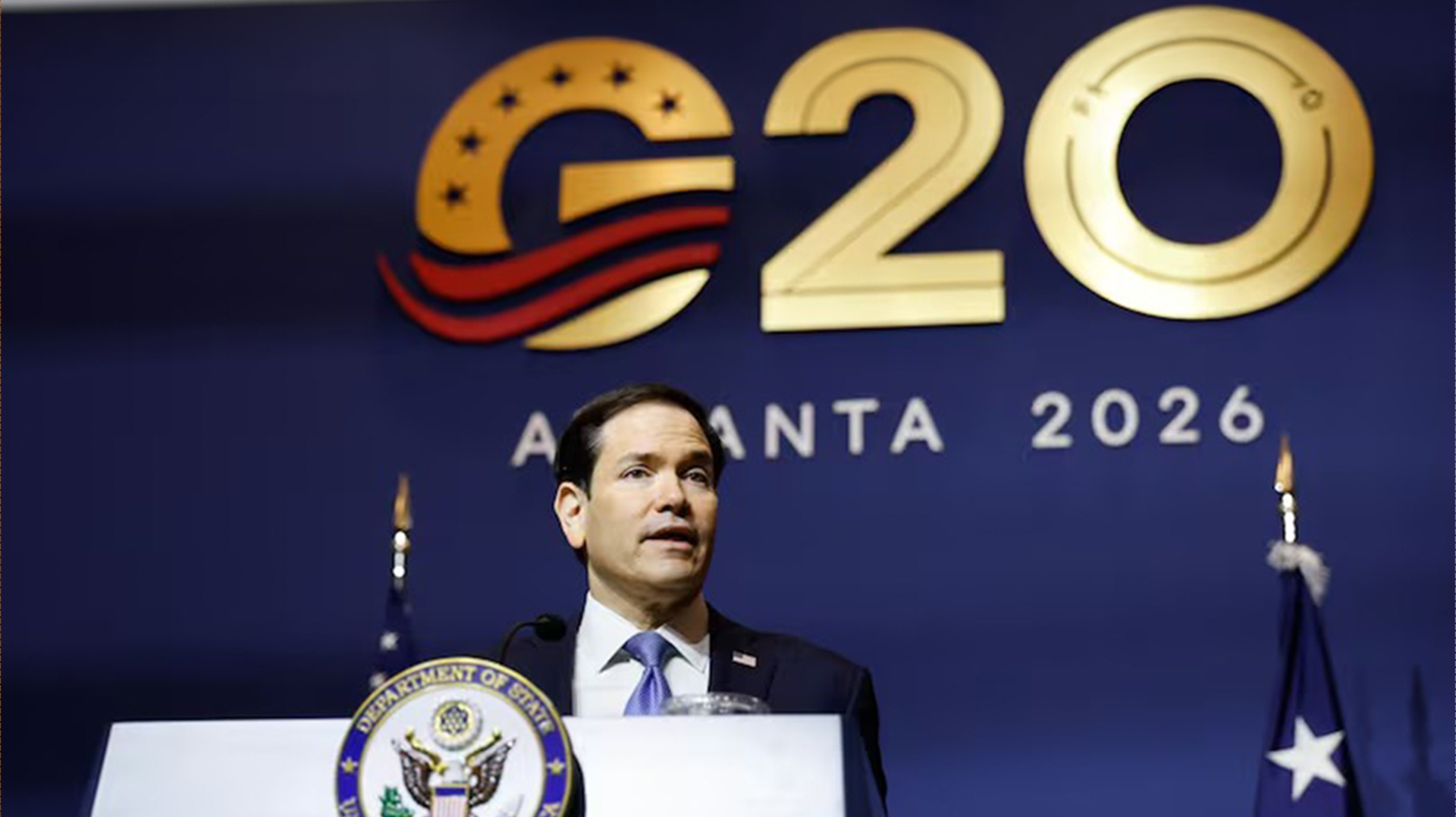
ERBIL (Kurdistan 24) - US Secretary of State Marco Rubio said on Saturday that President Donald Trump has not decided whether to order new strikes on Iran, even as he accused Tehran of threatening to destroy the energy infrastructure of its neighbors and the entire region. He spoke at a press conference in Atlanta as the G20 foreign ministers’ meeting closed without a joint communique.
“He hasn’t made a decision,” Rubio said, according to AFP, adding that the US could achieve military objectives if it sought to, but does not take any of it lightly. Rubio said Trump prefers a diplomatic solution and would rather act peacefully. The president, he said, does not view talks or meeting with someone as a concession, and his preference in any challenge around the world is to solve it diplomatically if possible.
Rubio described Iran’s position in stark terms. In the fuller version of his remarks, reported by Times of Israel, he said the regime is basically arguing that unless it gets what it wants, it will not only blow up ships but destroy the energy infrastructure of its neighbors and the entire region. “Just think about that,” he said, calling it not normal behavior. On Iran’s nuclear ambitions, he said, “You can only imagine what it would do to others if they possess weapons of mass destruction.”
On the Houthis, Rubio said they would not have the capabilities they have today without the direct support of the Iranian regime. The remark is consistent with his earlier position. He said on 9/8 that the Houthis are in many ways agents and proxies of Iran. It also follows reporting that Russian satellite imagery helped Houthi and Iraqi militia strikes on Saudi Arabia, according to an analysis by the geospatial firm AURORAH reported by AP and the Washington Post.
Rubio also said there is growing interest in a limited ceasefire in the Black Sea to keep energy and grain shipments by Russia and Ukraine moving, Reuters reported. He said the US is reviewing proposals from Türkiye and India to get grain shipments moving, that the situation threatens food security and some energy security worldwide, and that the US would like to achieve it. “It doesn’t solve the war, but at least it solves a unique aspect of it,” he said. Ukraine’s foreign minister, Andrii Sybiha, said in early October that Kyiv had received four proposals, from Türkiye, Egypt, India and the US, and would accept an energy and Black Sea ceasefire only as a combined package. Russia rejected a limited truce, with Kremlin spokesman Dmitry Peskov saying piecemeal arrangements cannot bring a peaceful settlement closer. Rubio said in September, after meeting Russian Foreign Minister Sergey Lavrov in New York, that both sides had expressed interest in a limited grain and energy ceasefire but that it would not be easy. Polish Foreign Minister Radoslaw Sikorski urged a rapid Black Sea truce at the G20 on Friday so grain reaches countries that need it.
On Greenland, Rubio said the US will never have to worry about the island being a place where a potential adversary can gain access, through commercial means, to things harmful to any of the countries involved. Trump announced a framework for a Greenland deal in January after talks with NATO Secretary General Mark Rutte; technical talks with Denmark and Greenland began later that month, and the deal was signed in September, ITV and AP reported.
On Saturday morning Rubio hosted the foreign ministers of Australia, India and Japan for a Quad meeting, their third this year, as plans take shape for a leaders’ summit in Manila next month, Reuters reported. He said the Quad is not an anti-China or anti-anybody coalition. Any concerns raised within it, he said, are about behaviors and activities that repeatedly come from one country.
The G20 itself ended without consensus. AP reported that ministers wrapped up two days of talks without agreement on several critical security issues, with divisions over Russia’s war in Ukraine, the Iran conflict and US tariffs, and that Rubio would issue a chairman’s statement in place of a joint communique. Rubio called the first day “very productive,” and participants said all had agreed to try to overcome their differences despite long odds. The final session on supply chains examined freedom of navigation in the Strait of Hormuz and the Red, Black and South China Seas. Rubio said freedom of navigation, critical minerals, supply chains and food security matter not only to the countries at the table but to countries around the world.
The divisions were visible from Friday. The US scrapped plans for a group photograph after several European diplomats objected to standing beside Lavrov and threatened to walk out, AP, Reuters and CNN reported. CNN cited two sources saying Rubio decided to drop the photo to keep the focus on substance. German Foreign Minister Johann Wadephul said there is “no normalcy with Russia.” Lavrov dismissed the controversy as “family photo diplomacy.”
Iraq is directly exposed to the threat Rubio described. G7 foreign ministers condemned Iranian and proxy attacks on energy infrastructure earlier this year, including in Iraq and particularly in the Kurdistan Region. Rubio said on 6/23 in Abu Dhabi that hostilities in the region cannot end while Iranian proxies launch missiles and drones from Iraq. Prime Minister Ali al-Zaidi told Rubio at the UN General Assembly in September that Baghdad would press ahead with bringing all weapons under state control, and Rubio voiced support, according to the Iraqi account reported by Shafaq News. The integration of Sinjar Resistance Units fighters into Iraqi security institutions began on Monday as part of that effort.
Trump’s decision on Iran is expected after the 11/3 midterms, and the G20 leaders will meet on 12/14 and 12/15 near Miami.