Biden administration reaffirms US opposition to Iranian nuclear weapon
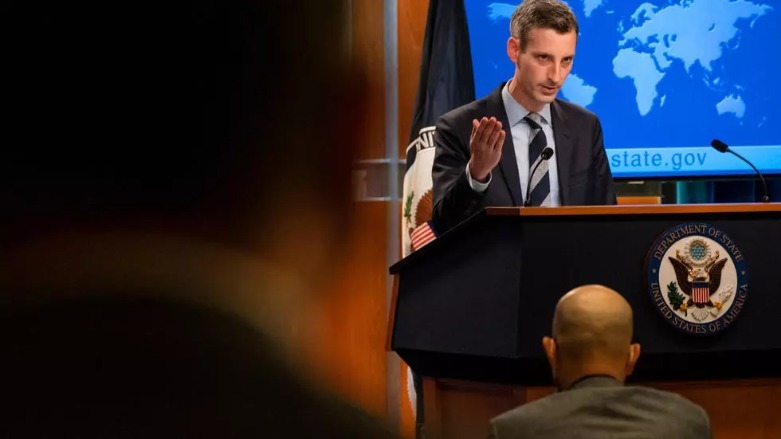
WASHINGTON DC (Kurdistan 24) – State Department Spokesperson, Ned Price, reaffirmed the Biden administration’s opposition to Iran’s acquisition of a nuclear weapon.
“Joe Biden has been very clear” and “we will not countenance a nuclear-armed Iran, Price said, as he briefed reporters on Thursday
“Our approach,” Price continued, emphasizing that the new administration’s approach is a “diplomatic one” will be “to ensure that Iran can never acquire a nuclear weapon.”
Even if diplomacy is the Biden administration’s approach (and there is no evident reason to doubt that), it is unclear why Price would gratuitously reassure Tehran on that score. It was, after all, the US-led attack on Iraq that overthrew Saddam Hussein’s regime which prompted Tehran to suspend its nuclear program in 2003.
The Iranian nuclear deal, formally known as the JCPOA (Joint Comprehensive Plan of Action), was concluded by the Obama administration in 2015. Iran agreed to imitations on its nuclear activities in exchange for the lifting of sanctions. Other countries—the four other permanent members of the UN Security Council: Britain, China, France, and Russia, along with Germany—are also parties to the JCPOA.
However, critics complained that the JCPOA made too many concessions to Iran and would not stop it from building a nuclear weapon. In 2018, Donald Trump withdrew from the agreement, re-imposing sanctions on Iran.
As Trump’s then-National Security Advisor, Amb. John Bolton, explained to Kurdistan 24, a major flaw in the JCPOA was that it allowed Iran to enrich uranium—albeit at the low level of 3.67%. But that percentage could be increased, whenever Iran decided to do so.
Bolton described that concession as a “fatal mistake.” Merely having “the right to enriched reactor grade” uranium gave Iran a “substantial” step toward building a bomb, he said.
Since the US withdrawal from the JCPOA, Iran has reneged on a number of its commitments under that agreement. In January, Iran began enriching uranium to 20%, the level it had reached before concluding the JCPOA and far above the level permitted in that accord.
Most recently, on Wednesday, the International Atomic Energy Agency, informed its members that Iran had produced a limited quantity of uranium metal. That material can be used in the construction of a nuclear bomb, and the JCPOA prohibits Iran from “producing or acquiring plutonium or uranium metals or their alloys” for 15 years—i.e. until 2030.
The IAEA announcement prompted France and Russia, independently, to issue warnings to Iran on Thursday.
"We understand the logic of their actions and the reasons prompting Iran,” Russian Deputy Foreign Minister Sergei Ryabkov stated. “Despite this, it is necessary to show restraint and a responsible approach.”
A Spokesperson for France’s Foreign Ministry said, with less empathy for Tehran, “To preserve the political space to find a negotiated solution, we call on Iran not to take any new measures that would further worsen the nuclear situation, already extremely worrying due to the accumulation of violations of the Vienna Accord, including the latest just reported by the IAEA.”
In addition, France, Germany, and Britain, all parties to the JCPOA, said in a statement issued on Friday, “We strongly urge Iran to halt these activities without delay and not to take any new non-compliant steps on its nuclear program.
“In escalating its non-compliance, Iran is undermining the opportunity for renewed diplomacy to fully realize the objectives of the JCPOA,” the E3 statement continued.
The US and Iran are currently deadlocked over the next step. Iran has said that the US must lift sanctions, before it will return to complying with its JCPOA commitments. In something of a nod to Washington, Iran’s Foreign Minister, Mohammed Javad Zarif, speaking on CNN last week, went so far as to suggest that the European Union’s foreign policy chief, Josep Borrell, could “choreograph the actions” of the US and Iran, so they could, in tandem, restore the nuclear accord.
The Biden administration, however, rejected that suggestion, as it maintains that Iran must take the first step.
Read More: US cool to Iran’s proposal for coordinated return to JCPOA; wants to address more than nuclear issue
Indeed, Price repeated that position on Thursday: “If Iran resumes its full compliance with the 2015 nuclear deal, we’ll do the same.”
Moreover, the US will seek to “lengthen and strengthen the provisions of that deal,” Price said and then it will expand on the accord to include at least two other issues: Iran’s missile program and its support for proxy forces in the region.
The Biden administration has declared that it will reverse Trump’s unilateralism and return to the traditional US posture of working closely with allies. That seems to be how it is dealing with the Iranian nuclear challenge—as suggested by the successive warnings to Tehran from various parties.
To what extent this approach will prove effective remains to be seen. So far, Iran has responded with the defiant assertion that the US must first return to the JCPOA and lift sanctions.
Editing by John J. Catherine