‘Kurdish women fighters were made, not born’
These strong women weren’t born in a vacuum, and emerged because of the resistance of previous generations who had to also fight oppression.
LOS ANGELES, United States (K24)—On Wednesday, Dr. Amir Sharifi, Linguistics Professor at California State University, Long Beach spoke about the Kurdish women movement in Syria and Turkey to a group of diverse Americans in Los Angeles.
The Greater Los Angeles Chapter of the United States National Committee (USNC) for United Nations Women held its sixtieth event in an art gallery in Bergamot Station, Santa Monica.
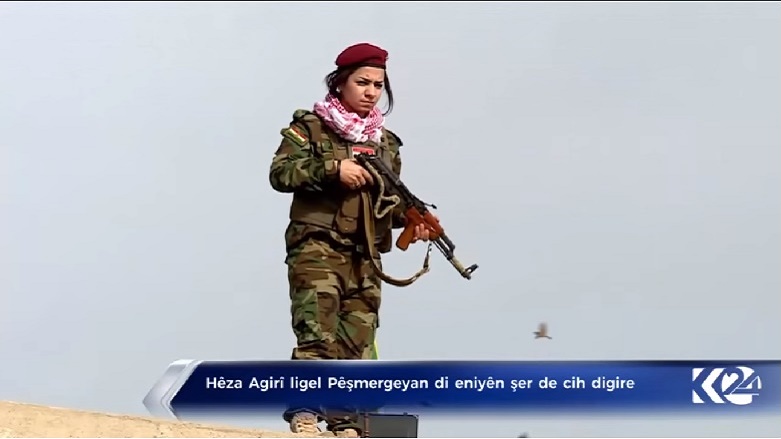
The speaker drew the audience’s attention to the global recognition of Kurdish female fighters and their heroic victory in liberating the city of Kobani from Islamic State (IS), in Rojava (Syrian Kurdistan).
“Kurdish women were the face and the voice of resistance in Kobani against IS,” Dr. Sharifi said.
He then asked the attendees to think about how these women came to exist in the Middle East.
The professor, originally from Sina, Rojhalat (Iranian Kurdistan), pointed out that these strong women weren’t born in a vacuum, and emerged because of the sacrifices of previous generations who had to also fight oppression.
“Kurdish history is not extensively documented, and Kurdish women’s history is even more fragmented,” said Dr. Sharifi. However, Kurdish women have been fighters since the Ottoman Empire and “in folklore they were represented as assertive and dominant.”
The fact that Kurdish history has been largely secular has paved the way for a group of women to shine in history. However, most have suffered multiple levels of oppression. They had visible enemies: repressive states they find themselves in; and invisible enemies: the culture and tradition of their own nation.
“Anytime there has been a genocide, a gendercide has occurred as well…In 1925-1937 many Kurdish women committed suicide to escape rape and abuse by Turkish soldiers.”
Traditionally, Kurdish women are perceived as guardians of the motherland but the new feminists refuse to accept restricted roles.
After the presentation, the enthusiastic attendees engaged in discussions with the speaker about the impact of the Kurdish women movement on other feminist movements in the Middle East and around the world.
Cathy Hillman, founder and president of Greater Los Angeles Chapter of USNC for UN Women said she was happy with the event and the audience's engagement with the topic.
Sam Attar one of the atendees told K24 he believes "the movement in Rojava is more than 'girls with guns' and there is more depth and meaning to what is happening in that part of the world, in IS backyard."
Peji Kuk said he was concerned "about the anarchist element of the Rojava movement," and was not sure how that would influence the future of this region.
In the group discussion that followed, the participants concluded that Kurdish women’s movement can change western perceptions of Middle Eastern women.
Reporting by Ava Homa
Editing by Benjamin Kweskin