KRG discusses ‘Kirkuk’s demographic change’ by Baghdad with MEPs
Since last October's military takeover of the region, roughly 100 Kurdish officials in Kirkuk have been removed from their posts.
ERBIL, Kurdistan Region (Kurdistan 24) – Kurdish officials on Tuesday met with members of the European Union (EU) Parliament to discuss the violations committed by Iraqi forces along with Shia militias in Khurmatu, the campaign of demographic change in Kirkuk, as well as Baghdad’s sanctions on the Kurdistan Region.
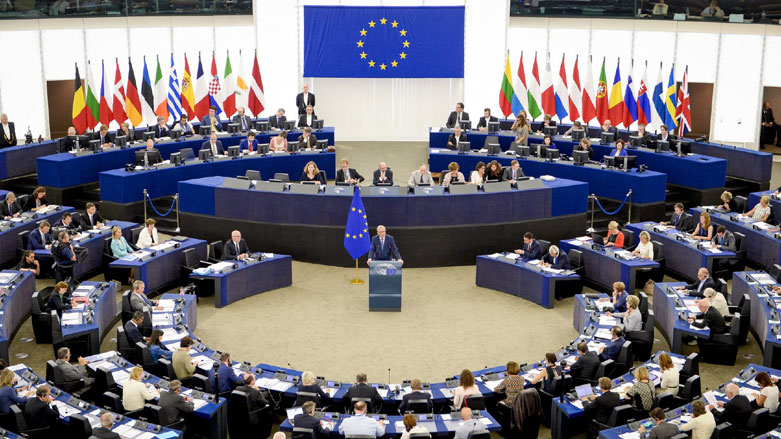
The Head of the Kurdistan Regional Government’s (KRG) Mission to the EU, Delavar Ajgeiy, met with Cristian Dan Preda of Romania, the foreign affairs coordinator for the largest political group in the EU Parliament, the European People’s Party (EPP), and Barbara Lochbihler, vice chair of the EU Parliament’s Human Rights Committee in Brussels.
“In the meeting, we discussed the situation in the disputed territories, [and the] Arabization process in those areas,” the Mission’s press office stated.
“We discussed the unconstitutional violations committed by the Iraqi government and the Hashd al-Shaabi militia [with] an aim to change the demography of Kirkuk [Province] and surrounding areas,” it added.
The oil-rich province of Kirkuk is one of the most disputed territories between the KRG and the Federal Government of Iraq. It is a diverse province with multiple ethnic and religious communities, including Turkmen, Arabs, Christians, and Kurds, who make up a majority of the population.
Historically claimed by the Kurds, it was under the protection of Kurdish Peshmerga forces from 2014 until the end of 2017, following the emergence of the Islamic State (IS).
On Oct. 16, Iraqi forces and Iranian-backed Shia Hashd al-Shaabi militias, also known as the Popular Mobilization Forces (PMF), carried out a military attack and took control of Kirkuk and other disputed territories, pushing the Peshmerga from the areas.
The offensive resulted in the displacement of over 180,000 people to the Kurdistan Region, mostly from Kirkuk.
Collective punitive measures against Kurdistan, including an international flight ban, and not sending the KRG employees’ salaries, by Baghdad were another topic discussed with the European Parliament members.
Ajgeiy mentioned that they also discussed holding meetings in the future, in coordination with the KRG’s Mission in the EU, regarding the topics addressed in the EU’s Foreign Affairs and Human Rights Committees.
The former Iraqi Ba’ath regime, under Saddam Hussein’s dictatorship, implemented Arabization campaigns in Kirkuk Province and other Kurdish-populated areas in Nineveh, Salahuddin, and Diyala.
The campaign was meant to change the demography of the areas by forcibly displacing the Kurdish residents and replacing them with Arabs from central and southern Iraq.
Since last October’s military takeover of the region, roughly 100 Kurdish officials in Kirkuk have been removed from their posts.
Among them are the Governor, Kirkuk’s Security Director, the Mayors of Kirkuk city, Dibis, Daquq, and Khurmatu, as well as the District and Suburban Police Director.
Kurdish officials in Kirkuk assert that since Oct. 16, the province is facing another demographic change, but this time sectarian in nature, calling it a “Shia-fication” process.
Editing by Karzan Sulaivany