Trump Cites Democratic ‘Hate Speech’ is Dangerous Following Washington Gala Shooting Incident
Suspect’s manifesto and systemic security gaps under investigation after president’s evacuation from Washington Hilton.
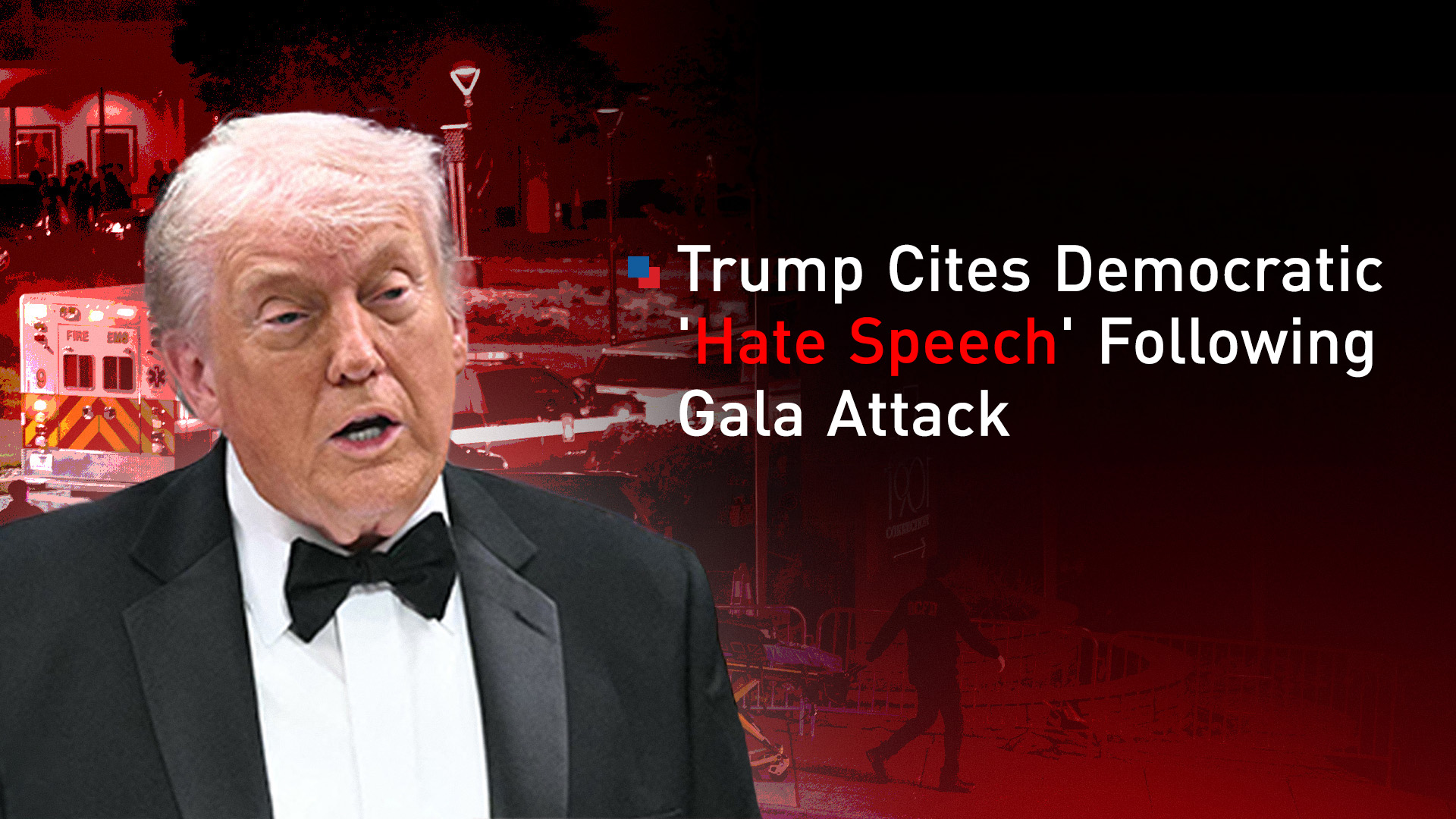
ERBIL (Kurdistan24) - President Donald Trump asserted that "hate speech" from Democrats is "very dangerous for the country" during an interview following his evacuation from a shooting incident at the White House Correspondents' Dinner in Washington, D.C., according to a report published by CBS News.
Trump characterized the political environment as volatile, stating: "I think the fact that I've accomplished so much...I've made our country great again. I mean, this country was dead. Our country was dead."
Immediately following the incident, the Associated Press reported that the suspect, a 31-year-old California man, aired grievances against Trump administration policies in writings sent to his family minutes before the attack.
The suspect's documented communications prompted his relatives to contact local law enforcement, initiating a federal investigation into a manifesto that outlined a targeted assault on administration officials and detailed the attacker's motives.
The breach of the security perimeter at the Washington Hilton, a venue hosting a major gathering dedicated to celebrating the First Amendment, represents a critical failure in event security.
What is known is that a heavily armed individual bypassed security checkpoints before discharging a weapon in a space occupied by the president, vice president, and more than 2,500 guests.
Assessed by authorities as a targeted political attack, the incident raises immediate public safety concerns regarding the adequacy of institutional protection for high-value figures and the capacity of intelligence frameworks to preemptively identify radicalized individuals.
Immediate Incident and Trump's Reported Reaction
During an interview with CBS News at the White House following the evacuation, Trump described his perspective on the disruption.
Seated near the First Lady when the commotion began, he noted that he initially attempted to remain standing to observe the situation before Secret Service agents instructed him to drop to the floor.
When asked about his level of concern regarding potential injuries, Trump replied, "I wasn't worried. I understand life. We live in a crazy world."
Trump recounted that the security detail flanked him within ten seconds and commended their professionalism.
He described the suspect's movement through the venue as "a blur" due to the individual's speed.
After being moved to a holding room, Trump stated he expressed a desire to return to the ballroom to continue the dinner.
He firmly rejected specific allegations made in the suspect's manifesto, aggressively dismissing the attacker's characterizations of him as the product of a "sick person."
Verified Details of the Shooting
The attack unfolded at the Washington Hilton, the identical location where President Ronald Reagan survived an assassination attempt 45 years prior.
Minutes after the event commenced, the gunman rushed the 45-yard distance through the security barricades and metal detectors.
As shots were fired, chaos erupted within the ballroom.
CBS News and the Associated Press reported that guests ducked under tables for cover, and a chant of "God Bless America" briefly echoed as Trump was escorted offstage.
Law enforcement swarmed the room, and the suspect was violently tackled to the ground. Outside the hotel, members of the National Guard and other authorities secured the perimeter while helicopters circled overhead.
A Secret Service agent was struck by gunfire during the altercation but survived without injury due to a bulletproof vest.
AP-Reported Suspect Background and Grievances
The suspect, identified by officials as Cole Tomas Allen, is an educated tutor and amateur video game developer. He holds a master's degree in computer science and a mechanical engineering degree.
Minutes prior to the assault, Allen dispatched a document exceeding 1,000 words to his family.
The Associated Press reported that the text oscillated between apologies to loved ones, religious justifications, and political anger. Referring to himself as a "Friendly Federal Assassin," Allen explicitly stated that administration officials were his targets.
The writings cited specific administration actions, including U.S. strikes on suspected drug-smuggling vessels.
Furthermore, Allen's manifesto mocked the venue's security measures, expressing astonishment at the absence of armed agents in areas he had scouted since checking into the hotel days earlier.
Records indicate Allen had previously contributed to a Democratic political action committee and was affiliated with a group known as the "Wide Awakes."
Law Enforcement Response and Investigation Status
The investigative response was catalyzed by Allen's family. His brother contacted the New London Police Department in Connecticut roughly two hours after the shooting, leading to immediate federal notification.
Simultaneously, his sister informed investigators that Allen had legally purchased a .38-caliber semiautomatic pistol and a 12-gauge shotgun, storing them secretly at their parents' home in Torrance, California.
Acting Attorney General Todd Blanche stated that Allen is believed to have acted alone and is set to face criminal charges on Monday.
Federal investigators are currently treating the extensive manifesto, alongside a history of anti-Trump social media posts, as the primary evidence guiding their understanding of his motives.
Security Implications and Institutional Context
What appears as an isolated act of violence is being assessed within a broader context of political security concerns.
The ability of an armed individual to penetrate the perimeter of a high-profile event hosting the highest echelons of the U.S. government indicates severe vulnerabilities in standard screening protocols.
The suspect's documented surveillance of the hotel underscores the challenge of securing predictable, large-scale political gatherings.
While the Secret Service neutralized the immediate physical threat, the reliance on reactive measures, such as tactical flanking and ballistic vests, highlights the extreme demands placed on contemporary political protection in a polarized environment.