Sudani’s Alliance Criticizes SCF Amid Deepening Prime Ministerial Deadlock
Sudani’s political alliance has forcefully condemned Iraq's ruling Shiite Coordination Framework (SCF), exposing deep internal divisions over the prime ministerial nomination as constitutional deadlines rapidly expire.
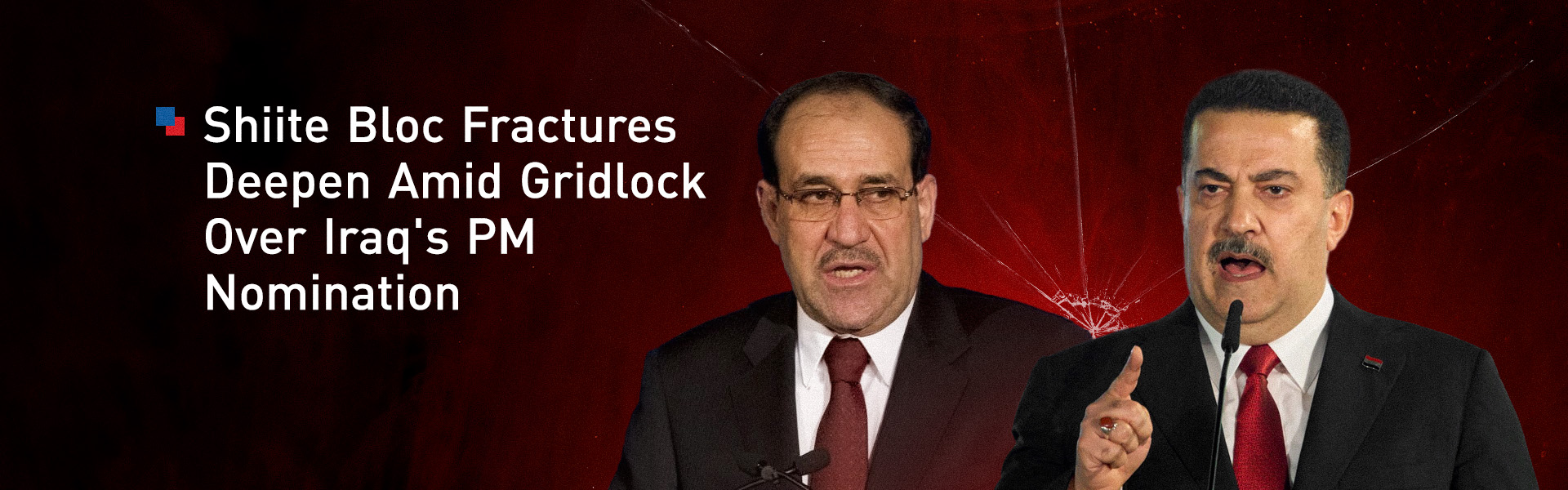
ERBIL (Kurdistan24) - The incumbent Iraqi Prime Minister Mohammed Shia al-Sudani's political alliance launched a direct and forceful political attack on the Shiite Coordination Framework in the Iraqi political arena of Baghdad, declaring that rival parties are attempting to install an "unknown" candidate while paralyzing constitutional procedures, as described in a recently released report.
Sudani Alliance's Political Escalation
Qusay Mahbouba, head of the Amarji Liberal Party and a leader in the Construction and Development Alliance, the coalition led by Sudani, issued a formal statement outlining severe institutional grievances.
According to the report, Mahbouba characterized his alliance's role in maintaining the country's stability as positive, noting that they decided to become part of the Shiite Coordination Framework solely for the sake of the national interest.
This escalation explicitly highlights severe fragmentation within the Shiite Coordination Framework, the umbrella coalition of Shiite political parties designated as the largest parliamentary bloc.
As internal disputes over the premiership intensify, this breakdown in consensus clarifies what is happening within Iraq's political blocs: a total negotiation deadlock that threatens to derail constitutional timelines, risking a vacuum of authority and undermining the broader stability of state governance.
In his remarks, Mahbouba asserted that without the effective role of the Construction and Development Alliance, the process of electing the President and the Speaker of Parliament, alongside the completion of other constitutional procedures, would have completely failed.
He then directed sharp criticism at the other factions within the Shiite bloc.
"We adhered to our promises, but you broke your word; we showed political flexibility, but you were revolving in doubt and confusion," Mahbouba said, according to the report.
Details and Language of the Attack
Contrasting the competing prime ministerial bids, Mahbouba emphasized that Sudani is a proven "statesman" with a clear and successful reconstruction project.
In contrast, he argued that rival parties within the bloc possess an unknown candidate and a vague project designed only to serve narrow interests.
The alliance leader concluded his statement with a stark warning, asserting that history and the Iraqi people would hold those opposing parties strictly accountable for attempting to paralyze the political process.
Mahbouba announced that the Construction and Development Alliance would continue advancing its administrative project, declaring that Iraq is greater than all types of maneuvers and personal interests.
Shiite Bloc Fragmentation and Negotiation Dynamics
The public rebuke from Sudani's camp emerges directly from fractured Shiite bloc negotiations in Baghdad, where the prime ministerial candidacy remains a highly contested dispute between the incumbent and former Prime Minister Nouri al-Maliki.
Officials from the Construction and Development Coalition recently claimed that Sudani maintained the highest probability of securing a second term following Maliki's reported withdrawal.
Faisal Maslamawi, the coalition's spokesperson, stated that Maliki withdrew due to "several reservations regarding him."
However, Maliki's State of Law Coalition moved aggressively to reject the claims.
Hisham Rukabi, head of Maliki's media office, dismissed the assertions as rumors and insisted that Maliki remained the officially recognized candidate of the Shiite Coordination Framework.
According to senior sources, Maliki reacted with visible anger to proposals suggesting he withdraw in favor of a consensus nominee, resulting in his boycott of recent Shiite Coordination Framework leadership meetings and exposing a profound institutional rift.
The internal friction is governed by a strict constitutional clock.
Following the recent election of President of the Republic, the presidency is mandated to task the largest parliamentary bloc's candidate with forming a cabinet within 15 days.
Sanad Hamdani, a member of the al-Sadiqun Movement, noted that the voting within the bloc has become acutely divided, heavily complicating the legal timeline.
Broader Political Process and Deal-Making Mechanisms
The procedural deadlock has triggered intense political alchemy through late-night deals, illustrating the chemistry of fragile power in Iraq.
In a bid to bypass the entrenched rivalry, a late-night meeting at Maliki's residence yielded a proposal to nominate Bassem al-Badri for the premiership.
According to Hamdani, Badri secured seven of the 12 decisive votes within the Shiite Coordination Framework, leaving Sudani with five.
To secure consensus, the State of Law Coalition offered significant institutional concessions to Sudani's bloc.
The proposed compromise grants the Construction and Development Coalition the position of Deputy Prime Minister and five ministerial portfolios, including one "sovereign" ministry, in exchange for supporting Badri.
Factions also agreed to block any initiatives aimed at reopening the files of previous governments, prioritizing immediate stability over administrative accountability.
Prior to this, candidates such as Haider al-Abadi, Adnan al-Zurfi, and Mohammed Sahib al-Darraji were introduced but explicitly declined by Maliki's camp.
This internal horse-trading is occurring against a backdrop of localized security risks that complicate the national power structure.
Armed clashes recently erupted in Karbala between Saraya al-Salam, the military wing of the National Shiite Movement, and a splinter faction known as Al-Azhariyyun.
The firefight resulted in one fatality and forced the closure of Saraya al-Salam bases across the province.
The clashes involved a group recently expelled by Shiite cleric Muqtada al-Sadr following an incident in which Al-Azhariyyun members intercepted the convoy of the Iraqi Interior Minister in Samarra.
External and Regional Influence
The protracted government formation process is heavily influenced by the direct involvement of regional actors.
Amid the gridlock, Esmail Qaani, commander of the Iranian Revolutionary Guard Corps' Quds Force, traveled to Baghdad alongside Tom Barrack, the United States President's envoy for Syrian affairs.
The simultaneous presence of these rival envoys in the Green Zone reflects a rare convergence of regional interests seeking to mediate the selection of the Shiite Coordination Framework's nominee.
In a formal message explaining his visit, Qaani preached an "Iraqi" choice, asserting that the selection of the prime minister is a "solely Iraqi" decision.
He expressed gratitude for the solidarity shown by the Iraqi people and religious authorities but issued a stark warning against international mediation efforts that conflict with Tehran's interests.
"Iraq is far too great to allow others, especially criminals against humanity, to interfere in its affairs," Qaani stated.
According to political sources, Iran's strategic priority is focused on damage control: securing a prime minister capable of preserving Shiite political dominance while maintaining functional relationships to avoid Iraq's total economic isolation.
International Pressure Context
While Iranian mediation seeks to unify the bloc, Washington is aggressively tightening the economic constraints on the Shiite Coordination Framework.
The U.S. State Department issued a stern demand for the Iraqi government to immediately dismantle Iran-aligned militias or face severe consequences.
State Department spokesperson Tommy Pigott stated that the continued failure to prevent militia attacks, coupled with the political, financial, and operational cover provided by some elements associated with the Iraqi government, adversely impacts bilateral relations.
This policy declaration aligns with an extensive U.S. financial pressure campaign.
The U.S. Department of the Treasury's Office of Foreign Assets Control recently sanctioned seven commanders from influential armed groups, including Kata'ib Hezbollah and Asa'ib Ahl al-Haqq.
Additionally, the U.S. blocked a cargo plane carrying nearly $500 million in U.S. banknotes from Iraqi oil revenues and suspended funding for specific military training programs.
The U.S. State Department also announced a $10 million reward for information on Hashim Finyan Rahim al-Saraji, leader of Kata'ib Sayyid al-Shuhada.
Targeted groups have responded with conditional threats. Kata'ib Hezbollah declared that the safety of the U.S. Embassy in Baghdad relies on a policy of "security for all or security for none," while issuing regional warnings toward the State of Kuwait.
The vulnerability of diplomatic infrastructure was recently demonstrated when a drone fell near a U.S. diplomatic convoy escorting released American journalist Shelly Kittleson at Baghdad International Airport.
Amid these tensions, U.S. officials have established a strict stance, reportedly viewing Maliki's potential return to the premiership as a red line.
Analytical Framing of Institutional Vulnerability
What appears as a political dispute is, in effect, a broader contest over control, alignment, and the structure of power within Iraq's governing system.
The forceful statements from Sudani's alliance emphasize that the internal disputes among the Shiite bloc represent a fundamental crisis of institutional fragility rather than mere electoral friction.
Power distribution within the Shiite Coordination Framework relies on a precarious balance between competing political wings and their respective armed affiliates.
Factions attempt to secure executive leverage through complex bargaining, yet this consensus model struggles to insulate domestic governance from systemic external pressures.
The interaction between Baghdad's political deadlock, direct mediation by Iranian military commanders, and coercive financial measures applied by the United States reveals a governing apparatus where sovereign decision-making remains highly vulnerable.
The ongoing inability to finalize a leadership mandate not only threatens immediate constitutional procedures but exposes the entire structural architecture of the state to profound instability.