Iraq, UN complete joint exhumation of first Yezidi mass grave
The United Nations announced on Friday that the unearthing of the first mass grave filled with Yezidis (Ezidis) killed by the Islamic State had been completed in a village in the town of Sinjar (Shingal).
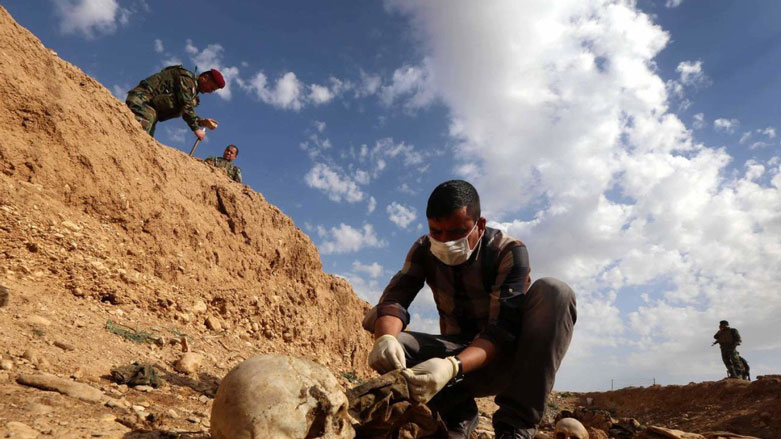
ERBIL (Kurdistan 24) – The United Nations announced on Friday that the unearthing of the first mass grave filled with Yezidis (Ezidis) killed by the Islamic State had been completed in a village in the town of Sinjar (Shingal).
"Concluding the five-day exhumation process, the remains were extracted from the site and stored in a specially adapted secure vehicle for transportation to Baghdad," read a statement.
The effort was conducted by the Mass Graves Directorate within the Iraqi Martyrs’ Foundation, the Medico-Legal Directorate under the Iraqi Ministry of Health, and the Ministry of Martyrs and Anfal of the Kurdistan Regional Government, guided and supported by a team of forensic and legal experts from the United Nations Investigative Team to Promote Accountability for Crimes Committed by Da’esh/ISIL (UNITAD).
Following the emergence of the Islamic State in Iraq in 2014, the Ezidi religious minority suffered heavily at the hands of the jihadist group, including mass executions. The occupation of Shingal led to the displacement of hundreds of thousands of Ezidis, who the Islamic State considers heretics.
Militants subjected Ezidi women and girls to sexual slavery, kidnapped children, forced religious conversions, executed scores of men, and abused, sold, and trafficked women across areas they controlled in Iraq and Syria.
So far, dozens of Ezidi mass graves have been found in the country, 11 of which were discovered in the small village of Kojo.
In a special ceremony organized the week before to observe the onset of the exhumation, Mahdi al-Alaq, The Secretary-General of the Iraqi Council of Ministers, called the persecution of Ezidis “the most brutal crimes of the modern era.”
“The Republic of Iraq welcomes the UN Security Council resolution 2379 to establish an independent investigation to support national efforts aimed at mobilizing and collecting all evidence of the enormity of all crimes committed by the terrorist gang in Iraq,” said Alaq, who was representing Prime Minister of Iraq Adil Abdul-Mahdi.
Baravan Hamdi, the Undersecretary of the KRG’s Ministry of Martyrs and Anfal, was also present in the event and characterized the past events in Shingal as “one of the ugliest parts of contemporary history.” According to the official, the number of Ezidi mass graves so far found has reached 73, and the Kurdistan Region is eager to cooperate at the national and international level in order to achieve justice for all victims.
Hamdi highlighted the KRG’s ongoing efforts to rescue Ezidis still missing and called for the reconstruction and security of Shingal and surrounding Ezidis districts, mostly decimated since the arrival of the Islamic State
Ezidi survivor and Nobel Peace Prize Laureate Nadia Murad was also present in the event, saying, “Our wounds are deepened today as we will lift the remains of the loved ones who were killed treacherously in a mass grave in the area of Kojo.”
Murad, originally from Kojo herself, noted that the federal government of Iraq and the KRG failed to protect the lives of these victims when they were alive. “I hope they will not fail to bury their remains in the best way.”
UNITAD head Karim A. A. Khan also attended the ceremony and said, “This effort constitutes part of the investigation of Da’esh/ISIL crimes in order to identify those most responsible. It will also serve the very important function of identifying the victims so that their remains can be returned to their families for burial in accordance with their wishes, and with full respect for their religious or cultural practices.”