Watch: Security footage of Erbil diplomat killing; Confessions implicate PKK
Videotaped confessions released on Friday by security forces in the Kurdistan Region show suspects claiming that the recent highly-publicized assassination of a Turkish diplomat in the region's capital was planned and carried out by members of the outlawed Kurdistan Workers’ Party (PKK).
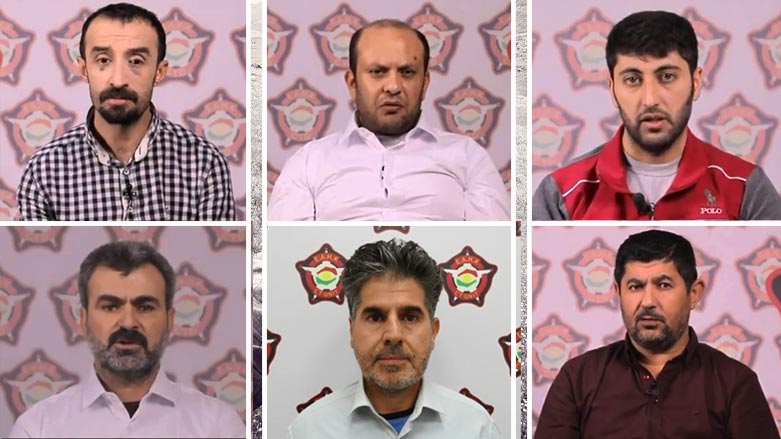
ERBIL (Kurdistan 24) – Videotaped confessions released on Friday by security forces in the Kurdistan Region show suspects claiming that the recent highly-publicized assassination of a Turkish diplomat in the region's capital was planned and carried out by members of the outlawed Kurdistan Workers’ Party (PKK).
Along with videotaped confessions of multiple suspects, officials also released CCTV footage of the July 17 attack. It shows Erbil-based Turkish diplomat Osman Kose dining at an upscale Erbil restaurant when three gunmen sitting at other tables suddenly stand up, take out handguns while they approach Kose, and shoot him. Two local residents were also killed.
Read More: Turkish consulate employee, 2 civilians killed in Erbil shooting: Security
The Kurdistan Regional Government (KRG) condemned the shooting as a “premeditated terrorist attack,” and promised the perpetrators would be brought to justice. On July 20, the Kurdistan Region’s Counter-Terrorism Department (CTD) announced the arrest of two suspects, adding that investigations were ongoing and that more arrests would soon follow.
“The security and counterterrorism forces of Kurdistan were able to arrest six persons in connection with the incident in a very short amount of time,” the Kurdistan Region Security Council (KRSC) said in a statement that accompanied the video containing the security footage and taped confessions.
The KRSC further detailed that three of those allegedly involved in the attack are from Turkey while the other three were from the Kurdistan Region.
In the confessions, multiple suspects are named that worked for a company called Zozk, but the exact nature of the business was not immediately clear since more than one local company shares the name.
The PKK was seen by many as most likely to be responsible for the killings as it is engaged in a decades-long insurgency against Turkey over Kurdish rights and self-rule in a conflict that has resulted in the death of over 40,000 people on both sides.
Shortly after the incident, a PKK official denied the group's involvement. On Wednesday, a senior PKK commander said the diplomat was assassinated by some youths and “sympathizers” of the PKK, remarking, “Thank you to whoever carried this out.”
The Confessions:
Primary Suspect: Mazloum Dagh
As the CTD announced when they named him as their prime suspect in the shooting, Mazloum Dagh states in his confession that he was born in the Kurdish city of Diyarbakir (Amed), Turkey in 1992. He says, “In 2015, I came to the Kurdistan [Region] to work. My brother was here. His name is Ibrahim.”
Dagh explains that he had another brother, which he named as Ismail, who has been a member of the PKK since 1998 and was killed in 2013 in Turkey. Ibrahim, Dagh points out, was also politically active and couldn’t go back to Turkey.
According to Dagh, he had earlier expressed his interest in joining the PKK when speaking to one of his brothers and in April and was told in a phone conversation that he would be allowed to join the group. He then went to the PKK’s headquarters in the Kurdistan Region's Qandil Mountains. Upon arrival, he was received by a man he said was known both as Fatih and Botan.
He stayed there for 26 days, during which he trained to use rifles and handguns. While leaving, he agreed to smuggle goods such as clothing items and shoes from cities in the Kurdistan Region to the fighters' outposts in Qandil. Dagh’s superiors also gave him the name of a man who would provide him a place to stay named Rajab Baqi Bradosti, who appears to be from the Kurdistan Region.
In addition, he was put in contact with someone named Dizhwar—whom he knew previously as Mamad—who he was told he could contact when he needed assistance. Dizhwar then gave Dagh a picture of Osman Kose, the Turkish diplomat killed in the shooting, and asked him to surveil the man.
Fatih, the PKK member in Qandil, then asked Dagh to kill Kose after a period of monitoring. After Dagh explained that Kose had two bodyguards always accompanying him, Fatih assigned two others, Alan and Ahmad, to take part in the operation.
On July 17, the three men met with Dizhwar who told them of the location of Kose. They went to the restaurant and after some time observing the diplomat from a few tables away, they fatally shot him with silenced pistols. Dagh was shot in the leg as well but fled the scene in his car that had a fake license plate.
The group of three later separated on Erbil’s 120 Meter Road with Dagh driving to a cemetery where he dumped his vehicle and called Dizhwar, who told him another person would pick him up and take him to a safe location. Ismail Geçici, who is also under arrest for involvement in the plot, then arrived at the cemetery and drove Dagh to Rajab Bradosti’s house.
There, Dagh met up with Dizhwar, received medical treatment, and stayed for the night. They left around noon the next day and joined Bradosti's brother Siyako, currently wanted by the KRSC, and went to the office of a company he worked for called Zozk. Later in the afternoon, they found out that Rajab had been arrested.
On the following day, July 19, Dagh and Dizhwar sought help at the home of another member of the Bradosti family, Sidqi Bradosti, the director of Zoz. They asked if it was possible to flee from Erbil but were told this would be difficult considering heightened security procedures at checkpoints leaving the city.
At the request of Sidqi, the two were then taken to an apartment house near Erbil's Majidi Mall by another Zozk employee where they rested for a few hours. He soon asked them to leave and dropped them off at 120 Meter Road. This is where Dagh and Dizhwar split up.
Dagh then reached out to another person named Muhsin Salih Sleman Gunish for help getting out of Erbil. He agreed, but they were soon apprehended on the outskirts of the city.

Abdulrahman Aar (Dizhwar)
In his confession video, the man known as Dizhwar identifies himself as Abdulrahman Aar, saying, “In 1986, I was born in Siirt [Turkey]. In 2006, I became a member of the PKK.”
He explains that he was known as Dizhwar and Mamad in the group, adding that he was working in Makhmour in 2016.
Aar goes on to corroborate the information Dagh had provided regarding his training starting in April and then the planning of the assassination, including acquiring pistols equipped with silencers and a fake license for their getaway car.
After telling Dagh’s team of three of the location of Kose, Dizhwar split up and awaited a phone call that would confirm that the task was complete. He received the call and relayed the information to his superior in Qandil, Fatih, who ordered Dizhwar not to contact him anymore.
He also confirms Dagh's narrative about when they met up with each other in Rajab Bradosti’s house and when they when their own separate ways. He added that he had been acquainted with Sidqi for over a year and knew he would help them.
He then went to the house of another friend, Rozhhat Mousa, who was also detained. Aar was arrested later that day.
Ismail Geçici
Ismail Geçici says in his confession that he was born in 1988 in the Kurdish city of Urfa, Turkey and arrived in Erbil to work 2015. After a while, he got to know Dizhwar who had introduced himself as “a PKK member.”
He then admits to acting as a driver for the operation and was tasked with picking up Dagh at the cemetery where he abandoned his car.
“I took Mazloum [Dagh] to Rajab’s house,” and then picked up medication to treat Dagh's injured leg.
Rajab Bradosti
Rajab Bradosti states in the video that he is originally from the town of Sidakan, Turkey, but had become a resident of Erbil.
He says he became familiar with “a number of PKK members, one of them Mamad [Dizhwar].”
“Before the July 17 incident, he said he would come to see me and introduce me to a friend.” He continues saying that this did not happen until the day of the shooting.
He helped with Dagh’s injuries until Geçici arrived to treat the wounds. Bradosti was then told to go a busy Erbil thoroughfare to gauge the level of security and to check on the vehicle they had dumped to see if it was still there.
“I drove around 60 Meter [Road] and when I went to the cemetery, it was still there and I returned home.”
Dizhwar and Dagh stayed the night at Bradosti’s place and lunched together the day after, when Rajab was arrested.
Ayoub Bradosti
In his video, Ayoub Bradosti says he is a Zozk employee and that its director Sidqi Bradosti called him two days after the shooting, asking him to transport the two men then at Sidqi's house to an apartment because “purportedly, they had something to do for two days.”
Early in the afternoon of the same day, Sidqi Bradosti called him and asked for him to again go back to the apartment and demand they leave the premises. When he did so, the two men asked Ayoub to drive them to the outskirts of the Erbil. He complied, dropped them off on 120 Meter Road, and was arrested later that day.
Sidqi Bradosti
Sidqi confesses that he also met the two men together on July 19th, although he had known and met Dizhwar as a PKK member before that. The two asked him to give them a place to stay for some time and he then called Ayoub, asking him to drive the two men to a safe place. Ayoub agreed.
He later found out that Dizhwar and Dagh were wanted by security forces in connection to the killings and then called Ayoub to ask that the two men leave the apartment and was arrested some hours later.
Editing by John J. Catherine